To everyone who sent in cool ideas: bloody well done! – both for your imagination and courage in breaking the unwritten rules about how we engage communities.
Hope you find these ideas inspiring.

A Regent Honeyeater soundscape, Lithgow
This mural – at the Capertee rest stop – uses a motion-triggered sound system to play the Regent Honeyeater’s call as you walk past. It’s so beautiful, you just have to play with it. (There are only 300 Regent Honeyeaters left.)
Thanks Viv Howard. This project was supported by Birdlife Australia, Central Tablelands Local Land Services and the National Landcare Program.
Re-loved food is sexy


These fabulous shots show some of Hidden Harvest’s work in changing perceptions about food waste. Their creative, fun, tasty approach is irresistible.
Thanks Berbel Franse. Hidden Harvest is a Wollongong-based NGO group that’s passionate about food waste.
Give nature a voice
These adorable, funny TV ads are a brilliant example of how to use charm and humour to grab and hold attention without causing resistance. Thanks for the inspiration, Water Corporation (WA).
Young people + creative action = climate adaptation

Banksia Gardens Youth Service, Broadmeadows, empowers young people on climate, by mashing ‘how-to’ workshops with youthful energy, fun and creativity.
CARYA – Climate Adaption Requires Youth Action project
“Bushcare is” – messaging, with a personal touch

“I loved doing this program and loved connecting with the people and seeing their responses.”
Thanks Erin Hall, Blue Mountains City Council. There’s something immensely engaging about the ‘voice’ of passionate lay people – always more honest and touching. We just WANT to read their words.
The Pink Nose Project, PNG
A genius, hi-viz idea that gives instant character and buzzworthiness to a project. It announces that women surfers are a cool, happening thing in PNG. The Pink Nose Project. So simple! An idea that really sparks my imagination. [Thanks Leigh Baker]

‘Our Home’ usable litter sculpture

These creative portable litter cages surely must uplift the buzzability of an otherwise boring subject – bushland litter. Passersby can’t help but pop litter inside – becoming agents of the solution – and there’s also a need social norming effect as we observe how many others have done the right thing.
Well done Melbourne Water.
A playful community consultation method

Well done Amy Brand of Let Me Be Frank. A simple, accessible way for people to express their visions for an urban tree strategy.
]]>
Volunteering is in the news. The NSW Flood Inquiry (Aug 2022) just recommended:
“the State Emergency Management Committee (SEMC) commission a review of volunteerism in NSW… to respond to declining formal volunteerism…” (Recommendation #6)
And, as if in reply, Volunteering Australia just launched its National Strategy for Volunteering, which concluded:
“We need to re-focus on the volunteer experience: Volunteers are increasingly valuing choice and flexibility. They want to engage with opportunities that meet their needs and provide a sense of agency.” (p32)
So, how to reinvent the volunteer experience for an era when everyone has endless options for their precious free time, including watching Netflix and just sleeping?
The answer is to let them focus more on satisfying human needs, like
Recognition. “Wow. Every week they make a special activity for me. They listen to me and have time for me.”
Pleasure. “Every week there’s something enjoyable to look forward to: coffee, cake, nice lunch, games.”
Connection. “I’m always buddied up. I never feel neglected.”
Variety. “Please, not the same thing again.”
And also: Low anxiety. “I never feel overwhelmed. I know what to do and how to do it.”
Being part of something wonderful. “I know the long term vision and my role in achieving it.”
But, HOW to actually DO reinvention?
Luckily we already know how to reinvent experiences:
Give the members permission to imagine their own innovations, of course (in a workshop). And then expect them to adventurously prototype their most promising ideas.
Look at these examples from Landcare: Adventurous Landcare groups have chosen memorable names, like Willow Warriors or Mudcrabs. They’ve added pleasurable activities like Yam Daisy Harvest, Bunny Boiler Challenge, or Big Brew and Bake Off. Some have pivoted their purpose, for example changing to a Bee Care Group. Others have organised buzzworthy new initiatives like Landcare for Singles, BushCare for Kids, or Citizen Science surveys.
The best of them have active social calendars. “Our group’s secret is a history of great social secretaries. Food is the key thing…and we have historic farm walks, sheering shed musicals, beach walks and BBQs.” – Three Creeks Landcare Group, Victoria
So, decision-makers, don’t scratch your heads, don’t commission more reports: just give your volunteer groups the permission and space to re-imagine themselves to become the kind of group they’d never want to miss a meeting of. You’ll be surprised at what they create!
Image: Courtesy Project Platypus https://www.platypus.org.au
]]>The more I do this work, the more I think the answer is… fun.
Fun is contagious. It destroys fear. It’s subversive (how many conservatives have a sense of humour?). It glues humans together. It’s brilliant medicine for the spirit. And it’s just the best ATTRACTOR…because everyone is already looking for it, all the time.
When we’re designing change projects we often ask “What do people NEED to KNOW?” But if we want to attract people, it’s good to ask: “What do people WANT to FEEL?” Or even better, get straight to the point and ask “How could we create delight or joy?”
The not-so-deep secret to making fun projects is to have fun when we’re making them!
Here is a fun project team… (hi Byron Bay scavengers).

 Of course our issues are serious and urgent and we’re resource-poor and under pressure. That causes worry. And worry causes tunnel vision.
So we need some tricks to get back to wide spectrum thinking where our natural creativity can flourish.
Here’s some of the tricks we use in the Changeology Masterclass.
(By the way, never try to be creative alone! It doesn’t work. Really. Get some friends or colleagues. Then try some tricks.)
Trick #1 Mashups
Ask your team members to think of activities they passionately love to do (knitting, bicycling, singing, cooking, tennis, board games…). Then say “Now mash that into our project. What would it look like?” It’s amazing how productive this process is!
Trick #2 Rules
Brainstorm with special rules to encourage playfulness. For example: “You have a actual magic wand.” “You can break the laws of physics”. “You can only think of ideas your manager would reject.” This helps people go beyond safe ideas.

Trick #3 Tools
In the Changeology Masterclass we use some tools to help us get into a creative place.
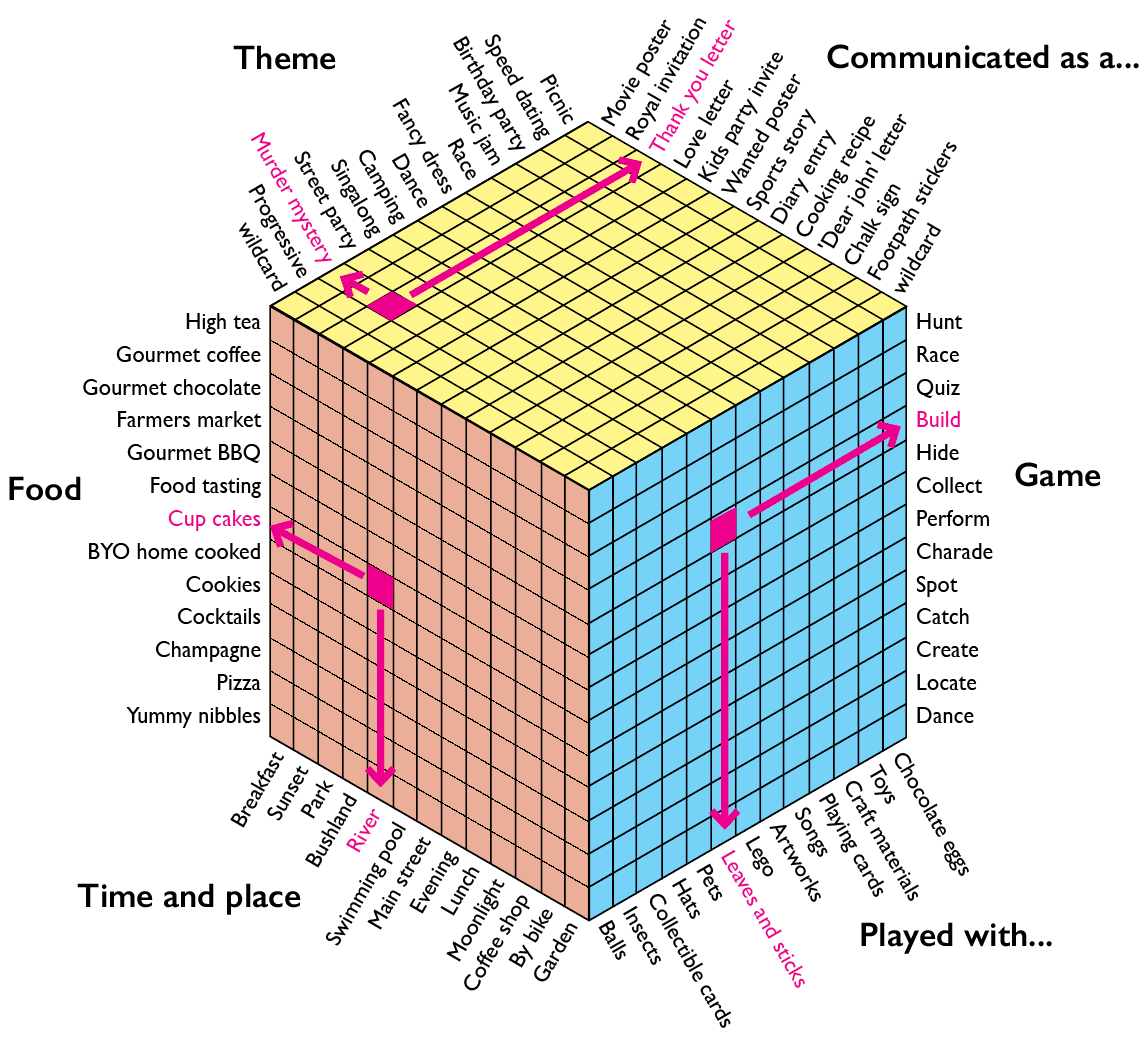
Like this “6-dimensional enchanting event constructor“. It reminds us of the wide spectrum of ways we humans like to have fun.
Trick #4 An inspiration collection
Another good idea is to have an inspiring library of fun ideas that just keeps growing. Below are some of my favourite engaging ideas from my own collection.
Happy fun-making folks!


Hi folks!
I thought I’d share a tool to design community and staff engagement activities. It’s called the “6-dimensional enchanting event constructor”.
Here’s the idea: I’ve gradually become convinced that the #1 rule for successful community engagement is to be, well, engaging! In other words, to design initiatives that are buzzworthy, fun, game-like, social and tasty (as well as important) – the kind of things we would want to “come and play” with even if we weren’t being paid.
When I see teams designing engagement projects under pressure, the first thing that tends to suffer is their ability to remember ideas they already know are engaging and fun. This seems like a small matter, but it effectively destroys their capacity for creativity, because creativity is all about mixing and matching existing ideas. As a result the solution is often just “another workshop”.
So this tool aims to be a memory-jogger. You can use it as a team activity, with pairs of people assembling alternatives then presenting them to the group.
(Use the attached PDF which has instructions, not just the image above.)
Hope you find it useful.
Best wishes
– Les
P.S. This is version 1 – let me know if you can see any ways to improve it. Remember that it’s not meant to contain EVERY possible idea, just enough to wake up our imaginations.
This little piece of genius, from a Swiss canton, shows that meeting a real person can be a most persuasive kind of persuasion.
The human brain becomes awake and present when we meet a real person, in ways that impersonal media can never achieve.
So how can we arrange for our audiences to interact with real faces? There must be scores of ways we could emulate the underlying idea. Who wants to give it a go?
Love Makes a Way
The Love Makes a Way movement caused 3,500 older Australians to travel to their MPs offices, and stay and pray until they got arrested or expelled, in the name of releasing refugee children from detention. This is an inspiring Christian movement based on civil disobedience.
We always say that actions should be designed to be easy. But this story made me realise it’s not always true. Onerous actions have a place – especially where causes are strongly motivating and we come together in groups. So maybe Love Makes a Way illustrates how the hardness of the action can be equal to the actors’ passions. Where people care strongly, the ask can be hard.
What’s a ‘design lab’?
Design is the hot thing (designing projects, solutions to social problems, services) for good reason – it’s a really useful approach to change work. We’ve all heard of a ‘design lab’. But what is that? Here’s a slideshow that comprehensively describes what the UK Government’s Policy Lab does (they innovate programs and services). Including the tools they use. This is an excellent overview.
They’ve also provided an open policy tool kit which is full of useful processes. Including what to do in a one day workshop – this is really great model and something that’s easy to adopt.
Effective brainstorms – it’s all in the wording
Here’s the best video I’ve seen on what a design workshop looks like. Notice the finessing of conventional workshop: the precise wording of the instructions matter.
For a word-for-word script for effective workshopping, this post might be useful. There is a lot to keep in mind, so a script can help.
I can’t emphasis the importance of instructing participants to be ‘concrete, specific, and refer things we can see and touch’. Don’t say ‘educate’, instead say ‘set up a billboard outside the IGA’. (Ah-hah, now I know what you mean!)
Fluffy ideas are useless because project managers can’t act on ideas they can’t see in their mind’s eye. True, those ideas will die in the prioritisation phase anyway…but I hate to think of great ideas dying just because of the abstract language used to describe them.
Term of the month: “high serendipity”
(Adj.) Refers to environments where there’s a high chance of a happy or beneficial accidental encounter. Can we design high serendipity experiences for ourselves and others? This term doesn’t pop up in Google, which means I just invented it. I know it’s gotta be useful.
A fantastic health promotion job in northern rivers NSW
My friend Jillian Adams, the health promotion manager of Northern NSW Local Health District, has a fab job going for a health promotion communicator.
Upcoming CHANGEOLOGY and FACILITATION SKILLS workshops, Sydney and Melbourne
The workshops are on again in October. This time Changeology is looking more and more like a hybrid design workshop and a creativity camp. There’s still a grounding social psychology and step-by-step process, but the more I deliver it, the more I find I’m emphasising processes which push the imaginations of project designers into seekingly wacky places. As Albert Camus said: “All great deeds and all great thoughts have a ridiculous beginning.”
Changeology method hothouse
The 2-day master class in making change happen
Get the ideas, inspirations, processes and tools to devise projects that change the world. Full details.
Melbourne 17-18 October | Sydney 25-26 October
Book a place: Sydney or Melbourne.
Facilitate with Confidence
Facilitate any gathering with skill and authority
Lay a solid foundation for your role as a facilitator of meetings and workshops in any context. Full details.
Melbourne 19 October | Sydney 27 October
Book a place: Sydney or Melbourne.
Interestingly, half the participants had ‘innovation’ or ‘improvement’ in their job titles, so this was a real showcase of innovation in Victorian local government.

Incidentally, we really had fun pushing the boundaries of ‘conference’, with lots of interactivity where participants worked together and shared their own knowledge, rather than only hearing from experts. I think we proved that works. We also made a process for participants to design their own prototypes during the conference. We proved that can work too!
Here are my top take-aways.
Best quote: “Why do we insist on punishing our customers with our inner chaos.”
1) Thomas Frey, compulsory international Futurist
Thomas tried to thrill us with a future of ‘driverless cars’, ‘teacherless schools’ and ‘builderless houses’, but, frankly, he just scared me. Dear Thomas: if democracy teeters when 20% of the population have no productive work, what happens when that figure is 30% or 40%?? This is the ‘unmanning’ (sexist term) of the economy. It made me realise that only a truck-load of governance, structural and social innovation, based on values, can save us from technology.
2) The City of Casey: Caz McLean, Chris O’Connor
The City of Casey, a big, rapidly growing peripheral council in Melbourne, has a Customer Focus and Redesign Division. To change culture, they started with the physical space. They created a ‘flexible workplace’ with no fixed desks and lots of tech. People work wherever they need to, with whom they need to. A recent discrete innovation was HR recruitment: they replaced complex forms with just ‘200 words on why you want to work with us’.
3) City of Ballarat: Martijn Schroder, Business Transformation Manager
“We will pay dearly for continuing mediocrity in service delivery.”
His advice: “Publish data well.” Council has innumerable data sets so use them for decisions, not gut feel. Data ‘slays myths’ and ‘creates conflict’ which leads to improvements.
He talks about: Value Demand (effort spent on providing services) versus Failure Demand (effort spent dealing with service failures). For example, missed bin collections waste everyone’s time – council admin, drivers and customers.
Martijn is currently creating an Innovation Lab to allow the City to work with business and academia.
4) Sunshine Coast Council, Ann Yardley
Ann leads the regular Hackfest with a $20,000 prize. The idea is: make available lots of council and open source data sets about the local community; then invite a lot of clever local IT folk to mix-n-match it into useful community apps in an focused 2 day event. They make some cool apps!
Open data is a good way to improve council’s data integrity “we expose it and they tell us what’s wrong with it.”
5) Lake Macquarie Council, Sharon Pope
This is a council that was happy to receive cheques and had no credit card payments! So it clearly needed a digital strategy, so Sharon brought together community IT professionals and council staff and ‘mashed them together’. A Hackathon (workshop) with Danish Smart City thought leader and local ‘tech heroes’ got the ball rolling and started educating council staff.
“Don’t worry what people will use the data for. Don’t second guess what purposes they will imagine and create. The Hackathon demonstrated to council staff that they just needed to get all the clean data out there!”
6) Adelaide City Council, Paul Daley, Advisor, Entrepreneurship and Innovation
“A ‘smart city’ uses lots of data and tech, but, critically, it designs a public realm which is great to experience, with active, creative public spaces.”
A nice risk-management tip: For ‘Splash Adelaide’, a community festival, council let anyone set up anything, with just one proviso: ‘they take it down in 24 hours if there’s a problem’.
3 tips be an innovator in local government:
– start under the radar;
– work to win the personal trust and credibility of executives
– market success back to the organisation.
Recently opened: the Adelaide Smart City Studio, a prominent space for events, workshops and showcasing. Every surface has a whiteboard. It’s much used by smart IT and creative companies.
7) Service Design Melb, Yoko Akama and team
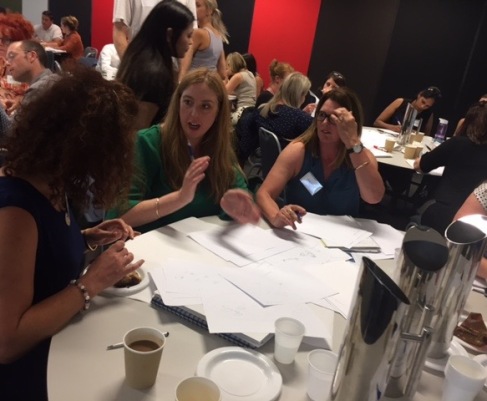
Demonstrated personas and empathy mapping, and offered a couple of neat brainstorming variants, which worked:
– The 6-8-5 rule. Each person comes up with 6-8 ideas in 5 minutes (puts the pressure on so people don’t worry whether their idea is ‘right’).
– Brainstorming in pairs (resulted in better-fleshed ideas)
– ‘What if’ cards, that overturned common assumptions. For example: “What if there’s no money?” “What if there’s no public open space?”
I can’t remember who said this “You don’t need personas if you have people.” That’s good.
8) Carlton Connection Initiative, Jacyl Shaw, University of Melbourne
CCI is a physical space in an old hospital building that’s roughly fitted out for workshops, talks and creative spaces.
She believes innovation depends on physical spaces (not virtual ones). CCI is amazingly dynamic, with a fantastic diversity of people and stimulation passing through each week. Modelled on Renaissance Florence: a physical space that brings together competition, collaboration, proximity and funding. It enables innovators to “Never walk alone.”
9) Brimbank City Council, Justine Resta and Angela Robertson
BCC has a ‘Business Transformation Unit. The aim: transform all council services and customer interactions into single online shop. It was a huge effort, for example it needed ALL council data aggregated into single Spectrum platform. They brought in a user experience (UX) design agency, did lots of journey maps, did lots of public consultations.
The key to the change was an IT Governance Group involving the CEO and 2 directors. They “cleared barriers and made quick decisions”, plus 4 internal staff full-time.
The CEO said “You have permission to fail. Don’t spend you time planning. Just do it.”
“Models don’t change culture, action does.”
“There was lots of conflict and push back, but we needed people to question things so we could get it right for them.”
They used IDEO’s superb www.designkit.org and then made up their own processes.
10) Yarra Ranges Council, Joelle McKay, Innovation Lead

Joelle is certified for “Lego Serious Play” and done lots of it with council staff. An example with Lego Serious Play: staff are told “If your job was a tower, build it.” They then explain their models, which reveals insights into directions for improvement.
She is about to lead a whole-of-council 3-day Hack(!) using Lego Serious Play and other tools to get staff working in groups to develop new solutions and ideas. Day 3 will be a “market place” where staff pitch their ideas to each other.
]]>
How to pitch an innovation to a risk averse manager

So you’ve got this amazing, cool, gigantically engaging project idea, and you want your manager to sign off on it.
This is where your beautiful new tyre hits the hard asphalt of institutional reality. You’ve convinced your team – but they think like you do. Now you have to convince someone who doesn’t think like you do. This will probably be your biggest single hurdle. If you can convince your manager, you’re well positioned to convince others.
Think about your manager’s world: she has a small amount of power and autonomy, and it’s fragile. She’ll need to justify her decision to sceptical executives above her. And they are in just the same situation. They also have small amounts of fragile autonomy.
And, as you know, she’s very busy and has virtually no cognitive bandwidth to spare.
What you’ve got working for you is that your manager has problems she needs help to solve. And the terrible secret that all managers have (but can’t talk about) is that they know they are crap at achieving some of their critical goals. This is the capacity gap you can use to frame a successful sign-off. Managers are open to anything that increases their capacity to meet wobbly KPIs (key performance indicators). But it has to be safe!
Now we can see a strategy for pitching our idea. Although our idea is WORLD-SHAKINGLY REVOLUTIONARY, we must temper that vision and instead pitch it as a safe, low-risk way to progress our managers’ immediately salient goals. And we need a crisp, instantly comprehensible description that that our manager can intuitively understand and sell up the chain.
And we have just 3 minutes to do it.
So let’s get some practice, using this 8 step formula:
Step 1) Open with a 10 second elevator pitch. Describe the idea and the outcome in 10 seconds or 25 words. Make it clean and simple.
“This proposal is for a 2 week community reporting blitz to create a snapshot of backyard dumping in Bondi.”
Step 2) State the need. In one paragraph, write a crisp problem statement. If you have some metrics, mention them.
“We’ve had 17 complaints of waste dumping in Bondi back streets in the last 12 months. But we have no idea of the real extent, of what’s being dumped, and who’s dumping it. We need a clear picture so we can devise a response. Yet we don’t have the staff to go out and check.”
Step 3) Remember to link to your managers’ KPIs. Ideally link to one or more KPIs your manager is having trouble meeting – that way you can be the answer to their problem. Feel free to use a management buzzword-de-jour here.
“Tackling back street dumping can let crews focus more on ‘accelerated delivery’ of main street cleansing.”
Step 4) Sketch the innovation. How does it work? Sketch the mechanics of your idea. Conjure a word-picture. Better still, draw a real picture so the manager can instantly visualise the elements and how they work together.
“The proposal involves asking joggers to snap photos of waste dumped and send them to a council SMS number. That will gives us a quick visual database of rubbish dumped, geocoded and dated. To encourage participation, we’ll offer free coffee vouchers for the first 50 individuals who send in photos.”
And show them a picture.
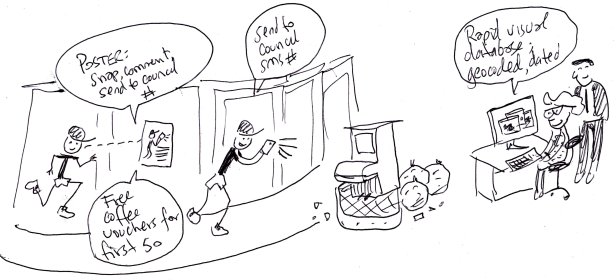
Step 5) What’s the ask? What, exactly, is the size of the bet you’re asking your manager to make?
“We’ll need $1500 for printing and coffee vouchers. We’ll need 3 days each for 2 staff to organise the prototype.”
Step 6) Any evidence this idea has worked elsewhere? If so, mention it. If you have metrics from successful precedents, present them.
Step 7) How you’ll manage the risks. How will you constrain the investment to make it a small, safe, bet? Think: limited time, compact location, small budget. Or start with rapid prototyping: a small, safe, test of concept, carried out swiftly, with very basic resources.
“We’d like to prototype the idea with 4 of our own staff who are joggers. Then test the idea with local joggers, on a limited basis, in Barney St and Janis Lane, for a two week trial. We’ll assess the results and report back to you.”
Step 8) Now be silent. Leave it to them. People actually have to talk themselves into change. Your silence will invite a response. They’ll ask some questions. A conversation will occur. They’ll test out their fears and you’ll have the answers (because you rehearsed them).
To maximise your chances
Rehearse. Rehearse. Rehearse the pitch in front of an audience. Practice answering the kind of questions you’re manager is likely to ask.
Get allies. Ask respected people in the organisation to support your pitch
Have reputational credit. Sometimes it’s important to be patient and wait until you have wins in the organisation before you propose significant changes.
Put them in the driving seat. Since autonomy is scarce for your manager, they relish it. So, share control. Don’t make it a ‘pitch’ or ‘request’. Make it “We’d like your input into an idea.” Then take on their input.
Don’t argue or disagree. Argument causes resistance. Placing a manager under pressure is the surest route to ‘no’.
Use Google. Have a good look around for similar ideas in similar organisations. If others have succeeded, the risks look smaller to your manager. If a lot have succeeded, then you can utilise a powerful motivator: fear of missing out.
And don’t forget to keep them in the loop. If they agree to go ahead, immediately schedule the first check-in meeting (in say 2-3 weeks). Keep them briefed, in person, regularly, and keep inviting their input.
Your language: it should be positive, succinct, definite
A pitch should be succinct, lacking waffle and expressed in quietly assertive language.
The future tense is good: “We will” is always preferable to the weak “we would”.
The client wants to know you’re confident and in control.
Avoid: “We could…” or “We’re thinking of…” or “Maybe…”.
Say: “We will produce… “We will deliver… “We will implement….”
Use concrete language; avoid abstractions eg. Don’t say “Key target groups”, say “People who will participate”.
More on pitching innovations to managers
Sick of Hearing Your Boss Saying “No”? (10 Ways to Make Him Say “Yes!”), Guerris de Ternay, Contriber
How to sell an idea to your boss, Roberto Verganto, Harvard Business Review
Unleashing Breakthrough Innovation in Government, Nikhil R. Sahni, Maxwell Wessel, & Clayton M. Christensen, Stanford Social Innovation Review
Engagement Lab is not just about creating original community engagement projects, it’s about how to pitch those projects to managers and get a ‘yes’
“I’m happy to give it a go. Put a bit of budget on it and see how it goes. If it doesn’t work we won’t do it again.” – council waste manager, Hunter region
It’d be wonderful if all managers spoke like this about their staff’s original ideas. But most managers are, well, managers.
So you’ve got this amazing, cool, gigantically engaging project idea, and you want your manager to sign off on it.
This is where your beautiful new tyre hits the hard asphalt of institutional reality. You’ve convinced your team – but they think like you do. Now you have to convince someone who doesn’t think like you do. This will probably be your biggest single hurdle. If you can convince your manager, you’re well positioned to convince others.
Think about your manager’s world: she has a small amount of power and autonomy, and it’s fragile. She’ll need to justify her decision to sceptical executives above her. And they are in just the same situation. They also have small amounts of fragile autonomy.
And, as you know, she’s very busy and has virtually no cognitive bandwidth to spare.
What you’ve got working for you is that your manager has problems she needs help to solve. And the terrible secret that all managers have (but can’t talk about) is that they know they are crap at achieving some of their critical goals. This is the capacity gap you can use to frame a successful sign-off. Managers are open to anything that increases their capacity to meet wobbly KPIs. But it has to be safe!
Now we can see a strategy for pitching our idea. Although our idea is WORLD-SHAKINGLY REVOLUTIONARY, we must temper that vision and instead pitch it as a safe, low-risk way to progress our managers’ immediately salient goals. And we need a crisp, instantly comprehensible description that that our manager can intuitively understand and sell up the chain.
And we have just 3 minutes to do it.
So let’s get some practice, using this 7 step formula:
Step 1) Open with a 10 second elevator pitch. Describe the idea and the outcome in 10 seconds or 25 words. Make it clean and simple. The outcome has to be one that overlaps with your manager’s KPIs.
“A 2 week community reporting blitz to create a snapshot of backyard dumping in Bondi.”
Step 2) State the need. In one paragraph, write a crisp problem statement. If you have some metrics, mention them.
“We’ve had 17 complaints of waste dumping in Bondi back streets in the last 12 months. But we have no idea of the real extent, of what’s being dumped, and who’s dumping it. We need a clear picture so we can devise a response. Yet we don’t have the staff to go out and check.”
Step 3) Sketch the innovation. How does it work? Sketch the mechanics of your idea. Conjure a word-picture. Better still, draw a real picture so the manager can instantly visualise the elements and how they work together.
“We’ll ask joggers to snap photos of waste dumped and send them to a council SMS number. That will gives us a quick visual database of rubbish dumped, geocoded and dated. To encourage participation, we’ll offer free coffee vouchers for the first 50 individuals who send in photos.”
And show them a picture.
Step 4) What’s the ask? What, exactly, is the size of the bet you’re asking your manager to make?
“We’ll need $1500 for printing and coffee vouchers. We’ll need 3 days each for 2 staff to organise the prototype.”
Step 5) Any evidence this idea has worked elsewhere? If so, mention it. If you have metrics from successful precedents, present them.
Step 6) How you’ll manage the risks. How will you constrain the investment to make it a small, safe, bet? Think: limited time, compact location, small budget. Or start with rapid prototyping: a small, safe, test of concept, carried out swiftly, with very basic resources.
“We’d like to prototype the idea with 4 of our own staff who are joggers. Then test the idea with local joggers, on a limited basis, in Barney St and Janis Lane, for a two week trial. We’ll assess the results and report back to you.”
Step 7) Now be silent. Leave it to them. People actually have to talk themselves into change. Your silence will invite a response. They’ll ask some questions. A conversation will occur. They’ll test out their fears and you’ll have the answers (because you rehearsed them).
To maximise your chances
Rehearse. Rehearse. Rehearse the pitch in front of an audience. Practice answering the kind of questions you’re manager is likely to ask.
Get allies. Ask respected people in the organisation to support your pitch
Have reputational credit. Sometimes it’s important to be patient and wait until you have wins in the organisation before you propose significant changes.
Put them in the driving seat. Since autonomy is scarce for your manager, they relish it. So, share control. Don’t make it a ‘pitch’ or ‘request’. Make it “We’d like your input into an idea.” Then take on their input.
Don’t argue or disagree. Argument causes resistance. Placing a manager under pressure is the surest route to ‘no’.
Use Google. Have a good look around for similar ideas in similar organisations. If others have succeeded, the risks look smaller to your manager. If a lot have succeeded, then you can utilise a powerful motivator: fear of missing out.
And don’t forget to keep them in the loop. If they agree to go ahead, immediately schedule the first check-in meeting (in say 2-3 weeks). Keep them briefed, in person, regularly, and keep inviting their input.
Your language: it should be positive, succinct, definite
A pitch should be succinct, lacking waffle and expressed in quietly assertive language.
The future tense is good: “We will” is always preferable to the weak “we would”.
The client wants to know you’re confident and in control.
Avoid: “We could…” or “We’re thinking of…” or “Maybe…”.
Say: “We will produce… “We will deliver… “We will implement….”
Use concrete language; avoid abstractions eg. Don’t say “Key target groups”, say “People who will participate”.
More on pitching innovations to managers
Sick of Hearing Your Boss Saying “No”? (10 Ways to Make Him Say “Yes!”), Guerris de Ternay, Contriber
How to sell an idea to your boss, Roberto Verganto, Harvard Business Review
Unleashing Breakthrough Innovation in Government, Nikhil R. Sahni, Maxwell Wessel, & Clayton M. Christensen, Stanford Social Innovation Review
I’m delighted to announce the winners of the DOING SOMETHING INTERESTING? competition. (Remember? Way back in April.) Copies of Changeology are winging their way to them.
My secret intention was to flush out innovative examples I could share. I’m very happy with the result.
In no particular order the winners are:
1) Impromptu kinder engineers, Wyndham City Council, Vic
For imagination and agility in speedily improvising a delightful community engagement project on the fly.

Here is Cliff Eberly’s description:
I’m thrilled to be able to share this story with you.
Wyndham City’s Road Resurfacing Team has been doing some wonderful engagement work around the repaving and reconstruction of local roads. It started out with them taking the Wyndham Cruiser, Council’s promotional vehicle, out to do meet and greets with local residents prior to road works.
In the photos attached they connected with a kindergarten that was affected by the road resurfacing. The kids donned construction hats, high visibility vests and got up close (in a kinder safe kind of way) with the diggers while learning a bit about what Council was doing on their street.
Overall, the engineers have reported that doing face-to-face, personal engagement with local people has dramatically decreased the number of angry phone calls they receive mid-project and increased residents’ satisfaction with the job being done.
Happy to end the week on this one.
Cliff
2) Fall In Love With Nature on the Central Coast, NSW
For breaking the stereotype of a conservation engagement project.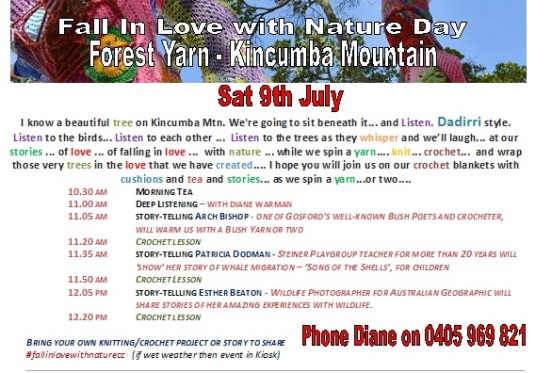
This ongoing project aims to get adults into nature by mashing nature experiences with stuff we love.
It was put together by a loose network of conservation professionals on the NSW Central Coast, organised by Rhiannon Anderson and managed by Sue Burton, and funded by AAEE/CEN. They mashed conservation with tea, stories, art and knitting, listening to the trees, and listening to each other, all wrapped up in the idea of “falling in love”, a theme they’ll just keep wrapping around more events. The core of the project is lean and simple, just an intriguing title, a card with a hashtag to give out at events, and chalkboards with the hash tag where people can write why they love nature on at community events. Look out for #fallinlovewithnaturecc
 3) Bunny Boiler Challenge, Bass Coast Landcare Network and Phillip Island Landcare, Vic
For a irresistible event.
“Rabbits are a national disgrace – they also taste great!”
This popular community event mashed a rabbit control talk with a rabbit cooking contest, plus ‘pin the tail on the rabbit’ for kids, and more. And the guests got to eat the yummy bunny dishes! Brilliant. A perfect exampling of mixing a serious subject with an irresistible social event.
110 folks turned up in March “with a mad scramble at the end for tables”. According to Joel Geoghegan, one of the organisers, it’s “90% fun and eating and 10% reality” with music, poetry and a talk on….rabbit control techniques.
4) Whimsical Wayfinding by the sustainable transport team, City of Port Phillip (Vic)
 For a perfect implementation of the Brains Trust approach.
The project, led by Jessica Cerejo, aimed to help people discover Emerald Hill by foot (as opposed to driving).
 The process: two community ‘brains trust’ workshops. The first briefed, informed and inspired the brains trust, then facilitated them to create a theory of change to create the desired future. The second session developed a fast prototype of Whimsical Wayfinding: informal signs to point people find the hidden gems of Emerald Hill.

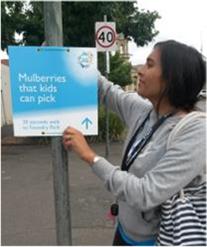
The signs were then fast prototyped at the Emerald Hill festival. People viewed the signs, added more and voted on them.
After installation, a survey showed more than 40% of people didn’t know about Pocket Park or the Community Garden/Foundry Park until they saw the signs.
PLUS an honourable mention to the City of Port Phillip’s sustainable transport team’s Ride2School Day 2016.
We don’t need to reward them. Their schools won 5 out of 6 school awards in the national program, with the city itself won the highest ranking Ride2School Day Council award with a $10,000 prize. http://www.enviroehub.com.au/ride2school
Well done all!
– Les
For those of you not familiar with the Spectrum of Participation, it’s the central conceptual framework for community consultation in planning, especially in local government. It’s so central to thinking about planning that it’s almost impossible to contemplate community consultation without invoking the Spectrum.
But here’s the problem. I just reviewed a host of contemporary community consultation methods (to make an slide show for a new training workshop). No matter how much I bent the definitions, I couldn’t make what we actually DO in community consultation fit the Spectrum.
Here, item by item, is the problem:
INFORM: “To provide the public with…information…”
Er yes, we always communicate. Yet disseminating information alone can’t, by definition, be a form of consultation. And communication is, yes, inevitable. So having an INFORM level is kind of superfluous. The only reason for including it in the Spectrum is to make the point that it’s never enough by itself. In that case, why is it ON the Spectrum?
(There is an amazingly tense and fraught, and ultimately funny, LinkedIn thread where engagement consultant Brett Sangster innocently asked the question “Is ‘inform a legitimate level of ‘engagement’?” and prompted, so far, 327 comments, revealing a chaos of diasagreement on this question amongst engagement professionals.)
CONSULT: “To obtain public feedback…”.
Yes, that sounds exactly like what community consultation does and is. And, despite all sorts of attempts to push the boundaries, that’s where the great majority of community consultation efforts, and platforms, continue to lie. The reason being that’s all most authorities want or have time for. And, mostly, all that the public have time for as well. (Many of the really interesting innovations in community consultation are about mobile-enabled ‘1 minute consultations’, where the effort demanded from the public matches their actual level of interest. Those are definitely on the CONSULT level.)
INVOLVE: “To work directly with the public…”
Ah. This is the level I enjoy. Sitting down with people face-to-face. People can learn, and alter their positions, and relationships can be made, creating the possibility of trust. However it’s very hard to initiate this level, for the reason that most planning processes are so conventional, dull and irrelevant that it’s impossible to get citizens to give up their time. And fair enough too. If the issue is a ‘hot’ one, however, it’s easy to fill a workshop, and workshopping is infinitely better than the blood sport of public meetings. I personally think this is an area where we can do with a lot more fun and innovation.
COLLABORATE: “To partner with the public…”.
Here’s where the Spectrum floats away into fantasy. In principle, it’d be nice to partner with the public. However, partnering is about equivalence of power. And there is a immense disparity of power in plan-making that makes ‘collaborate’ only ever an aspiration. A nice one, but, sorry, the final decision is always with the power-holder, and it would be ridiculous, and disingenuous, to pretend it’s anywhere else.
Also, looking at real life examples, I really can’t distinguish Involve and Collaborate in the field. They end up being kind of the same thing: basically a group of people being workshopped by a facilitator, who occasionally allows them to influence the process.
(OK, I know of a couple of examples approaching partnership, but they are in only after near-death experiences by public agencies. They are exceptions that prove the rule.)
EMPOWER: “We will implement what you decide…”
This is where the Spectrum gets completely silly. In our society, power is not relinquished. The perceived risks for authorities are too great. I can see it’s nice to have there, like a glowing light on the hill, but when I train public officials I face a seemless wall of scepticism and self-doubt about this level. If I am being realistic it’s not a serious option. I suspect it’s just there as a fossil from Sherry Arnstein’s original 1969 Ladder of Citizen Participation. It’s neat. I can see it looks right. But it’s not the job of government to hand complete power to citizens. It’s not even a good idea most of the time. When agencies have ceded power, it’s almost always when citizens force their way onto the table, and even then it’s grudging and temporary. Take Landcare as an example: it looks like empowerment, but the funding schemes are withdrawn at a whim, and action is so mired in paperwork and accountability that it wears down active citizenship.
In summary: 3 of the 5 levels in the Spectrum do seem to have conceptual or reality problems. They don’t seem to make sense as intellectual categories either because they can’t be implemented or, in the case, of INFORM, aren’t actually a category of consultation. With this in mind, perhaps it would be more rational to have a Spectrum of Consultation with just two components:
CONSULT <———–> INVOLVE/COLLABORATE
I think that would be a much closer simulation of reality.
WHAT’S MISSING: Just listening
Interestingly, there’s a whole class of community engagement that’s absent from the Spectrum. It could be the most important kind of all.
Most of our public organisations have lost contact with their publics. They suffer from Chronic Engagement Deficit Disorder (CEDD) which cannot be solved by yet more formal and structured engagement processes. Exactly the opposite is required: engaging tactics that make possible just plain listening, where agency staff meet citizens without an agenda, and hear from each other as human beings.
Check out this video from Wyndham City Council. They call it a ‘listening post’ but really, it’s a ‘pop-up council’. You can see lots of different formal consultation processes under way in a central public space, combined with music, food and something for the kids, but what’s also happening is LISTENING WITHOUT AN AGENDA. Just getting the council managers, executives, the CEO, the Mayor and councillors, out of their offices and meeting rooms, and LISTENING to citizens, one-on-one.
I watched one of Wyndham’s council executives reporting on this experience in an internal forum, and his body language said it all. He was frankly delighted, and bubbling to express his appreciation of the process. For him it was a revelation. I would even say that CEDD is a disorder that public officials are hungry to have relieved.
Of course, such a tactic (actually any successful community engagement) depends on a commitment to hear. And that depends on one thing that isn’t measured in formal models: genuine curiosity.
With this in mind, I want to propose an alternative spectrum to help organisations decide on their community engagement tactics: the Curiosity-ometer.
The idea is: before any community consultation, honestly answer this question: “Where are you on the spectrum between ‘endorsement seeking’ and ‘open-mindedness’?” Being bracingly honest about this might reduce a lot of the wasted effort and conflict around community consultation.
