
Volunteering is in the news. The NSW Flood Inquiry (Aug 2022) just recommended:
“the State Emergency Management Committee (SEMC) commission a review of volunteerism in NSW… to respond to declining formal volunteerism…” (Recommendation #6)
And, as if in reply, Volunteering Australia just launched its National Strategy for Volunteering, which concluded:
“We need to re-focus on the volunteer experience: Volunteers are increasingly valuing choice and flexibility. They want to engage with opportunities that meet their needs and provide a sense of agency.” (p32)
So, how to reinvent the volunteer experience for an era when everyone has endless options for their precious free time, including watching Netflix and just sleeping?
The answer is to let them focus more on satisfying human needs, like
Recognition. “Wow. Every week they make a special activity for me. They listen to me and have time for me.”
Pleasure. “Every week there’s something enjoyable to look forward to: coffee, cake, nice lunch, games.”
Connection. “I’m always buddied up. I never feel neglected.”
Variety. “Please, not the same thing again.”
And also: Low anxiety. “I never feel overwhelmed. I know what to do and how to do it.”
Being part of something wonderful. “I know the long term vision and my role in achieving it.”
But, HOW to actually DO reinvention?
Luckily we already know how to reinvent experiences:
Give the members permission to imagine their own innovations, of course (in a workshop). And then expect them to adventurously prototype their most promising ideas.
Look at these examples from Landcare: Adventurous Landcare groups have chosen memorable names, like Willow Warriors or Mudcrabs. They’ve added pleasurable activities like Yam Daisy Harvest, Bunny Boiler Challenge, or Big Brew and Bake Off. Some have pivoted their purpose, for example changing to a Bee Care Group. Others have organised buzzworthy new initiatives like Landcare for Singles, BushCare for Kids, or Citizen Science surveys.
The best of them have active social calendars. “Our group’s secret is a history of great social secretaries. Food is the key thing…and we have historic farm walks, sheering shed musicals, beach walks and BBQs.” – Three Creeks Landcare Group, Victoria
So, decision-makers, don’t scratch your heads, don’t commission more reports: just give your volunteer groups the permission and space to re-imagine themselves to become the kind of group they’d never want to miss a meeting of. You’ll be surprised at what they create!
Image: Courtesy Project Platypus https://www.platypus.org.au
]]>
– The shock at realising they’ve been unconsciously belittling their listeners, for years
– Suddenly getting that “denial is the sound that anxiety makes”
– Realising that “we don’t need to explain why to do a new thing, just how to do it”
– Realising that “people literally talk themselves into change” (i.e. it’s not enough for people to passively read about it or watch videos)
– Seeing how the bell curve nicely matches people and tactics
– Excited about how easily a properly devised brainstorm pops out good solutions
– Realising that people are never empowered by “problem talk” (they need “solution talk”)
– Finding out how to peel a Post-it note so it doesn’t curl.
What challenges me about this is that people mostly aren’t focusing on the tools and processes (that I love), but on their own forehead-slapping, assumption-challenging, “mental flips”.
I like that people walk away thinking differently. We’re always told to beware of our unconscious assumptions. But, of course, it’s impossible to do that unless we mentally grabble with the alternatives. We need a special space to experiment with new ideas and hear ourselves talking about them! I guess that’s why workshops are transformative in a way that passive media isn’t.
Best wishes
– Les
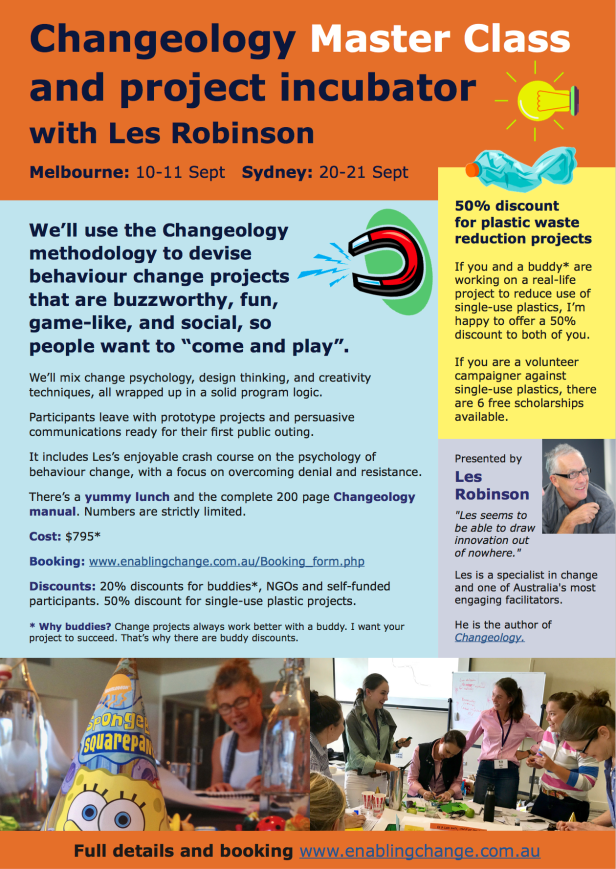
Here are the details for the next Changeology workshops:
Melbourne 10-11 September
Sydney 20-21 September
These workshops suit sustainability, health promotion, early years intervention, road safety, emergency management, workplace change and business transformation.
Download the flyer: http://www.enablingchange.com.au/2018_changeology_workshops.pdf
Warm wishes – Les
For booking and all details: www.enablingchange.com.au
This little piece of genius, from a Swiss canton, shows that meeting a real person can be a most persuasive kind of persuasion.
The human brain becomes awake and present when we meet a real person, in ways that impersonal media can never achieve.
So how can we arrange for our audiences to interact with real faces? There must be scores of ways we could emulate the underlying idea. Who wants to give it a go?
Love Makes a Way
The Love Makes a Way movement caused 3,500 older Australians to travel to their MPs offices, and stay and pray until they got arrested or expelled, in the name of releasing refugee children from detention. This is an inspiring Christian movement based on civil disobedience.
We always say that actions should be designed to be easy. But this story made me realise it’s not always true. Onerous actions have a place – especially where causes are strongly motivating and we come together in groups. So maybe Love Makes a Way illustrates how the hardness of the action can be equal to the actors’ passions. Where people care strongly, the ask can be hard.
What’s a ‘design lab’?
Design is the hot thing (designing projects, solutions to social problems, services) for good reason – it’s a really useful approach to change work. We’ve all heard of a ‘design lab’. But what is that? Here’s a slideshow that comprehensively describes what the UK Government’s Policy Lab does (they innovate programs and services). Including the tools they use. This is an excellent overview.
They’ve also provided an open policy tool kit which is full of useful processes. Including what to do in a one day workshop – this is really great model and something that’s easy to adopt.
Effective brainstorms – it’s all in the wording
Here’s the best video I’ve seen on what a design workshop looks like. Notice the finessing of conventional workshop: the precise wording of the instructions matter.
For a word-for-word script for effective workshopping, this post might be useful. There is a lot to keep in mind, so a script can help.
I can’t emphasis the importance of instructing participants to be ‘concrete, specific, and refer things we can see and touch’. Don’t say ‘educate’, instead say ‘set up a billboard outside the IGA’. (Ah-hah, now I know what you mean!)
Fluffy ideas are useless because project managers can’t act on ideas they can’t see in their mind’s eye. True, those ideas will die in the prioritisation phase anyway…but I hate to think of great ideas dying just because of the abstract language used to describe them.
Term of the month: “high serendipity”
(Adj.) Refers to environments where there’s a high chance of a happy or beneficial accidental encounter. Can we design high serendipity experiences for ourselves and others? This term doesn’t pop up in Google, which means I just invented it. I know it’s gotta be useful.
A fantastic health promotion job in northern rivers NSW
My friend Jillian Adams, the health promotion manager of Northern NSW Local Health District, has a fab job going for a health promotion communicator.
Upcoming CHANGEOLOGY and FACILITATION SKILLS workshops, Sydney and Melbourne
The workshops are on again in October. This time Changeology is looking more and more like a hybrid design workshop and a creativity camp. There’s still a grounding social psychology and step-by-step process, but the more I deliver it, the more I find I’m emphasising processes which push the imaginations of project designers into seekingly wacky places. As Albert Camus said: “All great deeds and all great thoughts have a ridiculous beginning.”
Changeology method hothouse
The 2-day master class in making change happen
Get the ideas, inspirations, processes and tools to devise projects that change the world. Full details.
Melbourne 17-18 October | Sydney 25-26 October
Book a place: Sydney or Melbourne.
Facilitate with Confidence
Facilitate any gathering with skill and authority
Lay a solid foundation for your role as a facilitator of meetings and workshops in any context. Full details.
Melbourne 19 October | Sydney 27 October
Book a place: Sydney or Melbourne.
First, everything in the universe is vibrations. Even the stuff (particles) of the universe is vibrations. And particles excite each other and change directions by bumping together and passing on their vibrations.
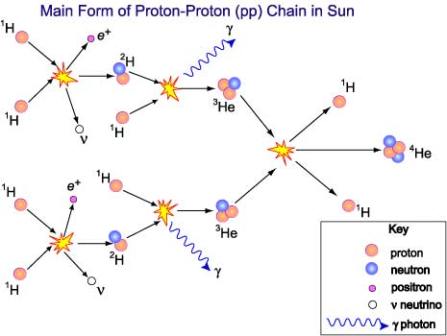
Yes, I can dig that. It’s exactly the same for human beings composed of kazillions of particles. We excite other human beings and change their directions by bumping into them and sharing our excitements. In fact, isn’t that what social change IS?
So maybe we can have an “excitation theory of change” – where it’s not facts or stories that change people, but our own excitements. Our emotional force.
That explains why leaders are always the most dynamic people in a room. And it explains how change is as much about emotion as facts and stories.
You can see that, unfortunately, with all those Trumpists in the USA who became a social movement by becoming excited and sharing their anger, resentment and the joy they got from just being a movement. That’s bad change of course because those people are being used by dangerous power-freaks. But good change is probably about just the same thing – remember the excitement of Obama’s election?
Second, I discovered the coolest equation in physics – the Principle of Least Action. And its best kept secret. It seems to be the only equation you actually need to describe how the universe works – the other big equations derive from it. It says that all objects in nature follow beautifully economical paths that simultaneously conserve their energy and make best use of the pushes and pulls that surround them in their environments. Which is why satellites effortlessly orbit the earth, why really good dancers are beautiful to watch, and why the blue wasps in my backyard never get tired.
Thinking about it, it also seems an apt description of human action. We humans have inner motivations (which are our hopes suffused with emotional energy), and there are pushes and pulls in our environments that determine the paths we follow to achieve (or not) those hopes.
That explains how humans love to find effortless paths of action (Csíkszentmihályi’s idea of Flow).
It also explains, I suppose, why poorly motivated humans won’t walk 10 metres out of their way to use a litter bin.
So you have a theory of human action with just 2 components:
1) Motivations to act, which might be feeble or powerful; and
2) Pushes and pulls in the environments that create pathways to action by guiding, hindering and enabling.
Voila! That’s close to quite a few existing change models, including Changeology. The more I think about it, the more I’m entranced by the simplicity and power of this theory.
[If you want to get into it, the physics of the Principle of Least Action is neatly depicted here: https://www.youtube.com/watch?v=xz7jLnWcxMs To envisage how it works in human psychology, think of “kinetic energy” as a person’s inner motivations, and think of “potential energy” as all the sources of the environmental pushes and pulls that influence how a particular motivation actually gets realised – approval of friends, social norms and prestige, convenience, cost, threats and so on. “The action” in physics would be just the same as “action” in ordinary life. “Least action” means that human action follows the most economical path, weaving elegantly through all the pushes and pulls. Intensity of motivation makes a huge difference to the result. Strong motivations are less at the mercy of pushes and pulls, explaining why people follow seemingly ridiculous paths while pursuing passions and addictions. Feeble motivations, meanwhile, tend to be firmly trapped in the rut of convenience.] ]]>
But something happened we didn’t expect: he became obsessed with ‘Dojos’. I’d say ”How was reading and maths today?” but instead we heard “l love Dojos, I’m going to get a special medal when I get a lot of dojos”.
A few months into the school year, he was daily referring to how many Dojos he and the other kids had. It was the first thing he talked about when he woke up in the morning. It was clearly praying on his mind.
A few months into the school year we were walking out of school and Dojos came up. One of his friends had over 100, but he only had 84. I asked him “Why do you think you don’t get as many Dojos?”
“I’m just not good enough.” My heart broke hearing these words of resignation and failure from my child.
We love our school and our teachers. But what’s with the Dojos?
We investigated.
Class Dojos is a free San Francisco-based online platform launched about 4 years ago. There are supposed to be over 40 million users in 150 countries.
It works like this: there’s an interactive white board in the classroom – a huge touch screen – with cartoon avatars representing each child. The teacher rewards a child by asking them to touch their character – there’s a happy “ding ding” and a point is added to their avatar’s score. Or an unhappy “bung bung” comes up when they lose a point.
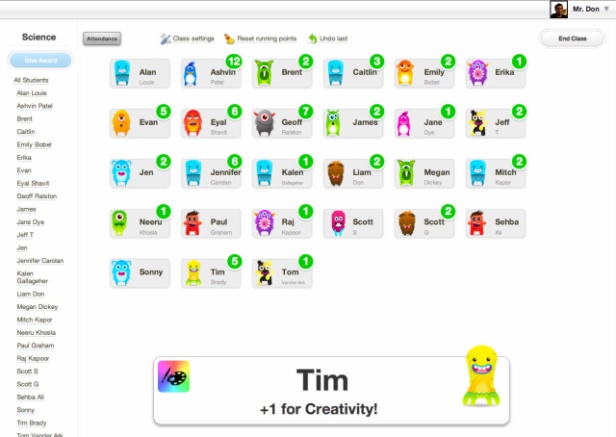
The accumulated score board is displayed whenever the screen isn’t being used for anything else – which was about an hour a day in our son’s classroom.
Dojos seem to work well to control classroom behaviour, but what we hear makes us worried about negative impacts on individual kids. Rewarding good behaviour is one thing, and it’s a normal part of school life, but the constantly-present score table could have a different kind of impact. It’s about comparison – with the standard being set by kids who have high maturity, focus and self-control. What does it say to those kids who are less mature, or more spirited and easily distracted? What impact does the score table have on those kid’s self-esteem and self-confidence – their emerging sense of who they are. Could kids who get consistently stuck on low scores rebel in order to protect their self-esteem?
The default behaviours are:
For “positive” (green) behaviours:
“On task”
“Participating”
“Working Hard”.
For “needs work” (red) behaviours:
“Off task”
“Talking out of turn”
“Unprepared”.
Teachers can add any behaviour they want, potentially rewarding or censuring virtually anything a child does or says in the classroom. They can also invite parents to sign up for text messages whenever their kids are rewarded or penalised.
The idea, of course, is that kids get a little burst of pleasure whenever they get rewarded, and a little burst of humiliation and shame whenever they are penalised. Because we humans are designed to seek pleasure and avoid pain, this should logically drive compliant classroom behaviour. And the public league table is presumably intended to get kids competing against each other to see who can be best and to publically shame those who do poorly.
Now this looks exactly like Business Management 101. The psychology behind it is behaviourism – the idea that the whole of human behaviour can be explained by stimulus-response associations. Behaviourism reached its peak in the 1970s, best exemplified by the “lab rat” experiments that dominated psych studies at the time. Humans are, of course, motivated to seek pleasure and avoid pain. But humans are not lab rats. The entire thrust of psychology since the 1970s – the “cognitive revolution” – recognises that pleasure and pain offer a very thin explanation of human behaviour.
What matters far more is:
– identity, the self-stories or internal narratives that make up a child’s emerging sense of “who I am”;
– self-efficacy, “what I believe I am capable of”, their belief in their own ability to control outcomes that matter to them; and
– self-esteem, a child’s emotional evaluation of their own worth, that predicts academic performance and happiness, amongst other things.
What is disturbing about the Class Dojo system is its obliviousness to this entire world of psychology. How does being pleased by immediate external rewards or goaded by shame at unexpected moments during the day affect a child’s sense of who they are? How does having their complex motivations, inventiveness and agency reduced to a single numerical score affect their identity? For kids with low scores, how does being negatively compared to their peers every day affect their self-efficacy? How does being stuck with a lower than average score affect a child’s self-esteem?
Our son is a very competitive child. In his first week at school he came home thrilled by winning Dojos. He wanted to get back to school so he could win more. But then he quickly became locked into the middle ranking and didn’t know what to do about it. He saw his friends with 120 points and said “It’s not fair. I’m helpful too.”
By the middle of term 2, substantial differences emerged in the classroom. Some kids had 120+ points, some had 60 points and some were stuck in the middle. The differences now seemed so significant and entrenched that our son – and perhaps others in his class – doubted his ability to move up the ranks and be as good as his peers. It was a bit like an exam that happened every day, every week, and never ended, perpetually conveying a disappointing story about the kind of person he was.
The reason kids might have trouble changing their positions is probably because many lack the natural ability to do so. There is a tremendous range of natural individual differences in a classroom. Some kids are more mature. Some are more wiggly, articulate, inventive or more easily distracted than others. Some are more spirited. Young kids with ADHD, for example, only learn and think clearly when they’re moving around.
Learning behavioural control takes years. It doesn’t happen at the scale of weeks and months that Class Dojo records changes. It’s not analogous to, for example, learning to spell ‘garden’ or subtract 4 from 9, which can be picked up fairly quickly. It’s really about who they are as people. And because it’s hard to change their ranking it might seem that they have no agency, or self-efficacy, to change the kind of people they are.
Already, by term 2, there was a risk our son’s class was being unintentionally stratified into those with high, medium and low self-efficacy and the self-stories that rationalise those rankings. We’d hear him says things like:
“Dad, I’m with Nicholas and Andrew.”
“What do you mean, are they on your table?”
“No, they hate Dojos too.”
“Why do they hate Dojos?”
“Because they’re the bad kids.”
Anyone who has read Martin Seligman’s Learned Optimism, about what creates resilience in children, will immediately recognise that unconsciously stratifying kids into groups based on personality traits is damaging. The reason: it affects their growing self-story about who they are and what they are capable of.
Class Dojo seems like a well-meaning attempt by a business economist and a Silicon Valley games engineer to solve a serious social problem – chaotic classrooms – by creating something familiar in their world: a sales league table that looks like a fun computer game. According to teachers who use it, it seems to work. There is less bad behaviour, children are more controlled, and teachers like it. But what is the cost of a behavioural intervention that risks the most important part of our children: their fragile, freshly emerging sense of who they are as people?
We are frankly amazed that this technology is spreading into schools without guidelines, evaluation, or debate. The Class Dojos website offers no guidelines on safe or appropriate use (their support materials chiefly concern selling the idea to other teachers). Nor do state education departments offer guidelines. There’s been no work by independent academics. There appears to have been no critical evaluation at all. The system simply hasn’t been around long enough to get on people’s radar.
What to do about Class Dojos? Because it promises teachers high levels of compliance, is colourful and interactive, it may indeed be better at controlling immediate behaviour than, say, stars on the wall.
If we have to live with Class Dojos at least let’s create some guidelines on safe use.
The system is customisable and it’s possible for teachers to limit some of the likely negatives. The trick will be to retain the judicious and fair use of recognition for individual improvement, while reducing or removing the impact of the league table that causes kids to compare themselves to each other.
After having doing some research, and seeing the many ways Class Dojos are being used in classrooms around the world, here are a few thoughts on ways the system might be modified to keep the useful aspects but minimise the down sides:
* Start each week with a blank slate by zeroing the scores that are visible to the kids – so they have a fresh possibility to succeed. (The accumulated score is still available to the teacher). Regularly zeroing the numbers would also prevent penalising children who are sick or away through no fault of their own.
* Have the board up for only 2 weeks at the start of each term to re-establish classroom norms.
* Display the avatar scores at only predictable times during the day, to prevent any negative comparisons being omnipresent for the kids or experienced at arbitrary times.
* Use the scores only to identify kids who made a big personal change in a given week, irrespective of their comparison to other kids.
* Alternatively, keep the numerical scores private – for the teacher’s use alone – so children don’t compare themselves to others and feel locked into middle and lower ranks.
* De-link the score from end-of-year rewards like presents or parties to prevent children becoming even more obsessed about the impact of their score.
* Use it as a tool for children to set their own classroom norms for good behaviour and decide on consequences/rewards. Here’s a teacher talking about this idea.
Postscript
After discussing our concerns with our teacher, she decided to zero the scores at the start of each term. Yay! We’re very pleased at the school’s responsiveness but we still have serious concerns about the entire idea of a ranking-based reward system.
P.P.S. We have since moved our child to a school that doesn’t use Class Dojos, and generally places less competitive pressure on children. He has become a far happier child. This is, frankly, a great relief.
P.P.P.S. Here is the nearest thing I could find to a survey of parental views on Class Dojos. Most parents here report negative impacts on their children. See the comments at the end of the post on this page: http://gettingsmart.com/2014/08/parents-review-classdojo/
 When I’m running close to a bunch of deadlines I trip over chair legs and run into cupboards. I miss appointments and credit card payments. I don’t hear people. It’s like I’ve suddenly become stupid.
I’ve been mentally captured by the condition of scarcity. In my case, it’s scarcity of time. The same principle applies to other kinds of scarcity: scarcity of money, scarcity of food, scarcity of health, scarcity of safety.
In their book Scarcity, The True Cost of Not Having Enough, Sendhil Mullainathan and Eldar Shafir, eloquently set out a psychology of scarcity. It’s got a host of implications for anyone designing change efforts.
Their argument is simple:
“Scarcity captures our attention, and this provides a narrow benefit: we do a better job of managing pressing needs. But more broadly, it costs us: we neglect other concerns, and we become less effective in the rest of life.”
Scarcity and urgency do have positive effects: they “yield a focus dividend. In a box of expensive chocolates, we savor (and hoard) the last ones. We run around on the last days of a vacation to see every sight. We write more carefully, and to our surprise often better, when we have a tight word limit.”
Scarcity also has strong negative effects: “The power of focus is also the power to shut things out. Instead of saying that scarcity “focuses,” we could just as easily say that scarcity causes us to tunnel: to focus single-mindedly on managing the scarcity at hand.”
They offer two important ideas: BANDWIDTH and TUNNELING.
Our mental BANDWIDTH is reduced by scarcity: we have less willpower, less attention and less active intelligence. “One study revealed that simply raising monetary concerns for the poor erodes cognitive performance even more than being seriously sleep deprived: 13-14 IQ points!”
And we tend to focus exclusively on what’s IN THE TUNNEL of our immediate needs. Things outside the tunnel become harder to see clearly, easier to undervalue, and more likely to get left out.
“Because we are preoccupied by scarcity, because our minds constantly return to it, we have less mind to give to the rest of life. …we find that scarcity…makes us less insightful, less forward-thinking, less controlled. And the effects are large. It is not that the poor have less bandwidth as individuals. Rather, it is that the experience of poverty reduces anyone’s bandwidth. When we think of the poor, we naturally think of a shortage of money. When we think of the busy, or the lonely, we think of a shortage of time, or of friends. But our results suggest that scarcity of all varieties also leads to a shortage of bandwidth.
One idea they propose is a radical reconceptualization of poverty: “We understand that rent and food and school fees all form part of a household’s budget. Now, rather than looking at education, health, finance, and child care as separate problems, we must recognize that they all form part of a person’s bandwidth capacity. And just as a financial tax can wreak havoc in one’s budget, so can a bandwidth tax create failure in any of several domains to which a person must attend. Conversely, fixing some of those bottlenecks can have far-reaching consequences. Child care provides more than just child care, and the right financial product does much more than just create savings for a rainy day. Each of these can liberate bandwidth, boost IQ, firm up self- control, enhance clarity of thinking, and even improve sleep. Far-fetched? The data suggest not.”
They compare the highly prescriptive nature of modern welfare systems (like Centrelink) to “going to a juggler who is in need of help and tossing one more ball in the air for him to juggle.” Instead, welfare programs should be highly fault tolerant to fit the narrow, disrupted attentions of those under financial stress. “Strict deadlines and rules set stressed people up for failure. The low tolerance for mistakes practically guarantees missed appointments, missed classes…”. Instead of blaming welfare recipients, they suggest redesigning the system to match people’s bandwidth.
“The deeper lesson is the need to focus on managing and cultivating bandwidth, despite pressures to the contrary brought on by scarcity. Increasing work hours, working people harder, forgoing vacations, and so on are all tunneling responses, like borrowing at high interest. They ignore the long-term consequences. Psychiatrists report an increasing number of patients who show symptoms of acute stress “stretched to their limits and beyond with no margin, no room in their lives for rest, relaxation, and reflection.” There is nothing magical about working forty or fifty or sixty hours a week. But there is something important about letting your mind out for a jog – to maximize effective bandwidth rather than hours worked.”
For designers of change programs there is a big lesson: if scarcity is a 360 degree drain on people’s ability to make changes in their lives then tackling their sense of scarcity may be a critical preliminary to the successful spread of new behaviours.
Here are some insights for change makers:
– it’s possible to use scarcity or urgency to activate people. Programs with “limited numbers” or early closing dates grab people’s attention and willpower;
– try to target people’s self-perceived urgent problems, that way we are “in the tunnel” of their attention spans and motivation;
– buffers of free un-assigned time, or un-tied money and resources, produce tremendous pay-offs in bandwidth by liberating people’s attention, intelligence and motivation;
– the rush of daily life may make it practically impossible for people to think or plan, so aim to create special events and locations where people are free from distraction;
– make things super-simple to understand and do (the authors point to a study that randomly assigned participants to diets that differed in their rule complexity and concluded, “Perceived rule complexity was the strongest factor associated with increased risk of quitting the cognitively demanding weight management program.”);
– recognise that most people will never have the bandwidth to make low priority changes in their lives. Small business people are a classic example of this problem. They need someone to do it for them! So create a service;
– and for our own creativity, recognise that productivity, accountability and deadlines are corrosive forces. To be imaginative and innovative in our work, make times and places that are free from their malign influence.
More… here’s The Guardian review of the book. ]]>
An anguished observer of the comprehensive failure of western aid in Africa, Sirolli innovated a seemingly radical approach to community change:
“You never initiate anything, you never motivate anybody. Instead you become a servant of local people’s passion. People who have a dream of how to be a better person. So you shut up. You never arrive in a community with any ideas …we sit with local people in a café, or at the pub and we become friends and we find out what local people want to do. The most important thing is passion. You can give somebody an idea. If that person doesn’t want to do it, what are you going to do? The passion that the person has for their own growth is the most important thing.”
Sirolli says the most useful role for a change maker is to be a servant to entrepreneurs by connecting them with the resources to act. And since no one can simultaneously be an ideas-person, a marketer, or a good administrator, the most important resource is the people who can fill the missing roles.
I love how he describes that “planning is the death of entrepreneurship” and why community meetings are always failures (because the local entrepreneurs don’t turn up).
There is so much in this video that I’m using it to introduce my Changeology training workshops this year. It captures exactly the leap we need to make from paternalism to enablement and the way success or failure depends, above all else, on the assumptions we bring along with us.
 The world is presently witnessing two awful spectacles of bullying on a global scale: the terrible tragedy in Gaza and Russia’s proxy war against the Ukraine. Closer to home, we’re witnessing the Australian government’s bullying of asylum seekers, the unemployed, the disabled, single mothers, and indigenous people in communities subject to the Intervention.
Bullying is an assertion of power designed to cower, belittle and control its victims. It hurts because it says to them “Your hard-earned human dignity amounts to little to us. You are a reduced form of humanity whose only function is to comply.”
These comments from BasicsCard recipients capture the emotional impact of bullying:
“I just didn’t have the energy to fight them. I went into shock. It made me feel like a piece of shit.”
“When it was pushed on me, I was really angry because they didn’t look at the big picture. They didn’t look at who I am.” (1)
There are bullies in every school yard. There are bullies amongst states – especially well-armed ones. States so frequently bully and intimidate their own citizens that it should probably be a useful addition to Weber’s definition of a state “The monopoly on the use of force and the default use of threats to control their subjects’ behaviour.” Just now we have an outbreak of politicians and academics advocating the use of threats to close down overseas surrogacy – a tactic which, I would have thought, had already failed.
Human beings respond viscerally to being bullied. It causes an instant, powerful immune response. It makes us resist. Some of us push back immediately, some bide their time, but every bullied person is profoundly motivated to restore their lost dignity.
Our capacity for resistance is one of the glories of human nature – the ability to push back against the bully to recover our threatened identity, optimism and hope. It explains human progress: how, generation after generation, the human race stumbles forward and slowly betters itself. It also explains every civil war and every liberation struggle.
Inexplicably, the science of psychology has almost completely avoided studying either resistance or dignity. However there’s still enough experimental and observational evidence to answer a few important FAQs.
Does bullying work?
Can bullying, as the bullies intend, achieve the goal of humbling and controlling the intended victims?
In the short term most intended victims will probably pull their heads in, feign compliance, or run away. But not for long, because the bullied have very strong motivations to push back.
To understand why the bullied don’t just hunker down and comply, it’s important to appreciate that dignity is indispensible for the basic functions of life. Without it we become anxious, listless, and depressed or angry. Our immune system works less well. The well-known psychologist Martin Seligman carried out seminal research on learned helplessness in the 1970s. His experiments with dogs found that, when unable to avoid unescapable shocks, most simply gave up trying to avoid them. (Significantly, though, around 30% of animal subjects simply could not be cowed.)
It appears that dignity, hope, identity and health are all wrapped together and indispensible for a healthy life. That makes humans into highly motivated, sustained resisters against those who would reduce their dignity.
The result is a fatal asymmetry between bullies and victims – one that’s ultimately fatal for the bullies. The asymmetry concerns endurance.
Because dignity can never afford to give up, resistance lasts for as long as it takes for dignity to be restored. It is amazingly tireless, patient and enduring. The Vietnamese struggle against colonialism took 30 years. The anti-Apartheid struggle in South Africa took over 40 years.
Bullying also brings out the magnificence of human ingenuity. Because the self is threatened, victims often think about practically nothing else except ways to undermine, circumvent, or punish their bullies. Because they’re on the job full time, they tend to be smarter than the bullies who are so often scrambling to keep up.
In the case of BasicsCard, for example, there’s evidence that gamblers resisted by changing the currency of gambling from cash to food, clothing, and the BasicsCard itself (2). (We may think that gambling is a unhealthy pastime, but that’s not the point. Humans are motivated to resist all threats to their liberties, whether the liberty is healthy or not.)
The tireless, ingenious character of resistance means that it always, always, eventually wins because the policies of states and institutions are less enduring. Their victims do not go away – they are still resisting when the bullies are old and grey, when they’ve lost the election, when their politics has crumbled.
Bullying may provide an immediate rush of power and omnipotence for the bullies. The problem is, it puts them in a co-dependent relationship with their victims. More and more of their time, and treasure, and reputation, and political capital, will go into controlling the bullied. They may end up finding, like many regimes, that it’s just about all they do.
In the end, bullies and bullied can find themselves in a mutually destructive co-dependent relationship, like that between the Gazans and Israelis, or between poor African-American neighbourhoods and city police forces.
Is being bullied good for the victims?
It seems an absurd question, but it’s clearly the theory behind many attempts at social engineering, notably from the conservative side of politics. Back in 2002 federal employment minister Mal Brough was honest enough to admit the government’s policy for the long term unemployed was “embuggerance”, a military term for making someone’s life a misery. Making the life of the unemployed impossible has since emerged as a core strategy behind the employment programs of both sides of politics. Forcing a young person to apply (and then be rejected) for 40 jobs a month, every month, until they find a job, when they are at the most emotionally insecure time of their lives, is surely one of the most diabolical humiliations ever conceived by Australian politics. The Intervention’s removal of what little autonomy was still possessed by indigenous people in the Northern Territory is another.
But is this kind of bullying good for the unemployed, or for indigenous people? Does it get them busy for a positive purpose?
The effect of “fear appeals” in advertising is an analogous phenomenon that’s been well studied by psychologists. [For example: For example: Elliot, B. (2003) The Psychology of Fear Appeals Revisited, http://acrs.org.au/files/arsrpe/RS030056.pdf ] The consensus is, in fact, that fear can be quite motivating. Fear arouses the emotions and focuses attention. The bigger the fear, the higher the motivation. But whether that motivation is directed towards hyperdefensiveness or towards positive action depends entirely on another factor: whether the subjects have the confidence to carry out the desired action. If the desired action is complicated, challenging, unpredictable, or itself threatening, then the prefered response is likely to be avoidance or resistance.
Bullying, too, causes the same motivation to resist, or hyper-resist. But more sharply so, since it is people’s identity that’s threatened. Ultimately it’s a positive thing that the bullied become so highly motivated. The downside is that they can easily end up spending much of their time doing things that are unproductive…like petty burglary to obtain spending money, or futilely shooting rockets across the border into southern Israel. These activities require a lot of motivation, but they don’t really help. If your unchecked hurt and rage embed you into a 24/7 culture of resistance, that’s probably a bad thing. You might find that you’re effectively self-harming: doing the bullies’ job for them.
So, no, being bullied isn’t really good for you.
Are there alternatives to bullying?
This too seems like a ridiculous question, but the stark behaviours we see in the news suggest that many power holders may never have contemplated alternatives.
First, is there an alternative to endemic social conflict, such as we see between Gaza and Israel?
Yes, dear friends, that is what justice was invented for.
Justice means putting into practice the principles of natural justice (the rule against bias, and the right to a fair hearing). And it means establishing institutions that act as neutral umpires in conflict situations. Hence we have independent judiciaries, commissions of inquiry, and ICAC.
Incidentally, institutions that create fairness do more than reduce conflict. They’re also the basis of national prosperity. Acemoglu and Robinson in their book Why Nations Fail argue persuasively that there is just one cause for the prosperity of nations: “institutions, institutions, institutions.” Nations whose institutions are captured by economic elites and converted into vehicles for enriching the few signal to the population that there is little point in investing their own energy in betterment. Those nations lose their prosperity.
Populations that resist self-aggrandising elites, and instead build and care for pro-fairness institutions, are those whose economies prosper. (It’s interesting how many historic dimensions there are to resistance!)
Second, what if you want to persuade people to do things that are good for them and avoid doing things that are damaging?
Forty years of research into human motivation and behaviour tell us that one factor above all others determines people’s choices and actions: self-efficacy.
Self-efficacy means that someone has the confidence that, if they invest their energy, time and reputation, they’ll get results they desire, with a minimum of risk and uncertainty. What matters is not making bad actions hard and unpleasant. It turns out that doesn’t work at all. It’s about making good actions easy, simple and more certain.
So, for young Gazans to act for peace they need a pathway to dignity that’s easier and more certain than building rockets.
And if long term unemployed Australians are to find jobs they need positive help to build their self-efficacy, as well as jobs that are actually available (just what a recent study by Anglicare concluded).
So, dear bullies, these are some things you should know: bullying is bad for you, just as it’s bad for your victims, and you’ll lose in the end. And if, perchance, you want to stop being a bully, you need to develop a commitment to fairness and start building an environment where other people can realise their hopes.
Sources:
(1) Source: Equality Rights Alliance (ERA) (2011) ‘Women’s experience of income management in the Northern Territory’. Canberra: ERA.
(2) Department of Families, Housing, Community Services and Indigenous Affairs (FaHCSIA), op. cit. (see ref. 38) p.48; and ORIMA Research (2010) ‘Evaluation of the child protection scheme of income management and voluntary income management measures in Western Australia’, p.204.

This photo shows Jazz, aged 4, barrelling up the track from Burning Palms in the Royal National Park, south of Sydney.
It was a warm day and the track is a steep climb up an escarpment, maybe 200-300 meters high.
“Dad. I’m tired. Will you carry me?” in a theatrically wan voice, from a child weighing 18 kilos, is the last thing a father wants to hear at the bottom of a steep climb.
So, I said: “Do you know there’s a treat for the first person to get to the top of the hill?”
Jazz: “What is it?”
Dad: “I can’t tell you. It’s a secret.”
Jazz: “Is it Lamingtons?”
Dad: “It’s a secret. But the winner gets it.”
Blimey that kid got a second wind and stormed up the track, beating my mate Ian in a hotly contested scramble at the finishing line.
I’ve never really paid much attention to the motivating power of competition before. Probably didn’t play enough competitive sport at school. But this has changed my views.
Competitions are about goals, rewards and egos – obviously a potent dopamine-pumping formula that can transform human beings from passive veges to human dynamos. I’m going to treat the idea with a lot more respect in future.
See also:
How toddlers invented culture (Chapter 1 of how watching toddlers explains everything)
The sweet taste of autonomy (Chapter 2 of how watching toddlers explains everything #2) ]]>

Is enjoyment the secret to creativity, imagination and productivity?
Reading Switch by Chip and Dan Heath (easily the best of the rush of change books that have hit the market in recent years – honestly, just go ahead and order it), I got excited by their reference to the work of psychologist Barbara Fredrickson. She asked “What good are positive emotions?” and the answer is amazing.
To start with, Fredrickson was intrigued by an experiment by Marcial Losada who observed business teams developing their annual plans. He used one-way mirrors and had his research team categorise every utterance they made. Strikingly, the biggest factor that predicted successful performance by each team in following months was the number of emotionally positive remarks they made.
Fredrickson looked for other research into the effect of positive emotions on performance and wrote an article called What good are positive emotions?
Quoting Chip and Dan Heath, ”Among the studies Fredrickson cites: Doctors experiencing positive emotions solve a tricky medical dilemma more flexibly and quickly. Students in a positive mood devise more innovative solutions to a technical challenge. Negotiators in a positive state of mind are more successful and creative negotiators; they find “win-win” solutions more often. Positive emotion also makes it easier for people to make connections among dissimilar ideas, and it makes them less likely to slip into an “us versus them” mentality.”(p279)
Fredrickson called her theory the Broaden-and-Build Theory of Positive Emotions and summarized it like this:
“positive emotions broaden an individual’s momentary thought-action repertoire: joy sparks the urge to play, interest sparks the urge to explore, contentment sparks the urge to savor and integrate, and love sparks a recurring cycle of each of these urges within safe, close relationships. [This contrasts with] the narrowed mindsets sparked by many negative emotions…such as attack or flee. By broadening an individual’s momentary thought-action repertoire – whether through play, exploration or similar activities – positive emotions promote discovery of novel and creative actions, ideas and social bonds, which in turn build that individual’s personal resources.
Fredrickson then asked an interesting question: How much positive emotion makes the difference?
Teaming up with Marcial Losada, they showed that the flip in performance is likely to happen when the ratio of positive to negative emotions exceeds 3:1. In other words, three positive emotions for each negative emotion. Below three, they wrote, people tend to languish in a self-absorbed, predictable rut. Above three they tend to flourish, becoming “generative, creative, resilient, ripe with possibility and beautifully complex.”
If you’re acquainted with Martin Seligman’s work on Positive Psychology, you’ll immediately see the parallels.
Tellingly, the ratio does not have to fall much below 3:1 before the decline sets in. A ratio of 2.3:1 was enough to pitch people into a rut.
And interestingly, they also found that too much positivity might be a bad thing. When the ratio exceeds around 11:1 the “dynamic of human flourishing” starts to disintegrate. It seems we all need a little negativity and conflict in our lives.
So, 3:1.
I think it’s a exciting number and I’m telling everyone about it.
It suggests you can shift a group towards creativity simply by increasing their en-joy-ment while they’re doing an activity so that positive emotions exceed negative emotions by more than 3:1, something that ought to be quite easy for a facilitator or leader to accomplish, for instance with a light-hearted touch, food, games, ground rules against negative remarks, and processes that focus relentlessly on positive outcomes, assets and strengths.
So here’s my theory of change for maximising the innovativeness and creativity of groups:
D + II + E = INNOVATION and CREATIVITY
Where:
D = diversity of participants’ values and life experiences, so they can challenge each others’ assumptions;
II = informed and inspired participants, so the boundaries of their narrow life experiences are blown away; and
E= en-joy-ment.
And it gets even deeper. Watching a team brainstorming a tricky creative challenge last week, I saw their knitted brows and unhappy faces until the moment they got their first creative spark. Then they started laughing, and the happier they got, the more creative ideas flowed, making them even happier until they were a five person riot. I noticed it was a two way flow. Happiness increased creativity. But creativity also increased happiness! It’s easy to reflect that, once a group experiences success on a creative task, it’s a virtuous circle.
Fredrickson, B.L. (1998) What Good are Positive Emotions? Review of General Psychology 2 pp300-319
http://www.unc.edu/peplab/publications/what_good.pdf
Fredrickson, B.L. (2004) The broaden-and-build theory of positive emotions, Philosophical Transactions of the Royal Society 359 pp1367-1377 http://www.ncbi.nlm.nih.gov/pmc/articles/PMC1693418/pdf/15347528.pdf
Fredrickson, B.L and Losada, M.F. (2005) Positive Affect and the Complex Dynamics of Human Flourishing, American Psychologist 60(7) pp678-686
http://www.unc.edu/peplab/publications/human_flourishing.pdf