Here are 3 infographics that look deeper.


What makes you anxious when you participate in a workshop?
Will you be embarrassed? Will you be bored? Will you be disrespected? Will you waste your time? Where’s the door?
As facilitators, it’s our job to head off those fears of our participants.
I’ve learnt that the first 10 minutes are where we make that happen.
Those 10 minutes can create 4 vital conditions for success. (P.S. This is core practice for me. I do it quite rigorously!)
1) PURPOSE
Participants know exactly why they’re there (= a crisp purpose statement)
2) RESPECT
Participants feel respected (= each person has been listened to, with respect, by at least one other person via an enjoyable 1:1 icebreaker)
3) SAFETY
Participants feel safe (= they’ve signed off on ground rules that protect and respect them, so they know they’re in good hands)
4) EXPECTATIONS
Participants know what to expect (= we’ve reviewed the running order).
Now the thing is, let’s not treat these like optional steps. Do them RIGOROUSLY. Write them into our plans, and continuously improve on our practice.
Now the fun bit
We can do all these steps interactively as a “call and response”. * See the sample script below. This lets us simultaneously convert our people into ACTIVE participants, not passive observers.
Now their fears have been calmed, and they’ve already begun to participate.
We’ve set up our workshop for success!
* We’ll practice each of these steps in the Facilitate with Confidence training on 24-25 October.
Booking and details here: www.enablingchange.com.au
P.S. Don’t drone on or elaborate. Get to the point quickly. That proves you also respect their time.
Here’s a sample script for the first 10 minutes:
“Welcome!“
1) A CRISP PURPOSE STATEMENT. For example:
“The purpose of this workshop is [just say it]. Are you in the right workshop? Show of hands!”
2) AN ENJOYABLE 1:1 ICEBREAKER. For example:
“Before we do anything… please stand up. In the next 5 minutes, how many people can you introduce yourself to and find something in common with? Go!”
3) GROUND RULES. For example:
“I’d like to suggest some ground rules [insert favourite ground rules]”. After each suggested rule, check “Are you OK with that? Show of hands!” [that locks it in].
4) RUNNING ORDER with timing. Review the order and make sure everyone has a copy.
Of course there’s more involved in the success of the whole event (like food, fun, strategic purpose, motion, variety, good questions, time for deliberation, and commitment to follow up)…but I’ve found that so much of the good stuff happens in those first 10 minutes.
There are still places in the next workshop (as of 17 Sept):

Over two enjoyable mornings: 24-25 October. With a great bunch of colleagues.
(This time there’s a special emphasis on creating enjoyment and physical motion in workshops.)
All details and registration here: www.enablingchange.com.au

So, I want to facilitate a workshop with a group of people. But I’ve never met them before. Hence I’m forced make assumptions about them.
Here’s what I reckon is a safe set of assumptions – good for almost any situation.
I can safely trust that my participants, whoever they are:
1) Will back me.
2) Arrive anxious and need thawing.
3) Are hoping someone’s in charge.
4) Appreciate structure.
5) Appreciate ground rules, with consent.
6) Collectively know more than the experts (so surface their knowledge first).
7) Are dying to be genuinely heard (beginning in pairs).
8) Will come back smiling from a paired session.
9) Have excellent stamina for doing, but little for listening.
10) Will throw themselves into answering good questions.
11) Always welcome moving their bodies, arms, anything.
12) To freely imagine, must be smiling.
13) Grow taller with praise.
14) Have a huge appetite for stories, but less for facts.
15) Will forget instructions unless they’re written down.
16) Will misinterpret abstract words or directions unless I give working examples.
17) Will tend to focus on problems unless I insist that ‘we’re only interested in positive solutions’ and give them examples.
18) Will be distracted by their devices if they can see them.
19) Will mysteriously grey their imaginations and hopefulness as soon as they sit down. I can fix that by showing them exciting inspirations and evidence of how others are ‘going beyond’.
By assuming these statements are true I can happily design and deliver quite complex and challenging workshops. Plus…there’s less to worry about!
BTW
While I’m at it, here are a couple more nuggets of hard-earned wisdom:
I’ve noticed that Elected representatives will frequently overtalk – so establish strict, tight time limits for any session they’re in.
Expert speakers will so often ignore time limits and present their standard PowerPoint spiel with scant regard for the audience’s actual interests or attention span – so give them a firm briefing on what the audience want to hear, plus strict time limits and slide limits. For example: “You have 10 minutes and 5 slides, the rest is question time” – that works well.
Facilitate with Confidence
Here’s the details of the next Facilitate with Confidence training: www.enablingchange.com.au


Volunteering is in the news. The NSW Flood Inquiry (Aug 2022) just recommended:
“the State Emergency Management Committee (SEMC) commission a review of volunteerism in NSW… to respond to declining formal volunteerism…” (Recommendation #6)
And, as if in reply, Volunteering Australia just launched its National Strategy for Volunteering, which concluded:
“We need to re-focus on the volunteer experience: Volunteers are increasingly valuing choice and flexibility. They want to engage with opportunities that meet their needs and provide a sense of agency.” (p32)
So, how to reinvent the volunteer experience for an era when everyone has endless options for their precious free time, including watching Netflix and just sleeping?
The answer is to let them focus more on satisfying human needs, like
Recognition. “Wow. Every week they make a special activity for me. They listen to me and have time for me.”
Pleasure. “Every week there’s something enjoyable to look forward to: coffee, cake, nice lunch, games.”
Connection. “I’m always buddied up. I never feel neglected.”
Variety. “Please, not the same thing again.”
And also: Low anxiety. “I never feel overwhelmed. I know what to do and how to do it.”
Being part of something wonderful. “I know the long term vision and my role in achieving it.”
But, HOW to actually DO reinvention?
Luckily we already know how to reinvent experiences:
Give the members permission to imagine their own innovations, of course (in a workshop). And then expect them to adventurously prototype their most promising ideas.
Look at these examples from Landcare: Adventurous Landcare groups have chosen memorable names, like Willow Warriors or Mudcrabs. They’ve added pleasurable activities like Yam Daisy Harvest, Bunny Boiler Challenge, or Big Brew and Bake Off. Some have pivoted their purpose, for example changing to a Bee Care Group. Others have organised buzzworthy new initiatives like Landcare for Singles, BushCare for Kids, or Citizen Science surveys.
The best of them have active social calendars. “Our group’s secret is a history of great social secretaries. Food is the key thing…and we have historic farm walks, sheering shed musicals, beach walks and BBQs.” – Three Creeks Landcare Group, Victoria
So, decision-makers, don’t scratch your heads, don’t commission more reports: just give your volunteer groups the permission and space to re-imagine themselves to become the kind of group they’d never want to miss a meeting of. You’ll be surprised at what they create!
Image: Courtesy Project Platypus https://www.platypus.org.au
]]>
Finally got to facilitate a full-on hybrid interactive workshop, with 18 people face-to-face and 12 people on Zoom.
We learnt a few lessons.
• Having a bluetooth mic is vital.
• Having an co-facilitator just for the online participants is vital.
• Rehearsal is vital.
The trick is to have all the laptops logged into Zoom/Teams, so each one appears in the Zoom / Teams gallery. Online participants can address the whole room via the data projector (which is nice).
The best feature of hybrid workshopping is that it slays the tyranny of distance. People can be literally anywhere – some even joined from their cars as they drove for work or child care.
Here’s a picture that shows the set up.
Thanks to Carrie Wilkinson from NPWS, who brilliantly co-designed and co-facilitated this event.
P.P.S. My next Facilitation Skills training is on 7-8 September. Details here: www.enablingchange.com.au
]]>‘Engagement’ means people notice your effort, buzz about it, and then come and play.
So it follows that our tactics can’t be boring and predictable. You and your team will need to escape that awful gravity of those safe and predictable practices you’re familiar with. (For example, no more ‘workshops’!)
So… how be creative?!
As a team facilitator, you’ll need good tricks to liberate the suppressed creativity of your team, and pump out original, noticeable and buzzworthy engagement tactics.
Here are 6 methods I’ve used (a lot). They always work. They’ll bust your people out of the safe ideas they’re stuck with.
1) Smiles

The biggest block to creativity is the fear of embarrassment! So start by slaying that fear. Here’s a method: anything that puts a smile on your people’s faces. Why does that work? Because it’s impossible for human brains to smile and worry at the same time!
I use party hats a lot (or, in Zoom, the fun Video Filters feature). It’s impossible for people to put on party hats without smiling and feeling like kids again. And, hey, we ALL just embarrassed ourselves – so what’s there to worry about?
Seriously, party hats are amazing creativity boosters.
I’ve also used a round of “What’s the time Mr Wolf”. That worked too. Also, letting people play with toys or Lego made a difference.
2) Matthew Mazzotta

There really should be category of inspirations called “Mazzottas” – stimulations that blow people’s minds with what’s possible. When your people see how other project teams have adventurously “gone beyond the box” they suddenly have a new sense of possibility, hope and permission.
Just watch this and you’ll understand: https://www.youtube.com/watch?v=dMYvWg7JF3I

3) Sleeping on it
James Webb Young’s 1940 creativity classic, A Technique for Producing Ideas, recommends a 5 step method for producing original ideas:
1) Gather lots of raw material (on topic and off topic).
2) Digest the material (“feel it all over”)
3) Sleep on it
4) An idea will come when you don’t expect it
5) The hard work of building and testing begins.
We humans tend get our best ideas in the shower, out walking, in bed at 3.00 am, cycling or some other time when our brains aren’t trying.
So just stop trying and ideas will come when you don’t expect them!
BUT… DO consciously jump into Google Images and Pinterest, and immerse you and your team in possibilities! That job should be taken seriously before ANY brainstorm (truly).
Here’s the ‘engaging ideas’ slide show I use to stimulate imaginations in the Changeology workshop. But really, make your own slide show! https://www.enablingchange.com.au/Engaging_ideas.pdf
4) Mashups
“A (new) idea is nothing more nor less than a new combination of old elements.” – James Webb Young
It’s true. Innovations are mostly mashups.
So, when trying to engage an audience, why not mash your serious project idea with fun engaging activities that people already love.
Here are two mashup methods I’ve used a lot.

Mashup 1 – Passion mashing
The facilitator says:
1) “Write down a genuine passion that you, personally, have, that’s NOT related to your project, for example cooking, gardening, chamber music, kids, pets, cycling etc”
2) “Now, in pairs, help your partner wonder out loud, what would it be like if that passion was mashed into your project?” (10 mins)
3) “Now please share an interesting idea your heard with the group.”
In 10 minutes your people will amaze themselves. This is such a simple and quick trick, yet it always throws up excellent ideas, that often “self inflate”, taking on a life of their own (another James Webb Young idea), with lots of laughter. I often use it as a warm up for the next method.
Mashup 2 – Classic fun activities

Now repeat the same instructions, except this time ask your people to randomly select two numbers between 1 and 33, then refer to the activities in the list below. Once they’ve chosen two activities, ask them to “help your partner wonder out loud what it could look like if one or both was mashed into their project”.
This reliably causes a riot of delightful self-inflating ideas, many of which are seriously useful.
Then when you hear a good idea announce “That’s a great idea. Do it!”
1. Masked ball
2. Music festival
3. Cook-off
4. Mad Hatters’ Tea Party
5. Easter egg hunt
6. Teddy bears picnic
7. Dance party
8. Card game
9. Kids birthday party
10. Music jam
11. Progressive dinner
12. Jigsaw puzzle
13. Olympic games
14. Food tasting
15. Queen’s high tea
16. Treasure hunt
17. Speed dating
18. Sand castle competition
19. Murder mystery party
20. Singalong
21. Projection festival
22. Circus
23. Musical chairs
24. Farmers market
25. Street party
26. Hide and seek
27. Day at the beach
28. BBQ with friends
29. Campout
30. Guessing game
31. Charades
32. Sculpture competition
33. Fancy dress party
5) Ban the standard model

This is a grown-up innovation method used by serious service and product designers.
Divide your people into teams of 2-5.
Repeat these instructions:
1) “Pretend you’re a boring, conventional, project team: not you!”
2) “In 2 minutes write down the list of 5-6 tactics that the boring team would automatically use for this project. Don’t think too much.”
3) “Now, I’ve received a direction from higher powers: all those tactics are BANNED – you’re forbidden to even talk about them.”
4) “Now, in silence, brainstorm what could you do instead.” (10 minutes)
Then ask your team to prioritise the ideas with dots.
See the example above. Notice how efficiently it ‘breaks the standard model’. (Thanks Waterwatch Victoria folks.)
6) Staring at nature

This is a 15 minute private activity. When you’re blocked, stop thinking. Instead walk to a natural place, get up close to a bit of nature, sit quietly and stare at it. Notice everything you can, and think about its relationships, life processes and transformations. An idea will come.
Here is a podcast that leads you through the method. I’ve done it. It worked.
The Inspiration Walk
http://knowfolk.com/journals/2016/11/18/the-inspiration-walk
]]>Here is a model checklist for planning a workshop, forum or summit.

I seriously regret not including this in my training until now. So, to make up for it, I’ve piled many years of hard-learnt savvy into a one-pager for graduates and colleagues.
There are big red circles around the items I’ve found to make a huge difference, but are easy to forget. (Even last week I let a speaker into an online workshop without briefing them, and, of course, they bored everyone with fantastic amounts of irrelevant detail… I kicked myself.)
I love checklists – they can be fabulous repositories of practical knowledge.
This checklist is optimised for a large-scale multi-stakeholder strategic forum, but it will work for a humble training event as well – any gathering that aims to bring minds together for a purpose.
It’s a long one-pager… maybe you can print it out and sticky-tape the two pieces together to make a little wall poster.
And please pass it on – the world needs more skilled facilitators.
Download the PDF here: www.enablingchange.com.au (there is nice set of facilitation resources developing here.)
Warm regards – Les
]]>The 4 Clarities Collaboration Inception Tool, updated
I use this tool to plan multi-stakeholder workshops. It emerged from training with the Greater Sydney Commission in 2018. It’s based on an ah-hah! realisation that stakeholder consultations and partnerships fail before they begin because of a lack of 4 clarities:
- Clarity of purpose
- Clarity of negotiation space
- Clarity of roles and authority
- Clarity of language
Get these right and I’ve laid down the foundations for success. I’ve updated this tool after some more work with the Victorian Essential Services Commission. I hope you find it useful. Here it is.
System-thinking is oh sooo important, but oh so serious

I can’t stop reading John Gall’s delightful, hilarious, Systemantics, the Systems Bible, published way back in 1975. At first I couldn’t work out if he was being serious or satirical. Then it slowly dawned on me that Gall has found a simply awesome way to communicate incredibly important material. Yes, “Systems in general work poorly or not at all.” and this is a complete course in systems wisdom.
Here’s a taste of his style:
“Russians, Chinese, Americans, Africans, may differ on everything else in the world, but the one thing they all agree on is that whatever the problem may be, the answer lies in setting up some system to deal with it..
and
“Systems are seductive. They promise to do a hard job faster, better, and more easily than you could do it by yourself. But if you set up a System, you are likely to find your time and effort now being consumed in the care and feeding of the System itself. New Problems are created by its very presence.
[ a.] Once set up, it won’t Go Away; it Grows and Encroaches.
[ b.] It begins to do Strange and Wonderful Things
[ c.] and Breaks Down in Ways You Never Thought Possible.
[ d.] It Kicks Back, Gets In The Way and Opposes Its Own Proper Function.
[ e.] Your own perspective becomes distorted by being In The System.
[ f.] You become anxious and Push On It To Make It Work.
[ g.] Eventually you come to believe that the misbegotten product it so grudgingly delivers is What You Really Wanted all the time.”
Here is a perfect maxim that should be engraved above every minister’s office (or forehead):
“A complex system that works is invariably found to have evolved from a simple system that worked. A complex system designed from scratch never works and cannot be patched up to make it work. You have to start over with a working simple system.”
If only.
That’s just staggeringly clear thinking.
Free scholarships for passionate volunteers

I love having volunteers in my training. They bring soul, spirit, different thinking and enrich the experience for everyone. I’m offering free scholarships for keen volunteers in the next cycle of inspiring training events (6 per workshop).
Changeology: Melb 8-9 April; Sydney 1-2 May
Facilitate with Confidence: Melb 10 April, Sydney 3 May
Full details here: www.enablingchange.com.au
If you know a volunteer who might enjoy this, ask them to send some details about their background and volunteer activities to les@enablingchange.com.au
Everything’s connected
I found these two intriguing examples of non-straight-line results, revealed in academic studies:

• Students who did Stephanie Alexander Kitchen Garden programs showed a 50% reducing in bullying behaviours. Source: University of Wollongong.
• Students who did school arts programs gain a full year in NAPLAN scores in reading. and 65% less absenteeism. Source: Victorian Parliament Music in Schools Inquiry 2013.
Now, of course, school gardens are not meant to be anti-bullying initiatives, and arts programs are not meant to be reading and absenteeism initiatives.
And, of course, our funders might be uninterested in these kind of unexpected results, but they’re exciting and memorable. Let’s watch out for them and proudly shout them to the public and our participants.
They’re telling us that real change need not be linear, simple or predictable.
A fiesta of activism, coming soon
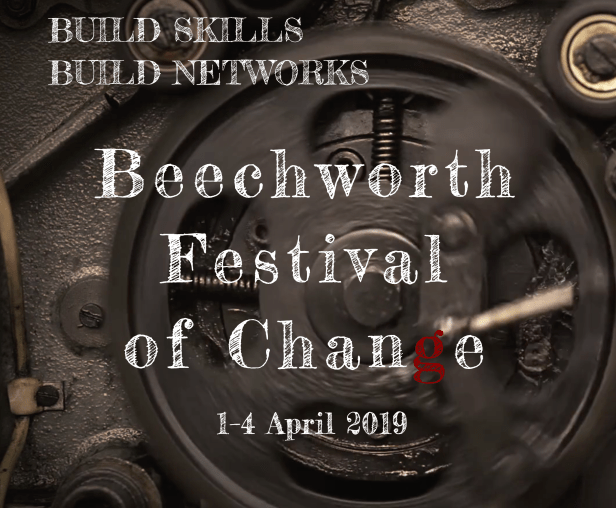
Soon, an inspiring week-long fiesta of events and creativity for campaigners and activists. The focus is on building skills and making connections. I’ll be there sharing some changeology and innovation tricks. To join in, start here: Festival of Change, Beechworth, 1-4 April
People love certain kinds of stories

I like this list of “content people crave” from marketer Scott Aughtmon: 21 types of content we all crave. It’s stuck on my wall.
Gee whiz
I’m in awe of Jessamy Gee. She just “graphically recorded” a Passion Mashing session for enviro volunteers at Knox City. All the complexity of the day went into her brain, and sprang out through her fingers, so quickly, so beautifully, and so well explained! I’m now a firm believer in the power of graphic recording and Jessamy is brilliant at it.

The more I do this work, the more I think the answer is… fun.
Fun is contagious. It destroys fear. It’s subversive (how many conservatives have a sense of humour?). It glues humans together. It’s brilliant medicine for the spirit. And it’s just the best ATTRACTOR…because everyone is already looking for it, all the time.
When we’re designing change projects we often ask “What do people NEED to KNOW?” But if we want to attract people, it’s good to ask: “What do people WANT to FEEL?” Or even better, get straight to the point and ask “How could we create delight or joy?”
The not-so-deep secret to making fun projects is to have fun when we’re making them!
Here is a fun project team… (hi Byron Bay scavengers).

 Of course our issues are serious and urgent and we’re resource-poor and under pressure. That causes worry. And worry causes tunnel vision.
So we need some tricks to get back to wide spectrum thinking where our natural creativity can flourish.
Here’s some of the tricks we use in the Changeology Masterclass.
(By the way, never try to be creative alone! It doesn’t work. Really. Get some friends or colleagues. Then try some tricks.)
Trick #1 Mashups
Ask your team members to think of activities they passionately love to do (knitting, bicycling, singing, cooking, tennis, board games…). Then say “Now mash that into our project. What would it look like?” It’s amazing how productive this process is!
Trick #2 Rules
Brainstorm with special rules to encourage playfulness. For example: “You have a actual magic wand.” “You can break the laws of physics”. “You can only think of ideas your manager would reject.” This helps people go beyond safe ideas.

Trick #3 Tools
In the Changeology Masterclass we use some tools to help us get into a creative place.
Like this “6-dimensional enchanting event constructor“. It reminds us of the wide spectrum of ways we humans like to have fun.
Trick #4 An inspiration collection
Another good idea is to have an inspiring library of fun ideas that just keeps growing. Below are some of my favourite engaging ideas from my own collection.
Happy fun-making folks!


