When we argue with people, we can be pretty sure their brains are arguing right back at us
The human brain is well equipped to rationalise current behaviours and defend comfort zones from the kind of arguments delivered by well-meaning educators.
Economists call this phenomenon the ‘sunk costs effect’. People make investments in certain courses of action and may defend those investments to the point of absurdity even when the prospective gains outweigh the benefits.
Hence educational campaigns that rely on reasons are likely to force people to voice counter-arguments. And the more they argue for a position, the firmer their position becomes.
As Miller and Rollnick explain in Motivational Interviewing, that’s exactly the opposite of what change makers should be doing:
“It is the client who should be voicing the arguments for change. When you find yourself in the role of arguing for change while your client (patient, student, child) is voicing arguments against it, you’re in precisely the wrong role.”
In sort, reasons tend to be counter-productive. There are plenty of alternative strategies, for example:

Hi all,
Inspired by Jono Hey’s excellent Sketchplanations, I thought I’d try explaining some Changeology concepts visually. It’s a bit of an experiment.


Looking back through old blog posts, I noticed a few that just seem so permanently relevant, I thought I’d share them:

A golden age of cruel and pea-brained social engineering
Why the Australian Government’s cruelty-based social programs will always fail (and bite back too).

Branded water bottles, pens, stickers, backpacks, mouse pads, key rings. A waste of money. So 20thcentury. Also, I hate them.

How to design a pitch even the grumpiest manager will say ‘yes’ to.
Register here for training

Here’s reminder to tell your colleagues about:
Two enjoyable mornings, 17-18 October.
FOR those designing engagement or change projects, small or large.
All details:www.enablingchange.com.au


Two interactive mornings, 24-25 October.
FOR those facilitating interactive workshops or forums, in any context.
All details:www.enablingchange.com.au
Designing SUSTAINED change always means intervening in systems. But what is a ‘system’?
To clarify what ‘system’ means, I’ve discovered/thought of 28 statements about systems.
Most of these are well known and can be discovered by Googling ‘system thinking’. Some are based on Donella Meadows‘ work and System Dynamics. Some are from books on resilience thinking. Some are my own.
1) A system is a set of components, or actors, that works as a whole to transform resources (inputs) into products and wastes (outputs).
2) Systems include cells, plants, ecosystems, catchments, people, communities, associations, corporations, institutions, states and economies, as well as non-living systems like factories and distribution networks.

3) Systems are often life support systems for their actors. What makes a system a system is the flow of information, energy, materials and services between the actors.
4) Systems are hierarchically nested within other systems. The actors of systems are themselves kinds of systems.
5) Although a system’s function is determined by its products, the goal or purpose of a human system depends on the worldviews of the actors and observers. One system can have many purposes, depending on the perspectives of the observers.
6) Efficiency, effectiveness, sustainability, resilience, productivity, addiction, health, sickness, and failure are all qualities or manifestations of systems.
7) Systems can be persistent or temporary (transient). Persistent systems (like associations, corporations and states) have specialised actors carrying out coordination functions. Transient systems do not.
8) Persistent systems, even poorly functioning ones, never give up until they die or are killed (their actors physically destroyed). This explains how human progress is slow and often generational: as J. K. Galbraith observed “like the Old Guard, the conventional wisdom dies but does not surrender.”
9) While some actors have coordination functions, no one is actually in control of a whole system. “While we can hold parts of the system in a certain condition, the broader system is beyond our command. Indeed, no one is in control; this is a key aspect of complex adaptive systems.” (Walker and Salt, Resilience Thinking p29)
10) Natural systems like cells and catchments are tangible. Human systems like communities, corporations and economies are intangible: their actors (individual humans) are bound together simply by agreed laws and social norms. Because human systems depend on the intangible mental states of their actors, their beliefs, values, goals and worldviews can be tremendously important and contested.
11) There are no such things as ‘externalities’. The boundaries of a system are entirely a matter of the convenience and biases of the observers. Who is in and who is out of a system is a subjective decision of the observer, which is why ‘window’ is a better term than ‘boundary’.
12) Closed system windows produce closed thinking (or silo thinking) with impoverished behavioural and cognitive repertoires which lower system adaptiveness. In-system actors are biased towards perceiving closed windows because that makes their decision-making easier.
13) Permeable systems welcome out-system actors. They are always more adaptable.
14) Systems are adaptive. Variation and novelty are constantly being added. Selective pressures are constantly driving evolution of individual components and the whole system.
15) Systems do not change in linear, predictable, incremental fashions.
16) Every system has the capacity to exist in a number of alternate stable states or regimes with different functions, structures and feedbacks. Sudden “regime shifts” can happen when shocks and disturbances push a system across a threshold into a different regime, frequently with unwelcome surprises. (Walker and Salt p31, p37)
17) How effectively systems adapt to changing environments and shocks depends on the timeliness of feedback loops, the existence of buffers, and the diversity of capabilities, ideas and ways of being. The more diverse the actors and abundant the buffers, the richer the adaptive possibilities.
18) Buffers of un-utilised resources, time, energy, are essential for adaptation and innovation. Buffers are also vital for system resilience. The larger the buffers, the more shocks a system can absorb before being pushed over a threshold into a different regime.
19) Diversity is also essential for resilience. “Functional diversity” means having a diversity of actors, each with a different response to changed conditions. This creates a wide repertoire of possible adaptive responses.
20) Systems that sacrifice diversity and buffers for optimised productivity have poor resilience. “Be aware that simplifying the system for increased efficiency reduces the system’s diversity or possible responses to disturbance, and the system becomes more vulnerable to stresses and shocks.” (Walker and Salt p123)
21) Systems always grow in size, resource consumption, and output, subject only to resource limits and competition from other systems. It is debatable whether expansion is innate to systems. However in turbulent, competitive environments with high unpredictability expansion is practically mandated by the actors’ innate need for safety.
22) Because a system’s actors are themselves systems that seek to expand, accumulating resources, information and energy, natural systems have complex feedback and control mechanisms to maintain internal balance (homeostasis) and limit the gain to dominant actors. Failure of these mechanisms leads to uncontrolled growth of some actors, starvation of others, and friction (conflict), reducing the overall productivity of the system.
23) Feedback loops are how systems manage their internal processes. Absent or poorly designed feedback loops lead to boom/bust oscillations.
24) A system is an entropy engine: it takes resources and splits them into a stream of more refined products (with lower entropy or disorder) and a stream of wastes (with higher entropy or disorder).
25) The products and wastes of natural systems are usually inputs into other systems. That’s what the ‘web of life’ means.
26) Systems always produce wastes. The ability of environments to absorb wastes depends on ‘sinks’ in the environment. Usually these sinks are themselves natural systems (for example carbon sinks are photosynthesis by plants and chemical and biological processes in the oceans).
27) System stability depends on resource stability. Cut, or dramatically increase resources, and the result is increasing internal conflict until the system passes a resilience threshold into a different stable state. This explains why discovering oil causes civil disorder, and why the inflow of New World silver pushed sixteenth century Europe into chaos.
28) The dysfunctions of systems are internal (siloing, failure of feedback loops, actors hoarding information and energy), or external (exhaustion of resources, competition, pollution of the environment by wastes).
There. That’s a pretty thorough definition of “system”.
Dear readers: Can you think of any more statements? Have I got anything wrong?
]]>
Lots of people have opinions about behaviour change, but Alan AtKisson is the real thing…a corporate change guru who’s been inspiring people for decades.
Here’s a Triple Pundit article from a participant in one of his workshops who took away three invaluable tips for changing the world:
An excerpt:
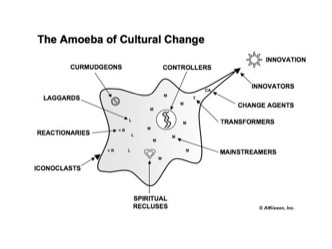
“AtKisson uses the metaphor of an amoeba to reflect the different roles people play within a system and how they affect decisions to adopt, ignore or resist new innovations…
He has identified a range of roles, including:
the Innovator, the person who invents a new idea, but is often overly enthusiastic about it;
Change Agents, people skilled at repackaging ideas and convincing people to try or adopt them;
Transformers, organizational gatekeepers who are interested in new ideas, but selective about which ones they allow past their filters; and
Mainstreamers, who tend only to adopt a change when all the incentives line up and when the people around them are all doing the new thing.
Then there are the Controllers. The advice was stay out of their way so they don’t kill an idea too soon!
Curmudgeons are pessimistic about change and can zap your energy…
While ignoring the Reactionary and Curmugdeon is a solid strategy, don’t forget to bring others along that eventually will be your allies.
The take home message–a Change Agent needs to create alliances with Innovators and Transformers and avoid the negativity of Crumudgeons, Laggards and Reactionaries. AtKisson concludes Chapter 9 of his book by saying, “Life is too short, and the stakes are too high, to waste time trying to sell ideas to people who oppose them, resist them or kill them – or who will sap a Change Agent’s energy.”
]]>
“To increase the success rate you have to increase the failure rate.”
I said: “Did you think of that yourself?”
She said: “Yes.”
I said: “Just then?”
She said: “Yes.”
I said: “Can I use it?”
She said: “Yes.”
To increase the success rate you have to increase the failure rate. Something to carve on the heads of politicians and bureaucrats who are terrified of risk.
Failure is good. It’s how you learn. The only real failure is a failure to learn from experience.
Which reminds me of my friend Geoff Brown’s comment on a previous post which read:
Lately I have been communicating the need for a mindset shift to tackling these complex problems. Like you say in this post, we need to be trying lots of different things and be aware that most of them will fail. Dave Snowden (Google Cognitive Edge) talks about a shift away from Fail-Safe strategies (where control of outcomes is assumed) to Safe-Fail strategies (where failure won’t end in disaster, but we quickly learn from them). I like Clay Shirky’s quote on this when he talks about the complexity of getting stuff to spread on the internet … “We need to learn to try lots and lots of new things and fail informatively so that you and others can find a skull on a pikestaff somewhere”.

Here’s why:
Of course you can market brands. But behaviour change is not like buying a different brand of beer, it’s about getting people to DO THINGS THEY ARE UNCOMFORTABLE WITH, DON’T WANT TO DO OR CAN’T DO, or they would already be doing them. Like parents letting their kids walk to school, or smokers quitting, or drivers switching to public transport.
These kinds of social, health and environmental behaviours are intractable because they are part of complex, “wicked” or messy social problems. That’s why they are still with us. They are intractable for very good reasons: they are fixed firmly in place by a powerful matrix of institutional, technological and social factors. To be effective change programs must therefore do more than just communicate persuasive messages, they must aim to modify those factors.
Paul Stern of the Division of Behavioral and Social Sciences and Education of the UK’s National Research Council explains that many behaviours are simply not amenable to voluntary change: [i]
“This pattern of [contextual] influences implies that effective laws and regulations, strong financial incentives or penalties, irresistible technology, powerful social norms, and the like can leave little room for personal factors to affect behavior…”
In other words, when people have very little choice how they act, structural changes (like regulation, pricing, infrastructure, service provision, governance reform, social innovation, and technological innovation) should be the preferred approaches.
He goes on to say that: “[however] when contextual influences are weak, personal factors…are likely to be the strongest influence on behavior.” However, if we are realistic, there are very few situations where contextual factors are weak. Every personal decision is thoroughly embedded in its context. Even a simple voluntary behaviour like “turning off the lights” is determined by technology and pricing.
The fact is, every effective social change effort has been predominantly structural. Improving the anti-social behaviour of drinkers, for instance, has required collaboration between police, community leaders and licensing authorities; physical re-design of venues; modified management practices; training for staff; advocacy; political leadership; and legislative change. Marketing has been the least important factor in the mix. Most solutions to “wicked” problems are like this. They involve multi-faceted strategies, and are very much about building relationships and re-designing practices, places and institutions, with marketing taking an important supportive role.
Of course there’s nothing wrong with good marketing. It’s a vital part of the mix. It spreads knowledge, creates interest, helps get people buzzing, and helps spark political action so that politicians get busy with the work of changing institutions and supporting technological innovation. It is an important handmaiden of change, but not the driver.
Let’s be clear what Social Marketing is
Social Marketing [ii] (SM) is a way of planning communication programs that aim to influence human behaviour. Community-based Social Marketing [iii] (CBSM) is a variant that includes influence techniques drawn from social psychology. Communication for Behavioural Impact [iv] (COMBI) is another variant that’s been designed for developing countries.
One of the most commonly heard definitions of SM is:
“Social Marketing is the application of commercial marketing technologies to the analysis, planning, execution and evaluation of programs designed to influence the voluntary behaviour of target audiences to improve their personal welfare and that of society.”[v]
The practice of SM (and SBSM and COMBI are very similar) is said to consist of:
1) Start with a specific behavioural goal.
2) Conduct research with the target audience(s).
3) Be informed by psychological theories or models.
4) Tailor your efforts to suit the needs of the target audience(s).
5) Consider the 4 Ps: Product, Price, Place and Promotion.
6) Offer personal outcomes that the audience values.
7) Address the influence of competing promotions.
This reads like applied common sense. You wouldn’t want to design a communication campaign any other way. Perhaps the excitement that surrounds SM is partly due to what it replaced, which was a complete lack of method in the design of health promotion efforts.
What’s the evidence for Social Marketing
As far as I can find, there has been only one systematic review of Social Marketing practice.[vi] This 2007 review, funded by the UK’s National Social Marketing Centre, analysed the results of 54 Social Marketing programs focusing on alcohol, tobacco, illicit drug use and physical activity.
The researchers concluded, in part: “A majority of the [youth] interventions…reported significant positive effects in the short term. Effects tended to dissipate in the medium and longer term… These results are broadly comparable wit
h systematic reviews of other types of substance use prevention interventions. The evidence is more mixed for adult smoking cessation, although small numbers of programs were nonetheless effective in this area.”[vii] [my emphasis]
In other words, these SM programs were found to be about as effective as interventions not based on SM methodology, which, I assume, means other kinds of educational interventions.
Notably, 48 of these 54 programs relied substantially on face-to-face tactics, like counselling and peer support, in addition to mass media. The results therefore can’t be extrapolated to the great majority of Social Marketing campaigns, which consist primarily of mass media efforts. Since face-to-face interaction generally has far greater personal impact than mass media communication, this systematic review probably overstates the effectiveness of SM.
So what does work?
Let’s take the three behavioural challenges which have a strong emerging evidence base about what works and what doesn’t work: tobacco cessation, road safety, and obesity prevention.
What reduces tobacco smoking?
According to a 2000 US National Cancer Institute study, media campaigns can produce reductions in smoking, “but only when the rest of the social structure actively changes the environment of the smoker.” [viii]
A 2001 World Health Organisation review of anti-smoking campaigns from 9 countries and 6 US states and concluded that media campaigns can work when combined with counseling services, price increases, advertising bans and indoor smoking bans, and plenty of news stories. [ix]
A 2004 review concluded “substantial evidence indicates that higher taxes and clean air laws can have a large impact on smoking rates. Evidence also indicates that media campaigns when implemented with other policies are important.” [x]
What reduces road accidents?
The World Health Organisation’s 2004 “World Report on Traffic Injury Prevention”, an authoritative global review of road safety interventions, does not mention SM, but notes “when used in support of legislation and law enforcement, publicity and information can create shared social norms for safety. However, when used in isolation, education, information and publicity do not generally deliver tangible and sustained reductions in deaths and serious injuries.” [xi]
A 2004 systematic review into the effectiveness of anti-drink-driving programs concluded that mass media campaigns that are carefully planned and well executed, that reach a sufficiently large audience, and that are implemented together with other prevention activities – such as highly-visible enforcement – are effective in reducing alcohol-impaired driving and alcohol-related crashes.[xii]
Summarising the evidence, Woolley (2001) [xiii] concluded that mass media advertising, when used alone, is unlikely to bring about significant road user behaviour change. However, advertising was found to play an important role in supporting other road safety activities, in particular enforcement.
Barry Elliott, a Australian researcher who carried out a systematic review of road safety campaigns, summed it up pithily: “you can’t sell road safety like soap.” [xiv]
What reduces obesity?
A recent US National Research Council report, Local Government Actions to Prevent Obesity provided a nice summary of the kinds of interventions that have the greatest potential to tackle childhood obesity. According to the press release: “Many of these steps focus on increasing access to healthy foods and opportunities for active play and exercise. They include providing incentives to lure grocery stores to underserved neighborhoods; eliminating outdoor ads for high-calorie, low-nutrient foods and drinks near schools; requiring calorie and other nutritional information on restaurant menus; implementing local “Safe Routes to School” programs; regulating minimum play space and time in child care programs; rerouting buses or developing other transportation strategies that ensure people can get to grocery stores; and using building codes to ensure facilities have working water fountains.”
In other words, if we wanted to run a comprehensive anti-obesity program then the skill mix would include an incentives manager, a regulator, a building code planner, a nutritionist, a transport planner, an educator (and a courageous politician or two to drive these changes) but not a marketer.
So what, exactly, is wrong with social marketing?
Social Marketing is a system of practice that does many things well. The problem is it what does not do well.
1) Just following orders
SM almost invariably assumes the prescribed behaviour or action is right, just, appropriate, and do-able. SM rarely goes behind the funding agency’s brief, so we have:
“Just think.” (the AFL’s anti-alcohol-violence campaign);
“Quit now before it’s too late” (Australian Gov
ernment’s tobacco campaign)
“Slow down stupid.” (Queensland’s anti-speeding campaign).
SM takes it as given that the particular behaviour should be adopted and can be adopted. It does not ask whether the prescribed behaviour make sense, whether it is capable of being adopted or whether it needs to be reinvented, matured, debugged, or replaced with an entirely different behaviour.
For instance, California’s anti-drug campaign has now abandoned the typical “Just don’t do it” or “Talk to your kids” approaches and opted for a far more subtle “Dinner makes the difference” approach, where the behaviour is simply to have dinner with your kids. This requires a fundamental re-think of the problem and the solution. We simply do not see this in typical SM programs where the funding agency’s assumptions are rarely challenged.
(The reason, of course, is the structural separation, in separate silos, of the policy-bods and boffins who devise strategies, the health workers who implement them, and the educators and marketers who communicate them.)
2) Context blindness
SM and CBSM are tokenistic in their treatment of context. Context, as we discussed, is central to the adoptability of behaviours and products. It’s more than the usual cursory consideration of the 4 Ps: “product, price, place, promotion”. Instead the entire contextual system needs to be the subject of strategizing and modification, including physical infrastructure, service design, place design, management and regulatory systems. Getting these right is usually what makes or breaks a change program, as we’ve seen in tobacco control, road safety, pollution control and littering.
This work can only be done by multi-disciplinary teams using a system-based approach. Again, it’s easy to see how silos enforce dysfunction here, and busting or bypassing silos is the prerequisite for effective systemic interventions.
(By the way, this is not nearly as hard as it sounds. For a rapid method for identifying doable interventions in a whole system, see How to make a theory of change.
3) Crop spraying
SM, as almost universally understood and practiced by governments, is all about big budget mass media advertising. This approach treats people as isolated individuals and sprays them from afar with messages the same way a crop duster sprays a crop of canola. But who still thinks that human societies change this way?
Fifty years of Diffusion of Innovations scholarship and more recent social network studies (notably the remarkable work Nicolas Christakis and James Fowler on the diffusion of obesity, happiness and smoking cessation through social networks) demonstrate that decisions to adopt new behaviours travel primarily along social networks of people who know and respect each other, on a wave of conversations, and mass media has very little to do with it.[xv]
The programs that are likely to influence voluntary behaviour change are therefore those based on fine-grained, conversational, local approaches (like facilitated workshops, forums, field days and the like). Unfortunately, the advertising agencies that win big budget SM campaigns have no incentive to share this insight with their funders.
4) Theory fetish
It’s a fine thing to have our thinking expanded by psychological and change theories, but it’s another thing to arbitrary impose a particular psychological theory on a real life behaviours of real people leading complicated lives in the real world. It’s quite common to see social marketing and health promotion programs introduced with a statement that “this program is based on the Transtheoretical Model” or the Health Belief Model or Social Learning Theory, or whatever. Excuse me, but this is crazy. The theory of change that informs a program should come from one place only – the reality of people’s lives, and it will be very different for each set and each setting and each moment in time. Generic theories and models can help us “see” better as change agents, but only by getting to know people face-to-face and listening intently to their stories can we begin to construct solutions to their needs.
Craig Lefebvre, a perceptive internal critic of Social Marketing, is clear on this when he writes that “One principle that distinguishes the best social marketers, I believe, is an unrelenting understanding, empathy and advocacy of the perspective of our priority population or community that is not slanted by what the theory or research evidence does or does not tell us.” [xvi]
5) Power blindness
SM and CBSM campaigns tend to be one-sided exercises in power by government-employed professionals who decide what behaviours are wrong, what behaviours are right, who needs to change, and what they need to know. Only problem is: people HATE being given advice by strangers about how they should behave. SM and CBSM don’t even begin to have answers for the waves of denial and resistance that are evoked by well meaning attempts to tell people how they should live their lives. See, for instance, the literature on psychological reactance [xvii] and the Boomerang Effect. [xviii]
Many SM programs have figured out a way to remain oblivious to denial and resistance: they evaluate their efforts at the level of awareness. Awareness, however, cuts both ways. Awareness may help drive change, but it is just as implicated in driving people to do the opposite to what they are told. There’s plenty of evidence, for instance, that marketing efforts may reinforce good behaviour amongst those who are already doing the right thing, but drive greater denial and/or resistance amongst the actual target audience.[xix] Even a seemingly benign effort like asking householders to calculate their ecological footprints has been shown to produce this effect. [xx]
6) Message Fetish
Lastly, SM and CBSM have “message fetish” embedded deep in their genomes. Marketing has always been an art of mass communication. It is concerned, above all else, with language and image. It will always be, for better or worse, about the magic of the message. It’s hopelessly infected with the assumption that the right form of words is the key to the human psyche. If it was that easy we’d all long ago have been living in paradise (or, more likely, hell). It just ain’t that way.
And my point is…
I don’t discount the utility of SM, CBSM and COMBI as communication practices, but as social change practices they fall short. The halo of omnipotence that currently surrounds them is unwarranted. They are a valuable support practices, not the messiah.
There is nothing wrong with marketers being involved in designing change programs. They bring a valuable set of skills and perspectives. In fact a change program that doesn’t involve marketers is probably only slightly less problematic than one that is run entirely by marketers.
However, the ability to change the world will never the shining glory of any one discipline. Successful change efforts happen when engineers, planners, politicians, regulators, facilitators and marketers step out of their cosy professional fugs, mix it up with each other, let their assumptions be challenged, be prepared to defend those assumptions with evidence, and invite the public to genuinely collaborate in this process. That’s when the shining glory begins.
If not SM, then what? I don’t think the alternative is rocket science, just a little uncomfortable:
1) Get the “who” right first
Bypass silos, work in multi-disciplinary teams, and invite the users to share the big decisions with you.
2) Get inspired by what works elsewhere. Don’t start till you’ve got lost in Google and Google Scholar a few times and been genuinely excited by the methods others have used, no matter how unfamiliar.
3) Listen to users and non-users and don’t stop listening till you’ve been startled or confronted by what you hear.
4) Notice your own power and actively share it around, especially with those whose behaviour you hope to change.
5) Think in terms of systems. Map the system and don’t limit your palette of interventions.
6) Get all those who can make a difference around the table before you start planning. Let them share the thinking, the planning and the credit.
7) Intervene in the context. Act to modify the environments in which people make their decisions, and then use communications to draw peoples’ attention to those changes and model appropriate behaviours.
8) Be ready to abandon your own assumptions, even the ones you don’t know you have.
What would an effective process for designing a social change program look like? I’m done my best to evolve one over the last few years. It’s available on my website, see The Enabling Change process.
v2.2 Les Robinson, December 2010
For more detailed critique of Social Marketing, see:
Tilbury, D., Coleman, V., Jones, A., MacMaster, K. (2005) A National Review of Environmental Education and its Contribution to Sustainability in Australia: Community Education. Canberra: Australian Government Department for the Environment and Heritage and Australian Research Institute in Education for Sustainability (ARIES), pp17
http://www.aries.mq.edu.au/pdf/Volume3_Revised05.pdf
http://www7.nationalacademies.org/dbasse/Environmental%20Law%20Review%20PDF.pdf
http://www.cbsm.com/pages/guide/introduction
http://en.wikipedia.org/wiki/Robert_Cialdini
http://www.emeraldinsight.com/Insight/viewPDF.jsp?contentType=Article&Fil…/Output/Published/EmeraldFullTextArticle/Pdf/1421070203.pdf
[vii] p180. Oddly only six of the 54 programs relied entirely on typical marketing methods, the rest included methods that no one would define as “marketing”, including counselling, smoking cessation groups, community organization, peer education, classroom lessons, training, citizen taskforces, buddy support, summer camps, exercise classes, and construction of walking paths. Only two, however, used any structural or regulatory methods, which is the point.
[x] David T. Levy, Frank Chaloupka, and Joseph Gitchell (2004) The Effects of Tobacco Control Policies on Smoking Rates: A Tobacco Control Scorecard, Journal of Public Health Management Practice, 2004, 10(4), 338–353
[xii] Elder R.W. et al (2004) Effectiveness of mass media campaigns for reducing drinking and driving and alcohol-involved crashes: a systematic review. American Journal of Preventive Medicine 27(1) p57-65
[xiv] Elliott, B. (1993) Road Safety Mass Media Campaigns: A Meta Analysis, Department Of Transport And Communications, Federal Office Of Road Safety
[xv] Social marketer Craig Lefebvre has written a nice series of blogs on putting the “social” into social marketing.
[xvi] http://socialmarketing.blogs.com/r_craiig_lefebvres_social/2009/11/getting-social-marketing-wrong-in-health-behavior-and-health-education.html


That all sounds like great advice!

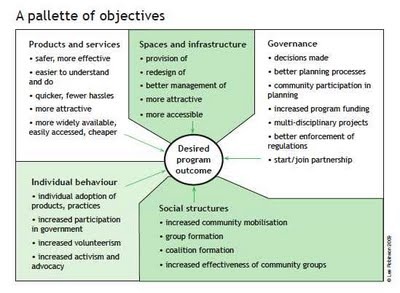
It’s a hell of a job thinking outside the square. One thing I’ve noticed in strategic planning sessions is that educators often have trouble thinking beyond “awareness”, PR types beyond “change attitudes”, engineers beyond “building stuff”, planners beyond “plans of management” and so on.
So here is a crib sheet for those participants who need a little help to think outside their professional bubbles. It’s at http://www.enablingchange.com.au/crib_sheet.pdf I especially designed it for Step 3 in the Enabling Change process, where a diverse group of participants select intervention points in the “system of improvement” (a.k.a. “program objectives”). There are just so many ways to change the world!

TRANSLATION: When people don’t really have much choice about their behaviours, focus on structural change.
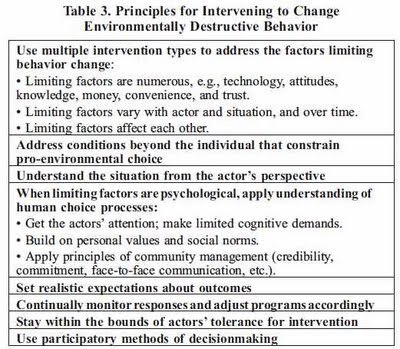
He also suggests some principles for designing interventions:
“The complexities of person-situation interactions and a careful reading of the research lend support to a set of general principles for behavior change such as listed in Table 3.