Here are 3 infographics that look deeper.


Here is a model checklist for planning a workshop, forum or summit.

I seriously regret not including this in my training until now. So, to make up for it, I’ve piled many years of hard-learnt savvy into a one-pager for graduates and colleagues.
There are big red circles around the items I’ve found to make a huge difference, but are easy to forget. (Even last week I let a speaker into an online workshop without briefing them, and, of course, they bored everyone with fantastic amounts of irrelevant detail… I kicked myself.)
I love checklists – they can be fabulous repositories of practical knowledge.
This checklist is optimised for a large-scale multi-stakeholder strategic forum, but it will work for a humble training event as well – any gathering that aims to bring minds together for a purpose.
It’s a long one-pager… maybe you can print it out and sticky-tape the two pieces together to make a little wall poster.
And please pass it on – the world needs more skilled facilitators.
Download the PDF here: www.enablingchange.com.au (there is nice set of facilitation resources developing here.)
Warm regards – Les
]]>

Surprising things heard in workshops
How Susan learnt to save money. Saw her uncle save every $5 note he received in a locked change box. When she decided to save she did the same thing with every $2 coin she received. The first time she emptied her jar there was $846. “That’s how I’m saving for a home deposit.”
“I used to walk around the office turning off lights at the end of each day. One day an employee I’d never spoken to said: ‘You’ve gotten inside my head’.”
“When council lends its marketing to community events we get a 50-100% increase in turnout.” – Geelong Council’s environment manager
“There is a moral advantage in not using contract labour. The landholders look after the sites more.” – Libby, Three Creeks Landcare Group, Vic.
A facilitator who carefully said “Welcome Bruce, or Melissa.” after every introduction.
The power of calling people out for bad behaviour: Marc McKenzie of RARE Consulting told about facilitating a meeting for wind, solar and gas industry stakeholders. The aim was to develop a common case for extending the Australian Government’s renewable energy target. But for the first 2 hours “all they did was argue about their differences”. Before morning tea Marc made this announcement “There’s clearly no consensus here. I can’t see any point in continuing this meeting unless you tell me otherwise.” Morning tea lasted 45 minutes and then the three industry association CEOs returned to Marc with an common agenda for the rest of the event, which lasted 2 instead of 3 days and resulted in a four page manifesto signed by all 3 CEOs.
Some rough-and-ready criteria for assessing a community change program (from discussion with WA Dept of Transport staff)
– I’d want to go even if I wasn’t being paid (“magnetism”)
– I’d want to tell my friends and neighbours about it.
– Legacy value (leaves a permanent benefit for the community)
– Addresses real community frustrations
– Connects people to people
– Reach per $
– Likely number of participants per $
Notes in the margin
Russell Brand’s arresting frankness at a Parliamentary committee on drug policy.
– How Methadone keeps people helpless and in the drug cycle.
– Treat addiction is an illness not a crime problem. Support people.
– Recognise that abstinence is the only solution for addicts.
Dumb Ways to Die, Melbourne Transit’s beguilingly fun way to make a point about train safety went massively viral, with 43 million hits between Nov 2012 and March 2013. Creator, John Mescall, from ad agency McCann Worldgroup Australia, said its “conservative” estimate was that the campaign had generated $50 million in “global-earned media value” so far, in addition to more than 700 press hits. “The old ad is on the way out, it’ll never entirely die out. More and more of what we do is designed to live online…” More.

Two cool social marketing campaigns I liked:
Dear Coal, we need to talk…
They will come for us
Stuff that’s out there:
How can I…
Set up a campaign website? Do Gooder lets activists set up fully featured campaign websites for free. By Digital Eskimo.
Organise a petition? Go to Change.org, an online petition platform.
Consult with really busy people? Just ask a minute of their time. A neat, and much-needed, community engagement idea from US-based agency, Local Projects.
Make public place recycling fun? Make it a game: a magnificent idea, simply realised in Lucerne, Switzerland. Lucerne Shines!!

Make a better mission statement? Forget your mission statement, instead ask: What’s your mission question? A thought-provoking article in Fast Company.
Start a business?
– Open a complete online store through Squarespace or Storenvy.
– Automate a vege box business with Bucky Box…just grow the food and find the customers.
– Create an exchange network to buy/sell food from local growers with Good Eggs.
Raise funds for a good idea? Circle Up, ProHatch or KickStarter.
Communicate your values? It’s just an advert, but one that sets a standard for employees as well as its customers. Keep in mind that, if you market your values, you’ll be under much stronger scrutiny from your customers to live up to them.
Inspire community action? Singapore’s National Environment Agency recently used OpenIDEO to answer to the question: “How might we inspire and enable communities to take more initiative in making their local environments better?” The result: 271 Inspirations; 102 concepts; 20 final concepts and one winner.
Involve kids in bushcare or Landcare? BushKids, an inititative of Lane Cove Bushland and Conservation Society; “I couldn’t believe my eyes, 7 year old planting trees from tubes and caring for toddlers.” There’s a waiting lit to join. And the mothers started their own bushcare group.
Get inspired by street art?

Tackle community violence? Cure Violence demonstrates the power of switching your paradigm. Instead of seeing violence as a crime, they saw it as an infectious disease. They are now running anti firearm violence programs in 12 US cities. “Violence is like a disease and can be treated like one.” Their method borrows from epidemiology:
1) Interrupt transmission. For example, employ an “interruptor” who detects and intervenes with “infectious” people where violence threatens to break out in a community. They are trained network of leaders to talk to people who’ve committed violence.
2) Change the thinking of the next likely transmitters of violence. Using outreach workers who talk to high risk individuals, modelling, practicing better responses to situations, eg. reducing retaliations, encouraging gang members to go back to school.
3) Change group norms. Use multiple messengers to change the conversation around violence in a community.
Manage a small team? Trello: a very neat platform that lets a small team manage its workflow collaboratively.
]]>
Everybody got a one-quarter A4 size sticker with the following printed on it:
Name:
I’m good at:
I love:
I’m looking for:
I asked them to work in pairs, helping their neighbour to figure out how to fill them in. Then we quickly went around the room and everyone simply called out the words they wrote.
It was delightful, funny, and broke the ice superbly. And it was also quick – which is important when there’s a lot of people present.
Here’s now they looked (names concealed).


A quote:
Honour the gathering. In this ever more interrupt-driven digital world, it’s a challenge to bring together all the right people at the same time to think, make and solve problems that are too complex for just a few people to figure out. Gatherings of this magnitude need opening ceremonies to acknowledge the value of the time we are about to spend together. Typically these ceremonies don’t include marching bands or fireworks (although that would be cool), but there are small and simple actions that help us all recognize that this is a sacred time. These small things include sending out invitations ahead of time, providing food and drink, creating an environment where people can focus without laptops or smart phones, welcoming and orienting people to our day together, and having the client sponsor begin the workshop with essentially an opening blessing for the people gathered and the work we will accomplish.
http://adaptivepath.com/ideas/the-ux-of-co-design-experience-principles-for-s…:19:09:33Z
]]>Of course, innovation seems to be all about expensive consultants and time consuming processes. The challenge for the rest of us is to remake innovation/design thinking so we can apply it to our garden variety cash- and time-starved council or agency projects.
Recently, the City of Sydney cycling team asked me to facilitate a brainstorm for a campaign get cyclists using their bells and generally behaving more considerately on shared paths.
My response was: “If you have a brainstorm, you’ll get a slogan. Why not try something more interesting?”
So, instead of one 2-hour brainstorm, we took three mornings, a week apart. We invited a diversity of people along, 19 in all, including council staff, shared path users, interested players and experts.
Here’s what we did:
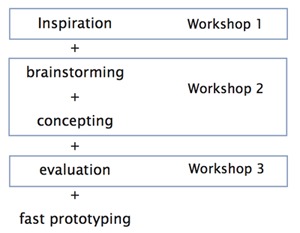
Morning 1: Information and inspiration
We briefed the participants on:
– the results of the social research and field observation council had previously undertaken on shared paths;
– our theory of change, which was that “if cyclists believe bell use is expected by other shared path users, then bell use will increase”; and
– inspiring campaign ideas from overseas, including ideas completely unrelated to cycling.
Morning 2: Brainstorming and concepting
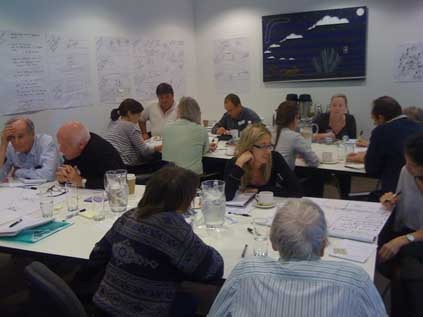
In four teams, with the theory of change in mind, we went through a series of brainstorms that generated 12 different concepts for the campaign.
Here is how the workshop looked:
Morning 3: Evaluation A smaller group sat down, decided on criteria for assessment, and sorted through the concepts, coming up with a “winning set” – which is depicted in the illustration below.
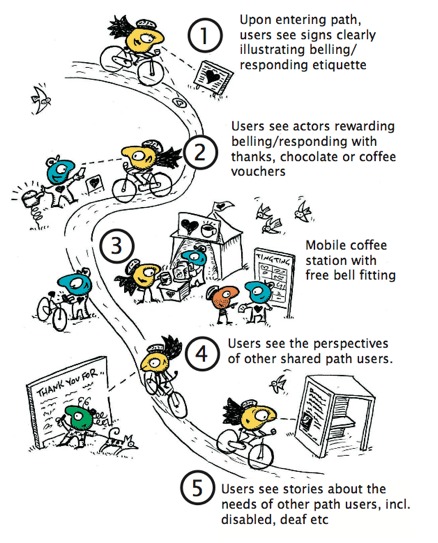
In a spirit of openness the City of Sydney team have given me permission to share the full briefing, brainstorming process and 12 initial concepts. They’re all in the PDF file that appears at the end of this post.
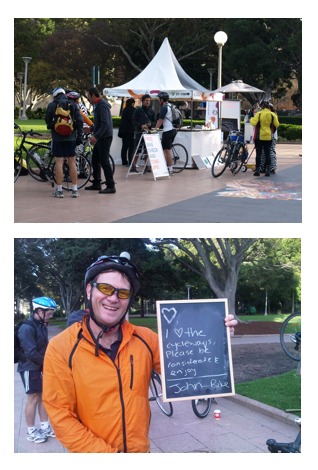
Fast prototyping followed. On the principle of “fail early” we asked “What can we put in the field next week, even if we have to draw it by hand?” Actually, we had to wait a couple of weeks for benchmarking (measuring how many people already use bells etc) to be completed. The fast prototyping is now under way.
When it’s finished, we’ll ask: what have we learned? Then we’ll improve the recipe and repeat.
Here is the fast prototyping schedule. Maybe they’ll see you there!!!
Week 1 – 2: 21 – 23 June and 28 – 30 June (Tues, Wed, Thurs AM 7:30 – 9:00am) Where: College Street Shared path, across from St Mary’s Cathedral and down from the Archibald fountain.
Week 3 -4: 5-7 July and 12-14 July (Tues, Wed, Thurs AM 7:30 – 9:00am) Where: Cleveland Street Shared Path, Moore Park (near the Golf course exit).
Week 5-6: 19-21 July and 26 -28 July (Tues, Wed, Thurs AM 7:30 – 9:00am) Where: Prince Alfred Park, Chalmers Street entrance.
Overall: I’m pleased with this attempt at innovation-for-the-rest-of-us. It was a little more time consuming than a standard brainstorm, but the results speak for themselves. It activated the three necessary conditions for creativity: diversity of participants; informed and inspired participants; and enjoyment. And It came up with ideas that could never have arisen in a garden variety brainstorm.
What would I do differently next time? I think I’d work even harder to activate creativity. I’d start with a quick game to activate playfulness. Then I’d have a short “getting in the mood” brainstorm where the rule was that the answers had to appear ludicrous to the speaker. I think that would loosen people’s imaginations up even faster.
Here are some photos from the first day of fast prototyping.
]]>

Is enjoyment the secret to creativity, imagination and productivity?
Reading Switch by Chip and Dan Heath (easily the best of the rush of change books that have hit the market in recent years – honestly, just go ahead and order it), I got excited by their reference to the work of psychologist Barbara Fredrickson. She asked “What good are positive emotions?” and the answer is amazing.
To start with, Fredrickson was intrigued by an experiment by Marcial Losada who observed business teams developing their annual plans. He used one-way mirrors and had his research team categorise every utterance they made. Strikingly, the biggest factor that predicted successful performance by each team in following months was the number of emotionally positive remarks they made.
Fredrickson looked for other research into the effect of positive emotions on performance and wrote an article called What good are positive emotions?
Quoting Chip and Dan Heath, ”Among the studies Fredrickson cites: Doctors experiencing positive emotions solve a tricky medical dilemma more flexibly and quickly. Students in a positive mood devise more innovative solutions to a technical challenge. Negotiators in a positive state of mind are more successful and creative negotiators; they find “win-win” solutions more often. Positive emotion also makes it easier for people to make connections among dissimilar ideas, and it makes them less likely to slip into an “us versus them” mentality.”(p279)
Fredrickson called her theory the Broaden-and-Build Theory of Positive Emotions and summarized it like this:
“positive emotions broaden an individual’s momentary thought-action repertoire: joy sparks the urge to play, interest sparks the urge to explore, contentment sparks the urge to savor and integrate, and love sparks a recurring cycle of each of these urges within safe, close relationships. [This contrasts with] the narrowed mindsets sparked by many negative emotions…such as attack or flee. By broadening an individual’s momentary thought-action repertoire – whether through play, exploration or similar activities – positive emotions promote discovery of novel and creative actions, ideas and social bonds, which in turn build that individual’s personal resources.
Fredrickson then asked an interesting question: How much positive emotion makes the difference?
Teaming up with Marcial Losada, they showed that the flip in performance is likely to happen when the ratio of positive to negative emotions exceeds 3:1. In other words, three positive emotions for each negative emotion. Below three, they wrote, people tend to languish in a self-absorbed, predictable rut. Above three they tend to flourish, becoming “generative, creative, resilient, ripe with possibility and beautifully complex.”
If you’re acquainted with Martin Seligman’s work on Positive Psychology, you’ll immediately see the parallels.
Tellingly, the ratio does not have to fall much below 3:1 before the decline sets in. A ratio of 2.3:1 was enough to pitch people into a rut.
And interestingly, they also found that too much positivity might be a bad thing. When the ratio exceeds around 11:1 the “dynamic of human flourishing” starts to disintegrate. It seems we all need a little negativity and conflict in our lives.
So, 3:1.
I think it’s a exciting number and I’m telling everyone about it.
It suggests you can shift a group towards creativity simply by increasing their en-joy-ment while they’re doing an activity so that positive emotions exceed negative emotions by more than 3:1, something that ought to be quite easy for a facilitator or leader to accomplish, for instance with a light-hearted touch, food, games, ground rules against negative remarks, and processes that focus relentlessly on positive outcomes, assets and strengths.
So here’s my theory of change for maximising the innovativeness and creativity of groups:
D + II + E = INNOVATION and CREATIVITY
Where:
D = diversity of participants’ values and life experiences, so they can challenge each others’ assumptions;
II = informed and inspired participants, so the boundaries of their narrow life experiences are blown away; and
E= en-joy-ment.
And it gets even deeper. Watching a team brainstorming a tricky creative challenge last week, I saw their knitted brows and unhappy faces until the moment they got their first creative spark. Then they started laughing, and the happier they got, the more creative ideas flowed, making them even happier until they were a five person riot. I noticed it was a two way flow. Happiness increased creativity. But creativity also increased happiness! It’s easy to reflect that, once a group experiences success on a creative task, it’s a virtuous circle.
Fredrickson, B.L. (1998) What Good are Positive Emotions? Review of General Psychology 2 pp300-319
http://www.unc.edu/peplab/publications/what_good.pdf
Fredrickson, B.L. (2004) The broaden-and-build theory of positive emotions, Philosophical Transactions of the Royal Society 359 pp1367-1377 http://www.ncbi.nlm.nih.gov/pmc/articles/PMC1693418/pdf/15347528.pdf
Fredrickson, B.L and Losada, M.F. (2005) Positive Affect and the Complex Dynamics of Human Flourishing, American Psychologist 60(7) pp678-686
http://www.unc.edu/peplab/publications/human_flourishing.pdf
I can see it working exceptionally well if there are set times for it, and the tweets are projected on the conference screen, and screened around the venue.
http://www.triplepundit.com/2011/01/masdar-abu-dhabi-tweetup/?utm_source=feed…
]]>