
Reading Dan Heath’s Upstream has got me thinking about how we could do better at designing projects that change systems (as opposed to changing people).
I’m worried that ‘system change’ tends to get neglected in smaller behaviour change projects. Which is a shame because system changes are the ones that are likely to generate sustained results, and why are we doing this if we don’t want to leave long term legacies? (In fact, isn’t that the whole point?!)
But just saying “please think in terms of systems” probably won’t help our project teams. Merely thinking about systems is liable to get our people dwelling on vague overwhelming forces beyond their control (like ‘capitalism’), which encourages helplessness.
We need a more subtle approach – one that’s a followable process and fits smaller projects where time and budget are at a premium.
So… here’s a little 4-step Systemology tool that aims to build more wholistic system thinking practice into project design.
It’s partly based on the work of Donella Meadows, surely the mother of systems thinking. And influenced by Dan Heath’s Upstream.
I hope it inspires! Feel free to share it around, and loop me some feedback.
You can download the PDF from my homepage: www.enablingchange.com.au
All the best – Les

That sentence has me rivetted.

I’m reading Dan Heath’s Upstream, a readable and memorable take on systems thinking.
Dan Heath (and his brother Chip) have an uncanny knack of converting potentially bamboozling ideas into memorable ‘ah-hahs’.
They also have an unerring nose for choosing subjects that need unpacking. Look at their bookology:
Made to Stick (devising contagious messages)
Switch (designing change programs that work)
Decisive (how groups make better decisions)
The Power of Moments (what’s special about moments of personal change)
These titles are practically a stand-alone curriculum for change makers.
Anyway, back to Upstream.
The title comes from a parable: ‘Stop rescuing drowning kids, instead go upstream and stop whoever is throwing them in the river.’
So, I’ve just read his pages about how Iceland tackled epidemic youth drunkenness.
“The first step, as in many upstream efforts, was to surround the problem by bringing together the people who could contribute to a solution – young people, parents, sports clubs, police, policymakers, researchers, municipalities.” I love ‘surround the problem’.
The next step was a shift in thinking from “just say no” to “change communities in order to change kids’ behaviour”. You could call that ‘pivoting the mission’ from blaming individuals to fixing the system.
And then, there was a critical role of academic research that identified risk factors for teenage substance abuse: having friends who drink or smoke, and lots of unstructured time to available to hang out with those friends. And also protective factors that reduced the risk: organised sports participation and spending time with parents. [Hey we parents could learn from that!]
Yes, our theories of change are often just sitting there in the academic literature!
And then, they incorporated a big hairy psychological insight “We shouldn’t fight teenagers instinct to get high. Instead we should aim to give them safer ways to get high.”
These insights generated a strategy with three main components.
• a national night time curfew (policing)
• parents groups in every school (community organising)
• a massive increase in funding for local sports organisations, including vouchers for families (funding and service delivery).
Notice that these components are diverse and adventurous – they pop out of broad and big thinking.
Behind the bigness are two vital states of mind – ‘yes we can’ and ‘it’s our responsibility’.
20 years later, the current generation of Icelandic teenagers don’t even remember when mass youth drunkenness was ever a thing.
Next is Dan’s story about US cities tackling homelessness, and the role of ‘data for learning’. We’re used to ‘data for supervision’ (how many people are homeless? how many people came to our workshop), but not ‘data for learning’ (where is person X sleeping doing tonight? why did farmer X not come to our workshop?). We are so used to collecting data for supervision, which is useless for program teams, that we fail to notice that we’re not collecting and reflecting on data that actually guides us. And that ‘data for learning’ is powerful when it’s about specific people, not policy (which so often just leads to gripe sessions).
So here are sound insights into ‘system mechanics’: surround the problem, take academic insights seriously, strategise fearlessly, and have a flow of people-centred ‘data for learning’.
We’re off to a good start. The next step is to get out the wrench and oxywelder and start rejigging the system that’s maintaining our problem. I’m going to read that part next.
]]>
Yes, of course we know “it’s the system, stupid”. But it’s still hard to resist the siren song of silver bullets.
Look at the debate over youth crime in Alice Springs. Politicians are arguing about the relative advantages of policing VERSUS alcohol control, and whether Voice to Parliament would make a difference.
By comparison, here’s how Iceland successfully tackled its entrenched youth drinking problem. It adopted a diverse mix of strategies, including:
(1) Parent organisations in every school (community organising)
(2) A national curfew for young people (policing)
(3) Greatly increasing the number of youth recreational programs (services)
Notice how DIVERSE that mix is.
And so, of course, youth crime in Alice Springs won’t be tackled by police OR alcohol bans OR the Voice, but by a diverse constellation of strategies like food kitchens, a lot of recreational activities, local leadership, alcohol regulation, policing, the Voice to Parliament, all those things and more, plus curiosity, patience and a load of listening.
So, at the start of new year of tackling our own wicked problems, let’s reflect the value of a diverse mix of strategies.
Here is my favourite diverse strategy thinking tool:
https://www.enablingchange.com.au/18_points_diagram_v3.pdf
Happy strategising folks.
]]>The 4 Clarities Collaboration Inception Tool, updated
I use this tool to plan multi-stakeholder workshops. It emerged from training with the Greater Sydney Commission in 2018. It’s based on an ah-hah! realisation that stakeholder consultations and partnerships fail before they begin because of a lack of 4 clarities:
- Clarity of purpose
- Clarity of negotiation space
- Clarity of roles and authority
- Clarity of language
Get these right and I’ve laid down the foundations for success. I’ve updated this tool after some more work with the Victorian Essential Services Commission. I hope you find it useful. Here it is.
System-thinking is oh sooo important, but oh so serious

I can’t stop reading John Gall’s delightful, hilarious, Systemantics, the Systems Bible, published way back in 1975. At first I couldn’t work out if he was being serious or satirical. Then it slowly dawned on me that Gall has found a simply awesome way to communicate incredibly important material. Yes, “Systems in general work poorly or not at all.” and this is a complete course in systems wisdom.
Here’s a taste of his style:
“Russians, Chinese, Americans, Africans, may differ on everything else in the world, but the one thing they all agree on is that whatever the problem may be, the answer lies in setting up some system to deal with it..
and
“Systems are seductive. They promise to do a hard job faster, better, and more easily than you could do it by yourself. But if you set up a System, you are likely to find your time and effort now being consumed in the care and feeding of the System itself. New Problems are created by its very presence.
[ a.] Once set up, it won’t Go Away; it Grows and Encroaches.
[ b.] It begins to do Strange and Wonderful Things
[ c.] and Breaks Down in Ways You Never Thought Possible.
[ d.] It Kicks Back, Gets In The Way and Opposes Its Own Proper Function.
[ e.] Your own perspective becomes distorted by being In The System.
[ f.] You become anxious and Push On It To Make It Work.
[ g.] Eventually you come to believe that the misbegotten product it so grudgingly delivers is What You Really Wanted all the time.”
Here is a perfect maxim that should be engraved above every minister’s office (or forehead):
“A complex system that works is invariably found to have evolved from a simple system that worked. A complex system designed from scratch never works and cannot be patched up to make it work. You have to start over with a working simple system.”
If only.
That’s just staggeringly clear thinking.
Free scholarships for passionate volunteers

I love having volunteers in my training. They bring soul, spirit, different thinking and enrich the experience for everyone. I’m offering free scholarships for keen volunteers in the next cycle of inspiring training events (6 per workshop).
Changeology: Melb 8-9 April; Sydney 1-2 May
Facilitate with Confidence: Melb 10 April, Sydney 3 May
Full details here: www.enablingchange.com.au
If you know a volunteer who might enjoy this, ask them to send some details about their background and volunteer activities to les@enablingchange.com.au
Everything’s connected
I found these two intriguing examples of non-straight-line results, revealed in academic studies:

• Students who did Stephanie Alexander Kitchen Garden programs showed a 50% reducing in bullying behaviours. Source: University of Wollongong.
• Students who did school arts programs gain a full year in NAPLAN scores in reading. and 65% less absenteeism. Source: Victorian Parliament Music in Schools Inquiry 2013.
Now, of course, school gardens are not meant to be anti-bullying initiatives, and arts programs are not meant to be reading and absenteeism initiatives.
And, of course, our funders might be uninterested in these kind of unexpected results, but they’re exciting and memorable. Let’s watch out for them and proudly shout them to the public and our participants.
They’re telling us that real change need not be linear, simple or predictable.
A fiesta of activism, coming soon
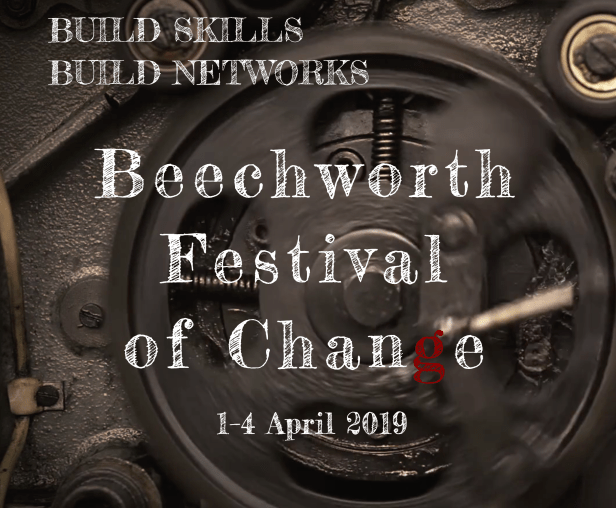
Soon, an inspiring week-long fiesta of events and creativity for campaigners and activists. The focus is on building skills and making connections. I’ll be there sharing some changeology and innovation tricks. To join in, start here: Festival of Change, Beechworth, 1-4 April
People love certain kinds of stories

I like this list of “content people crave” from marketer Scott Aughtmon: 21 types of content we all crave. It’s stuck on my wall.
Gee whiz
I’m in awe of Jessamy Gee. She just “graphically recorded” a Passion Mashing session for enviro volunteers at Knox City. All the complexity of the day went into her brain, and sprang out through her fingers, so quickly, so beautifully, and so well explained! I’m now a firm believer in the power of graphic recording and Jessamy is brilliant at it.

Yay!
That’s good. Practically all of our problems are chronic. Therefore, by definition, we need to alter the systems that maintain those problems chronically in place.
Soooo… Where do we start?
Change efforts mostly fail for the same reason – wrong assumptions in the minds of the people who devised them. Like “fewer people will take drugs if we arrest more drug takers” or “unemployed people will get jobs if we humiliate and punish them enough”.
(Ever noticed how the biggest programs seem to be based on the wrongest assumptions?)
Even small and benign efforts can be based on wrong assumptions (for example in road safety, sustainability, and health).. So how do we think better?
The problem is narrow intellectual repertoire: the people who invented the program had only one or a few possible solutions in their minds.
The obvious thing to do is to start with the fullest possible repertoire of possible systemic interventions to choose from.
This is where Donella Meadow’s pioneering 12 Leverage Points is so valuable.
Last year I translated her ideas into more familiar language and added some more familiar interventions.
Last week I explained it to a class of young innovators at the University of Technology Sydney, whose bright minds made me have a fresh look at it.
Here, as a result, is version 2!
I realise this stuff is so important that it needs to be as accessible as possible. I hope this new diagram helps.
Full size PDF here: http://www.enablingchange.com.au/18_points_diagram_v3.pdf
More at http://www.enablingchange.com.au/systems.php

 It’s alarming because these institutions have vital functions: they control the gains to dominant players by enforcing laws and regulations. They are guarantors of the sense of fairness that holds that society together. The Republicans’ clear intention is to unleash a tornado of profit making to reignite American capitalism. They are likely, of course, to simultaneously tilt inequality to nineteenth century levels and produce even deeper pits of despair to create the next Trump.*
This is exactly the cycle that destroyed the Roman Republic, whose separation of powers constitution was the model that inspired the US founding fathers. I see Trump as the Crassus who inevitably falls because of his own stupidity and greed. He died, with his legions, in the Syrian desert while trying to pillage the riches of the Parthian empire. Will he be followed by a smarter and more destructive Julius Caesar, Marc Antony and Augustus, all successively trashing institutions until there are no impediments left to absolute power? Well I hope not. It all depends on whether the United States manages to resuscitate and reinvigorate its institutions. It’s therefore very heartening to see the absolute alarm and horror amongst progressive Americans as Trump organises his bonfire. Only their passion will recover those pillars of stability.
Systems rarely, of course, totally collapse. Instead, as a threshold is passed, the whole system suddenly transforms into a new stable state that’s less diverse. Usually there’s no path back. That’s according to Resilience Thinking – see Walker and Salt’s pioneering book https://islandpress.org/book/resilience-thinking on the subject, and this superb resource from The Stockholm Resilience Centre. http://www.stockholmresilience.org/download/18.10119fc11455d3c557d6928/1459560241272/SRC+Applying+Resilience+final.pdf
Walker and Salt’s most famous example is the effect of rising salt in the Goulburn-Broken Basin, Victoria’s most productive agricultural landscape. For decades, irrigators pumped more and more water into the subsoil, with no discernable effect, until saline groundwaters reached the root zones, and sudden system transformation began. Those farmers can never return to highly productive orcharding again.
It’s eerie how similar this is the rise of poverty in America. We pretended not to notice for decades, then suddenly the threshold passes, and the system teeters. Will it have the resilience to recover?
* According to Thomas Picketty inequality in the US has already fallen to 1930s levels under the influence of neoliberalism. https://en.wikipedia.org/wiki/Thomas_Piketty ]]>
Maybe we’re aiming to tackle litter at the local shops, or prepare a town for floods, or help an agricultural system adapt to climate change, or tackle family violence or ice addiction in a community.
In that case we need to design an intervention.
Probably the two most important qualities we need to call upon now are caution and curiosity. Recent history is full of catastrophic interventions that left wreckage in their wake, or achieved some goals but at great cost to the social fabric. Usually they lacked both caution and curiosity. Think: the 2003 invasion of Iraq, the 2007 Northern Territory Intervention, and the 2009 Home Insulation (“Pink Batts”) Program.
Caution and curiosity, however, have costs: they slow us down. They make us spend time engaging with communities. They force us to start small and learn as we go. We may lose those glorious opportunities for bravura, dash, and heroic poses that politicians and CEOs love.
So, when designing an intervention, a critical first question is: how much caution and curiosity is appropriate? What qualities, indeed, should characterise the overall approach?
Dave Snowden is a systems thinker who champions a tool he calls Cynefin. It’s a simple 4-sector matrix that identifies four different classes of intervention design, depending on the complexity and turbulence of the situation. I’ve long needed such a tool for my Changeology training, so I thought I’d adapt it, by combining it with another tool called The Public Participation Matrix.
Here’s the result. I’ll be testing it out in my next round of public workshops in October.
I hope you find it useful. This is just version 1.0, so feedback is very welcome.

How to use it: Do some initial on-the-ground listening, then make a best guess about the scale of “risk” and “unknowns” inherent in the situation you wish to intervene in. This locates you in one of four classes, each with a different style of intervention.
Which class does your problem fall into?
The idea is to be very clear about which class you are in before you start. A mismatch between classes and situations practically guarantees the failure of your efforts (at the very least).
It will be immediately obvious, for example, that the 2003 Iraq invasion, the Northern Territory Intervention, and the Home Insulation (“Pink Batts”) Program mismatched their situations and responses.
The four classes are:
1) Familiar = Off the shelf response
The situation:
Calm. Actors well known, not likely to resist strongly.
You are aware of models that have worked successfully in similar situations.
The response:
Apply best practice or business as usual. Cut and paste successful ideas from comparable situations. Apply basic user engagement (for example, focus groups to pre-test ideas).
Dave Snowden called this class “Obvious”. The relationship between cause and effect is obvious to all and the ideal approach is to Sense – Categorise – Respond and apply best practice.*
2) Unfamiliar = Bespoke response
The situation:
Unfamiliar, with significant unknowns. The actors are numerous and diverse, and some may resist strongly. Unclear which of several possible solutions is appropriate. “Somewhat wicked”.
The response:
Mobilise a multi-disciplinary “brains trust” that includes users; craft a customised solution by mixing and matching from a wide palette of possibilities. Strategies should be multi-dimensional, working in more than one domain and mobilise more than one kind of expertise (e.g. mixing infrastructure, service design, communication, skill-building, leadership), and able to rapidly adapt (because some reactions will be unpredictable). Proceed by pilots, and gradually scale up. User engagement via social research and “consult/involve” level community engagement (for example, via an advisory workshop).
Dave Snowden called this class “Complicated”. The relationship between cause and effect requires analysis or some other form of investigation and/or the application of expert knowledge. The ideal approach is to Sense – Analyze – Respond and we can apply good practice.*
3) Reactive = Experimental response
The situation:
Unfamiliar and “stormy”. Dominated by unknowns, highly charged, rapidly changing, or politicised. High potential for strong resistance. Actors are numerous, diverse, sensitive, with likelihood of strong, unpredictable responses. Unclear if any existing solution is appropriate. “Very wicked”.
The response:
Probe the problem with a range of modest experimental projects, selecting a sub-set of solutions to prototype and develop further. Again, be prepared to work in more than one domain and mobilise more than one kind of expertise (e.g. mixing infrastructure, service design, communication, skill-building, leadership). User engagement via social research, multi-disciplinary “Brains Trust” including users, and community engagement at the “Collaborate” level (e.g. program developed and delivered in partnership with trusted local organisations, and outsourcing to the affected community).
Australia’s effective response to the HIV epidemic is a good example of this class of intervention.
Dave Snowden called this class “Complex”. The relationship between cause and effect can only be perceived in retrospect, but not in advance. The ideal approach is to Probe – Sense – Respond so we can sense emergent practice.*
4) Chaotic = Emergency response
The situation:
Natural or human disaster requiring urgent action; highly charged; politicised. Actors are numerous, diverse, reactive, with likelihood of strong, unpredictable responses. There are a range of possible solutions but there’s no way to tell, from a distance, which might make the situation better and which might make it worse.
The response:
Attack the problem with urgency but enable local improvisation with high tolerance for imperfection. Invest heavily in intelligence and communications, with tight feedback loops. Train and support agile, well-equipped, local agents and actors. User engagement at the “empower” level (e.g. outsource local responses to autonomous local actors – Community Fire Guard is an example).
Disaster response, bushfire management, and military action are examples of this class of intervention.
Dave Snowden called this class “Chaotic”. There is no relationship between cause and effect at the systems level. The ideal approach is to Act – Sense – Respond and we can discover novel practice.*
* From the Wikipedia entry: Cynefin.
]]>– Donella Meadows, Thinking in Systems, a Primer
Systems are everywhere: natural systems, institutional systems, health systems, food systems, communities, corporations, families, schools, bodies, lives.
Making a better world always means intervening in systems. Scratch any social, health or environmental problem, and I guarantee you’ll find dysfunctional systems.
Making systems healthy, so they run smoothly long into the future, is the goal of sustainability activists everywhere. Resilience, another desirable goal, is also about healthy systems.
But how, exactly, does one intervene strategically in a system? That’s where Donella Meadows’ work provides such valuable insight.
Instead of wacking discrete problems with ever heavier hammers, her approach suggests subtle ways to intervene in the causes of problems. It helps us think about contexts, communities and interrelationships and flows of information.
Donella, who passed away in 2001, was an environmental advocate, systems modeller, and student of Jay Forrester, the engineer and academic who pioneered System Dynamics. She built Forrester’s early computer simulations into the complex models behind the Club of Rome’s trailblazing Limits to Growth report in 1972.
Her concern was how to modify systems to move them from degenerating trajectories into sustainable ones. Her approach is clever because she sees systems as about flows of information rather than just structures. And the valuable thing she’s done is recognise that some kinds of interventions are intrinsically more powerful than others.
Donella listed 12 different ways to intervene in a system, in increasing order of effectiveness, from weak to strong. This approach is valuable for anyone doing change work.
On the down side the names she gives her leverage points are rather inaccessible and her ideas take a while to absorb.
So I’ve taken the liberty of adapting her system to suit the language that’s more familiar to professionals in sustainability, public health, road safety and so on. Plus I’ve added a number of interventions that we’re more familiar with.
The starting point is that you face a system (business, catchment, community…) that is dysfunctional, inadequate for its environmental challenges, out of balance so that part of it is bloating and part is starving, and more and more heat (conflict) is being generated. Or it might be destroying its environment. What levers can you pull? Inspired by Donella Meadows I can think of at least 18 different levers.
This paper is just my opinion. This is an exciting, undeveloped field and everyone’s ideas are welcome.
Hope you like it.
[All quotes from Donella Meadows are from her article Places to Intervene in a System, unless indicated.]
Leverage Points in a System
First, as an introduction, I thought I’d ask “what is a ‘system’?” I did a bit of research and thinking, and here’s what I found. Here are 28 statements about systems that seem to capture the richness of the concept.
Next, here are the 18 leverage points, arranged from weak to strong, that are inspired by Donella’s work.
You can download a full sized PDF version here.

1) Facts
Sometimes an actor is genuinely in ignorance of a vital fact that, if they knew it, would make a difference to their choices.
How many spoonfuls of sugar in can of a Coke? The answer is “just over 9”. This fact has turned out to be an amazingly powerful meme that’s put Coke and fizzy drink sales into a historic nosedive. What makes it powerful is its simplicity, its concreteness, its surprisingness, and that it tells listeners something important they didn’t know about their own lives. It’s perfectly constructed to go viral.
Here’s another: “95% of of adults in Kiama think it’s wrong to give a teenager alcohol”. That’s potent because it tells me about the social norms of my own community, the one I live with every day, and it tells me how to avoid transgressing those social norms. That’s important information that affects my decisions.
To see why these facts are so potent, read Made to Stick by Chip and Dan Heath. They show how ‘sticky’ facts are SUCCES-ful – which stands for “short, unexpected, concrete, credible, emotional stories”.
If you have facts like these, communicate them.
However keep in mind that, most of the time, facts are extraordinarily feeble tools of change. The facts might be true, but they are poorly designed to influence human choices. Often we’re not telling people anything they didn’t already know. Or denial and resistance are sparked by the mere act of telling. That’s why most fact-based campaigns are ineffective.
Sometimes, however, just the right fact, communicated without manipulation, pressure or threat, can make a big difference to people’s personal choices. And when enough people make different choices, systems can change.
What to do: Education or awareness campaigns that convey simple, personally compelling, objective facts.
2) Skills
You could increase the repertoire of behaviours available to certain players. If the actors respond to the same stimuli with different behaviours, that’s a stronger kind of change. Probably more sustained too. If, instead of assaulting a spouse a stressed person goes for a walk, that makes a big change to their outcomes. If a decision-maker under pressure learns to collaborate with staff instead of making snap decisions alone, that would alter the outcomes.
Impoverished behavioural repertoires lie behind a lot of problems. You could argue that this is a system change, but it’s still relatively weak because the actors are embedded in the same old system, subject to the same contextual forces.
What to do: Use modelling, social learning, experiential learning, training to enlarge the skill repertoire of actors
3) Add resources that increase an individual’s leverage or productivity
Giving people resources can enable them to make changes that would otherwise be slow and impossible.
An indebted farmer, for example, can’t afford off-stream watering systems, so an incentive payment, at the right time, might prevent his cattle wallowing in mud and polluting creeks. Such targeted, generous, resourcing can make a great difference to individuals.
However resourcing tends to be a weak lever. It depends on the generosity of stronger actors which is almost always withdrawn in time. It’s about compliance rather than capacity or motivation. And resourcing doesn’t substitute for motivation and can often ‘crowd out’ long term motivations.
Also, “A subsidy can skew your business really badly.” (said to me by a water authority executive about state government subsidies).
What’s more, accountability requirements are ever-increasing, onerous and intrusive, often amounting to a perverse “cognitive tax” excessively burdening already complicated lives.
Keep in mind, too, that in a competitive market, increasing an individual’s effectiveness or productivity is often a zero sum game, because all their competitors inevitably follow suit, increasing their productivity too, lowering the market price, so that everyone is working harder and faster, but staying poor. That’s the tragic productivity treadmill that’s beset agriculture for decades, effectively hollowing out the landscape by ramping up extraction from limited stocks – the soil and the well-being of farmers.
And resourcing leaves the system itself unchanged. The same farmer, locked in a globalised spiral of ever increasing productivity expectations and ever reducing commodity prices might not be able to afford to replace the infrastructure when it’s ruined a few years later by a flood.
That said, in less competitive environments, resourcing can often make a difference.
What to do: offer incentive programs, grants, loan schemes, vouchers, subsidies, technical assistance.
4) Provide services
Change requires time and lots of mental processing power. Busy, distracted people lack those things. The easiest way to enable those people to act is to do things for them. That’s what services are for.
It’s no accident that the explosion of service industries coincides with an increase in working hours and time-consuming demands of post-modern life.
I’ve worked with a state government program called BinTrim. It sends agents into hundreds of small businesses to help them change their recycling systems, by doing simple things business managers don’t have the time or skills to do, like negotiating with recycling contractors and installing new bins. That’s a perfect example of a service-based intervention.
Even the unemployed, as the authors of Scarcity point out, are mentally captured by their condition. They might have time on their hands but they still have little cognitive surplus, and it’s cognitive surplus that counts. They need services too, like free child care (which is also a perfect example of a buffer).
Services don’t change large scale systems, but they can make a big difference to small scale systems of individual lives and businesses.
What to do: Design a service that does things people lack the time, cognitive space, or skills to do for themselves.
5) Provide buffers
Potentially more useful than resourcing people to act is giving them sustained cash transfers, access to credit, time and expertise that’s free from expectations, that’s simply “in the bank”, literally redundant.
After reading Donella Meadows, I’m starting to see buffers everywhere. Why do I do my best thinking during yoga classes? Because I’m free from demands and distractions. Why does leaving a 30 minute unallocated time in a one day workshop stop time overruns? Why do so many senior executives I meet look ever-more glaze-eyed and distracted? Why do fish stocks need no-take zones? Why is volunteering so low amongst employed professionals? Why did one Missouri hospital find that the solution to operating theatre delays was simply to keep one operating theatre empty? *
Buffers protect systems from shocks, they prevent wild boom and bust oscillations, and they create the space people and systems need to adapt, innovate and take risks.
Google, famously, used to offer ‘20% time’ allowing employees to take one day a week for side projects, leading to profitable innovations like Gmail and Adsense.
Utah’s homelessness strategy is an interesting case study: “In 2005, ‘no‐strings attached’ housing was first provided to the chronic homeless, with minimal rent and no drug tests. There were fears that the project would ‘incentivise mooching’. Utah’s chronically homeless population has since fallen 90%, and by the end of 2015 ‘may be virtually gone’. Most recipients successfully make rent payments, and costs are much lower than that of providing services for the chronically homeless. While no behavioural analysis has yet been performed, the project may have powerful cognitive effects: providing housing simplifies the lives of the homeless, provides a buffer against shocks, and frees cognitive resources for challenging tasks like quitting drugs and finding employment.” **
The whole idea of buffers, of course, is anathema to managers and economists obsessed with productivity. Their un-systemic thinking threatens to produce a generation of employees who are so productive that they have the attention spans of newts. Creativity, like sanity and happy family lives, depends on having a portion of schedule-free time.
What to do: Cash transfers (via the welfare system), access to credit, free hours and days, paid study leave, flexible work hours, sabbaticals, mentoring.
* The hospital example is from Mullainathan and Shafir’s Scarcity p.183.
** For an overview of this approach see ‘Housing First’ in Wikipedia. The Utah homelessness example is quoted from Finighan, R. Beyond Nudge: The Potential of Behavioural Policy (2015), Melbourne Institute Policy Brief No. 4/15, Melbourne Institute of Applied Economic and Social Research The University of Melbourne
6) Build/modify physical infrastructure, processes or products
If you want people to bicycle, build a bikeway. Want them to save energy, give them motion-sensor switches. If you want to fight rural poverty, give African farmers a money-making pump they can fix themselves.
In Donella Meadow’s words, “The plumbing structure, the stocks and flows and their physical arrangement, can have an enormous effect on how the system operates. When the Hungarian road system was laid out so all traffic from one side of the nation to the other has to pass through central Budapest, that determined a lot about air pollution and commuting delays that are not easily fixed by pollution control devices, traffic lights, or speed limits.”
“The only way to fix a system that is laid out wrong is to rebuild it, if you can. Amory Lovins does wonders of energy conservation by straightening out bent pipes and enlarging too-small ones. If we let him do energy retrofits on all the buildings of the nation, we could shut down at least half of our electric power plants.”
Infrastructure and products work when they lower the time, financial and cognitive costs of acting.
This opens up the whole world of Design Thinking. “Design” is the “transformation of existing conditions into preferred ones.” It’s about creating simplicity, convenience, legibility, freedom, closeness, efficiency, safety and sociability.
Building new infrastructure is a strong intervention. Although it’s expensive and takes time the effects can be very long lasting.
What to do: Build/modify infrastructure, processes or products to reduce the costs of acting.
7) Build timely feedback loops
“Now we’re beginning to move from the physical part of the system to the information and control parts, where more leverage can be found.” wrote Donella.
Donella called feedback loops “the basic operating unitsof a system”.
Every day we humans make thousands of decisions, from when to turn the heater off, to what events we attend, to how we exercise, to what food we eat. To control outcomes we need data on the consequences of our actions. That’s called feedback. Having feedback, at the right time, on the negative consequences of actions means we can take corrective action before damage mounts. Really bad systems provide no feedback at all, so damage mounts with no possibility of mitigation.
“Missing feedback is one of the most common causes of system malfunction. Adding or restoring information can be a powerful intervention, usually much easier and cheaper than rebuilding physical infrastructure. The tragedy of the commons that is crashing the world’s commercial fisheries occurs because there is no feedback from the state of the fish population to the decision to invest in fishing vessels.” wrote Donella.
Fortunately the digital revolution has greatly increased the potential to deliver the right information to the right people at the right time. Smart meters let consumers monitor their home power or water use in real time. Wearable technologies like FitBit help me track my heart recovery rate. My phone tells me my bank balance in real time. But my credit card hides this information, causing bad decisions!
Donella was especially concerned about one aspect of feedback loops: the delay. “Delays that are too short cause overreaction, ‘chasing your tail,’ oscillations amplified by the jumpiness of the response. Delays that are too long cause damped, sustained, or exploding oscillations, depending on how much too long. At the extreme they cause chaos. Overlong delays in a system with a threshold, a danger point, a range past which irreversible damage can occur, cause overshoot and collapse.”
For organisations, feedback includes listening sensitively to one’s community and clients. Social media and formal “community engagement” processes, done well, can be valuable feedback mechanisms, allowing organisations to respond to threats and problems before the damage mounts.
What to do: collect data on consequences and feed it back to the actors (but not in formal evaluations: the delay is too long); build processes that regularly touch base with your community, customers or supporters.
8) Inclusive decision-making
Pope Francis recently wrote about “The disease of closed circles”, where “belonging to a clique becomes more powerful than our shared identity. This disease too always begins with good intentions, but with the passing of time it enslaves its members and becomes a cancer which threatens the harmony of the organisation and causes immense evil, especially to those we treat as outsiders. [This] ‘Friendly fire’ from our fellow soldiers is the most insidious danger. It is the evil which strikes from within. As it says in the bible, ‘Every kingdom divided against itself is laid waste.’”
Systems need coordination and this specialised role requires a staff or bureaucracy. The sociologist Max Weber thought that “the needs of mass administration today make [bureaucracy] completely indispensible.” Once a bureaucracy comes into existence, however, it tends to take on a life of its own, with its own interests, ruled by careerists, giving rise to “a universal ‘Tragedy’…that dooms every attempt to realise ideas into reality.” he concluded gloomily. *
One solution to the inflexibility and narrow-mindedness of bureaucracies is to believe we can do without them, relying on Adam Smith’s “invisible hand of the market”. A more mature approach, however, probably lies in governance innovation, especially the many methods of inclusive governance, ranging from deliberative budgeting to citizen juries, which inject outside voices into the decision-making processes of organisations.
For a nice introduction to inclusive methods see: Open Your Council
For a more complete list of inclusive governance methods, see: The Engagement Toolkit.
What to do: If you’re an ‘insider’, invite a diversity of actors to collaborate with you on important decisions. (And don’t forget to inform and inspire them before they deliberate). If you’re an ‘outsider’, convene a diverse decision-making forum, with multiple actors, and invite the decision-makers along. The essential skill here is facilitation.
* Max Weber quote from Swedberg, Richard (2005) The Max Weber Dictionary, p19, p188
9) Create a community-of-practice
How often we hear something like this:
“It never fails to amaze me how services could be so much improved if all those involved in supporting those in need actually liaised properly with each other – housing with health and substance misuse services as well as social services and other charitable organisations.” – Sue Waterston, www.fiveactions.org
Siloing is a commonplace dysfunction of systems. Pope Francis described it perfectly “The disease of poor coordination. Once leaders lose a sense of community among themselves, the body loses its harmonious functioning and its equilibrium; it then becomes an orchestra that produces noise: its members do not work together and lose the spirit of camaraderie and teamwork. When the foot says to the arm: ‘I don’t need you,’ or the hand says to the head, ‘I’m in charge,’ they create discomfort and parochialism.”
In system terms, siloing is about failed information flows. The solution is to create a community where the actors meet, learn from each other, understand each other’s perspectives, coordinate their efforts, share services and work together. Once people meet face to face then more remote methods can continue the conversation, like email discussions, newsletters, Facebook, blogs and so on. Keep in mind that online interactions don’t create the kind of community we are talking about here: community can only start when people meet face-to-face because communities depend on trust, and the human mind isn’t designed to trust a screen.
A nice case study is Communities for Children, a national system of paid regional coordinators who convene a network of all the agencies and providers whose decisions affect children’s wellbeing in a geographical area. They meet monthly to coordinate their work, spot gaps, share knowledge, and collaborate on projects. That is a good model for the kind of “community” that tackles failed information flows. On a less elaborate scale, a bimonthly breakfast meet-up supported by a LinkedIn discussion group might do the job.
Incidentally, one thing a community needs is places to meet. So ‘place-making’ in all it’s forms, starting with just putting circles of chairs in the street, is a valuable community enabler.
What to do: convene networks, communities of practice, cross-disciplinary groups, partnerships, silo-busting initiatives. If no one else is convening all the actors to sit down together, be the one who does it. The essential skill here is facilitation.
An excellent guide to facilitating a network or community of practice is Collaborating for Sustainability, which comes with case studies.
10) Accountability: creating “skin in the game” for decision-makers
“There is a systematic tendency on the part of human beings to avoid accountability for their own decisions. That’s why there are so many missing feedback loops — and why this kind of leverage point is so often popular with the masses, unpopular with the powers that be.” wrote Donella.
Creating consequences for decision-makers, so they face personal costs for their actions helps keep systems healthy. Complacency, incompetence, bias, self-enrichment, corruption, recklessness all thrive in consequence-free environments.
New York’s crime rate fell when local police supervisors were made personally responsible of the crime rates in their area.
The Global Financial Crisis, meanwhile, was caused by Wall Street bankers operating in an accountability vacuum. (This quote sums it up nicely: “placed in a dark room with a pile of money and no one watching, they took it all”!)
At its simplest, accountability means measuring and shining a spotlight on hidden data about the consequences of decisions. We’ve all heard the phrase “what gets measured gets done”. You have only to look at the ways NAPLAN (standardised school testing) has warped the curriculum and teaching practices of schools to see how systematic and powerful the mere fact of measuring+publicising data can be. “In the lead up to NAPLAN, it becomes ‘all about academia’ and the social/emotional/spiritual aspects of learning seem to take a back seat….NAPLAN limits our capacity to develop the non-NAPLAN aspects of holistic education.” said one primary school principal.
Donella gives a more positive example: “The Toxic Release Inventory — the U.S. government’s requirement, instituted in 1986, that every factory releasing hazardous air pollutants report those emissions publicly every year. Suddenly every community could find out precisely what was coming out of the smokestacks in town. There was no law against those emissions, no fines, no determination of “safe” levels, just information. But by 1990 emissions dropped 40 percent. They’ve continued to go down since, not so much because of citizen outrage as because of corporate shame. One chemical company that found itself on the Top Ten Polluters list reduced its emissions by 90 percent, just to “get off that list.”
Shaming is a very effective form of accountability. Shaming means exposing transgressions against morality or social norms. The mere threat of shaming helps actors self-regulate their behaviour. Tuna manufacturers could not endure the graphic exposure of dolphin by-catch in the 1990s driving changes in fishing practices (and dolphin-free labelling). Shaming of clothing brands for exploitation of child labour has had similar effects.
What to do: Collect data on consequences of decisions by powerful actors and feed it back, graphically, to the public. Examples include performance measures, independent monitoring, accreditation systems, rating systems, ombudsmen, rules about transparency, freedom of information laws, shaming campaigns. For an individual, commitment apps like stickK, Pact and Beeminder have similar effects.
[An interesting book on shaming campaigns is Jennifer Jacquet (2015) Is Shame Necessary? New Uses for an Old Tool, Penguin Books]
11) Level playing field (limit the gain to dominant actors)
This is about combating runaway processes. It’s important because that’s how most systems fail: not by scarcity but by unequal distribution of success. Dominant actors use their superior leverage to rapidly accumulate resources, while others are excluded, and the whole system degenerates into disorder.
In essence it’s about limiting “success to the successful”, an area full of potential for confrontation and violence because the powerful are highly motivated to maintain their privileged leverage and work tirelessly to pursue every conceivable advantage.
Negative feedback loops tend to be healthy, but positive feedback loops are potential threats. According to Donella, “A negative feedback loop is self-correcting; a positive feedback loop is self-reinforcing. The more it works, the more it gains power to work some more. The more people catch the flu, the more they infect other people. The more babies are born, the more people grow up to have babies. The more money you have in the bank, the more interest you earn, the more money you have in the bank. The more the soil erodes, the less vegetation it can support, the fewer roots and leaves to soften rain and runoff, the more soil erodes… Positive feedback loops are sources of growth, explosion, erosion, and collapse in systems. A system with an unchecked positive loop ultimately will destroy itself. That’s why there are so few of them. Usually a negative loop will kick in sooner or later. The epidemic will run out of infectable people — or people will take increasingly strong steps to avoid being infected. The death rate will rise to equal the birth rate — or people will see the consequences of unchecked population growth and have fewer babies. The soil will erode away to bedrock, and after a million years the bedrock will crumble into new soil — or people will stop overgrazing, put up checkdams, plant trees, and stop the erosion.
“Reducing the gain around a positive loop — slowing the growth — is usually a more powerful leverage point in systems than strengthening negative loops, and much preferable to letting the positive loop run.”
Successfully combating runaway processes requires strong laws and neutral umpires like independent judiciaries, commissions of inquiry, independent financial regulators, and independent corruption investigation bodies. It’s the logic behind anti-monopoly and competition laws.
The internet has been economically revolutionary because online platforms tremendously reduce the cost of starting a business (e.g. eBay, Etsy, Shopify, WordPress, Pencil etc), creating millions of new economic participants and combating the monopoly power of big actors.
What to do: anything that redistributes wealth (for example progressive taxation), privileged access to information (for example Freedom of Information laws) or which “levels the playing field” by equipping less leveraged players to participate in the system (for example universal high-quality public education, affirmative action programs, and low cost internet platforms).
12) Full cost pricing
Price signals are have powerful behavioural effects. For example, in 1999, World Bank consultants reviewed past studies and concluded that, all else being equal, a price rise of 10 per cent tended to produce a reduction of tobacco consumption of about 8 per cent.
In system terms, cost is a strong negative feedback loop that disciplines behaviour and controls runaway gains. Hence it’s a signal that actors try very hard to avoid! One way they do this is by removing ‘externalities’ from their account books – like polluted air, lost soil, workers health, damage to other other people’s infrastructure. Producers like to “socialise costs and privatise profits”. A well-designed tax can retrofit some of those externalities back into the pricing system.
The mix of taxes and tax breaks can act like a steering wheel that directs whole systems away from, or towards, cliffs. A carbon tax, for example, steers the whole economy away from fossil fuels, causing not just changes in behaviour but the blooming of entire new industries. Cheapness, meanwhile, is often a bad thing. Cheap petrol, for example, tangled modern cities in a fantastic blight of concrete freeways and barely endurable air pollution.
A stunning success of a well-placed tax is the landfill levy in Australian states, effectively a tax on dumping waste in landfill. First introduced in the 1990s to cover the ‘externality’ of replacing aging landfills, it has since pushed the cost of landfill to over $300 a tonne in NSW, not just reducing waste dramatically but also conjuring into existence new recycling industries worth $11 billion a year and employing some 30,000 people. Richard Pratt, Australia’s fourth richest man until he died in 2009 was a paper recycler. That’s what a well-placed tax makes possible.
Permit trading schemes, which sell a limited supply of tradable permits, achieve the same effect. And they also generate funds which can be put to good uses.
What to do: If you are a government, establish taxes, levies and permit trading schemes to price externalities into actors’ calculations. If you’re not a government, start a think tank or lobby group to argue for full life cycle pricing. Argue for reduced subsidies for socially and environmentally damaging activities.
13) Establish counterweights
The reason marriage equality, climate change, overseas aid and indigenous issues get the attention of decision makers, and why public health doesn’t, is because they are organised. Public health, by comparison, “has been timid or mostly absent”, as one public health advocate recently complained.
When disparate individuals or groups organise themselves and push back against the powerful, they literally change the shape of the system. Unions are probably the greatest example of counterweights. Industry groups and co-ops are others, down to the humble neighbourhood community action group. Organising a counterweight is more powerful than any of the leverage points listed so far because organised lobbying is how most political changes actually get made.
Organising is an act of system redesign because it creates new actors and increases the gear ratio of less powerful actors, shifting the distribution of power across the whole structure.
An action group does not have to be large to be successful. The most extraordinary changes have, as Margaret Mead famously observed, often been the collective endeavours of small, committed groups.
Unlikely alliances between existing actors can have the strongest system redesign effects. The unlikely alliance between Australian Conservation Foundation and the National Farmers Federation, for example, created Landcare, a movement that has physically transformed the Australian Landscape.
What to do: Organise a community or industry into a co-operative or lobby group. Convene an alliance of existing actors to lobby for change.
[ P.S. The go-to place for everything about community organising is The Change Agency. They have organising toolkits and a community organisers’ fellowship.]
14) Change the rules
Donella wrote, “The rules of the system define its scope, its boundaries, its degrees of freedom. Thou shalt not kill. Everyone has the right of free speech. Contracts are to be honoured. The president serves four-year terms and cannot serve more than two of them. Nine people on a team, you have to touch every base, three strikes and you’re out. If you get caught robbing a bank, you go to jail.”
Laws and regulations establish sanctions for undesirable behaviour, reinforce social norms and enable communities to self-police.
Mandatory laws “have been the tool of choice for many important welfare optimisation problems – seatbelts, bicycle helmets, cigarette advertising, rental property standards, fair mortgage contracts, water fluoridation, milk pasteurisation, superannuation, minimum wages, and much beyond.” *
The power of laws is why corporate lobbyists work to hard to weaken labour, environmental and financial regulations. And why progress so often depends on strengthening those laws. Think recent public battles over the Renewable Energy Target, food labelling rules, the Future of Financial Advice Act, and the Racial Discrimination Act.
“That’s why my systems intuition was sending off alarm bells as the new world trade system was explained to me,” wrote Donella. “It is a system with rules designed by corporations, run by corporations, for the benefit of corporations. Its rules exclude almost any feedback from any other sector of society. Most of its meetings are closed even to the press (no information flow, no feedback). It forces nations into positive loops “racing to the bottom,” competing with each other to weaken environmental and social safeguards in order to attract corporate investment. It’s a recipe for unleashing “success to the successful” loops, until they generate enormous accumulations of power…”
What to do: start a campaign, or a think tank, to get laws passed, or existing laws defended, or enforced.
* Quoted from Finighan, R. Beyond Nudge
15) Build/defend institutions
What predicts the prosperity of nations? According to Daron Acemoglu and James Robinson in their book Why Nations Fail, the answer is “Institutions, institutions, institutions”. They meant that prosperous states are the result of effective institutions working without fear or favour for the common good, not captured by elites for their private enrichment.
Institutions are born when organised campaigns succeed in passing legislation, solidifying their intentions into existence. New social functions, like fair working conditions, environmental protection or financial regulation, are conjured into permanence, backed by state power, budgets, executives and staffs.
Wealthy elites and their supporters work very hard to capture such institutions, or, if they resist capture, to destroy them. Lonely institutions are easily victims. Hence defending useful institutions is just as important as creating new ones.
What to do: start a “Friends of” group to defend a threatened institution. Work to pass laws to strengthen institutions or build necessary ones. Monitor institutions to ensure they work for the larger good.
On a more humble scale, any activity that is formalised, has dedicated personnel, and measured goals, acts like an institution, even if it’s just a community group or office committee. It changes the system (and it needs to be kept on track for the common good as well).
16) System innovation
Systems that don’t evolve fade away, become irrelevant or noxious. Sustainability therefore requires continuous evolution, flexibility and adaptation.
A shorthand way to think about innovation is that it’s about how a system learns.
Donella wrote: “Self-organization means changing any aspect of a system lower on this list — adding completely new physical structures, such as brains or wings or computers — adding new negative or positive loops, or new rules. The ability to self-organize is the strongest form of system resilience. A system that can evolve can survive almost any change, by changing itself. The human immune system has the power to develop new responses to (some kinds of) insults it has never before encountered. The human brain can take in new information and pop out completely new thoughts.”
Three kinds of interventions strengthen the ability of systems to innovate:
- grow the diversity of actors and the density of their connections (i.e. social capital);
- increase the stock of possibilities available (e.g. conserving genetic stocks and human cultures, multi-disciplinary projects, silo busting, bringing in outside voices);
- create permission to innovate and resource the innovators.
The most powerful innovations are new human relationships, especially between groups who haven’t worked together before, and new institutions.
What to do: Get together with friends and construct a better alternative. Instead of a campaign, start a ‘start-up’! Organise a community leadership program.
[Innovation can be a systematic practice. For an excellent introduction read the article Design Thinking by Tim Brown, CEO of the design firm IDEO.]
17) Pivoting the purpose
Pope Francis’s Laudato si encyclical is an attempt to change the purpose of the whole human system: the social agreement on what it’s all ultimately for.
Donella wrote: “…the goal of a system is a leverage point superior to the self-organizing ability of a system. If the goal is to bring more and more of the world under the control of one particular central planning system (the empire of Genghis Khan, the world of Islam, the People’s Republic of China, Wal-Mart, Disney, whatever), then everything further down the list, physical stocks and flows, feedback loops, information flows, even self-organising behavior, will be twisted to conform to that goal.”
Who sets goals? That’s the role of transformative leaders. “The number one determinant of change is active and visible sponsorship by the leadership.” *
Some leaders feel frozen by constraints, but, for courageous leaders, there are always higher purposes they can use to guide their systems. I once facilitated a debate by school principals on the purpose of education: was it about academic performance, citizenship, or spiritual development of children as whole people? (‘whole people’ won). A transformative leader sees greater purposes others are blind to, and brings them into existence by courageous and consistent words and actions.
To illustrate the point, Donella uses Ronald Reagan’s promotion of neoliberalism: “Not long before he came to office, a president could say “Ask not what government can do for you, ask what you can do for the government,” and no one even laughed. Reagan said over and over, the goal is not to get the people to help the government and not to get government to help the people, but to get government off our backs. One can argue, and I would, that larger system changes and the rise of corporate power over government let him get away with that. But the thoroughness with which the public discourse in the U.S. and even the world has been changed since Reagan is testimony to the high leverage of articulating, meaning, repeating, standing up for, insisting upon new system goals.”
What to do: in the systems in which you play a leadership role, courageously speak and act as if a transformed purpose was already a fact.
* Told to me by John Davey, an organisational change consultant.
18) Change the mindset or paradigm behind the system
Big, unstated assumptions govern all human affairs. Change those assumptions and everything else follows.
“Paradigms are the sources of systems,” wrote Donella Meadows, “From them, from shared social agreements about the nature of reality, come system goals and information flows, feedbacks, stocks, flows and everything else about systems. No one has ever said that better than Ralph Waldo Emerson:
‘Every nation and every man instantly surround themselves with a material apparatus which exactly corresponds to … their state of thought. Observe how every truth and every error, each a thought of some man’s mind, clothes itself with societies, houses, cities, language, ceremonies, newspapers. Observe the ideas of the present day … see how timber, brick, lime, and stone have flown into convenient shape, obedient to the master idea reigning in the minds of many persons…. It follows, of course, that the least enlargement of ideas … would cause the most striking changes of external things.’
In Donella’s words: “The shared idea in the minds of society, the great big unstated assumptions — unstated because unnecessary to state; everyone already knows them — constitute that society’s paradigm, or deepest set of beliefs about how the world works… Money measures something real and has real meaning (therefore people who are paid less are literally worth less). Growth is good. Nature is a stock of resources to be converted to human purposes. Evolution stopped with the emergence of Homo sapiens. One can “own” land. Those are just a few of the paradigmatic assumptions of our current culture, all of which have utterly dumfounded other cultures, who thought them not the least bit obvious.”
What to do: paradigms are intangibles that are created and reinforced by day-to-day conversations and communications. So: know your values, speak and write them confidently. Enable other believers to speak out. Place your believers in positions of influence. Create think-tanks and institutions based on those values.
Here is Donella’s prescription: “So how do you change paradigms? Thomas Kuhn, who wrote the seminal book about the great paradigm shifts of science, has a lot to say about that. In a nutshell, you keep pointing at the anomalies and failures in the old paradigm, you keep coming yourself, and loudly and with assurance from the new one, you insert people with the new paradigm in places of public visibility and power. You don’t waste time with reactionaries; rather you work with active change agents and with the vast middle ground of people who are open-minded.”
—————————
Dear readers: Have I left anything out? Is this the best order of ideas? I’m happy to amend this model based on feedback. – Les
Designing SUSTAINED change always means intervening in systems. But what is a ‘system’?
To clarify what ‘system’ means, I’ve discovered/thought of 28 statements about systems.
Most of these are well known and can be discovered by Googling ‘system thinking’. Some are based on Donella Meadows‘ work and System Dynamics. Some are from books on resilience thinking. Some are my own.
1) A system is a set of components, or actors, that works as a whole to transform resources (inputs) into products and wastes (outputs).
2) Systems include cells, plants, ecosystems, catchments, people, communities, associations, corporations, institutions, states and economies, as well as non-living systems like factories and distribution networks.

3) Systems are often life support systems for their actors. What makes a system a system is the flow of information, energy, materials and services between the actors.
4) Systems are hierarchically nested within other systems. The actors of systems are themselves kinds of systems.
5) Although a system’s function is determined by its products, the goal or purpose of a human system depends on the worldviews of the actors and observers. One system can have many purposes, depending on the perspectives of the observers.
6) Efficiency, effectiveness, sustainability, resilience, productivity, addiction, health, sickness, and failure are all qualities or manifestations of systems.
7) Systems can be persistent or temporary (transient). Persistent systems (like associations, corporations and states) have specialised actors carrying out coordination functions. Transient systems do not.
8) Persistent systems, even poorly functioning ones, never give up until they die or are killed (their actors physically destroyed). This explains how human progress is slow and often generational: as J. K. Galbraith observed “like the Old Guard, the conventional wisdom dies but does not surrender.”
9) While some actors have coordination functions, no one is actually in control of a whole system. “While we can hold parts of the system in a certain condition, the broader system is beyond our command. Indeed, no one is in control; this is a key aspect of complex adaptive systems.” (Walker and Salt, Resilience Thinking p29)
10) Natural systems like cells and catchments are tangible. Human systems like communities, corporations and economies are intangible: their actors (individual humans) are bound together simply by agreed laws and social norms. Because human systems depend on the intangible mental states of their actors, their beliefs, values, goals and worldviews can be tremendously important and contested.
11) There are no such things as ‘externalities’. The boundaries of a system are entirely a matter of the convenience and biases of the observers. Who is in and who is out of a system is a subjective decision of the observer, which is why ‘window’ is a better term than ‘boundary’.
12) Closed system windows produce closed thinking (or silo thinking) with impoverished behavioural and cognitive repertoires which lower system adaptiveness. In-system actors are biased towards perceiving closed windows because that makes their decision-making easier.
13) Permeable systems welcome out-system actors. They are always more adaptable.
14) Systems are adaptive. Variation and novelty are constantly being added. Selective pressures are constantly driving evolution of individual components and the whole system.
15) Systems do not change in linear, predictable, incremental fashions.
16) Every system has the capacity to exist in a number of alternate stable states or regimes with different functions, structures and feedbacks. Sudden “regime shifts” can happen when shocks and disturbances push a system across a threshold into a different regime, frequently with unwelcome surprises. (Walker and Salt p31, p37)
17) How effectively systems adapt to changing environments and shocks depends on the timeliness of feedback loops, the existence of buffers, and the diversity of capabilities, ideas and ways of being. The more diverse the actors and abundant the buffers, the richer the adaptive possibilities.
18) Buffers of un-utilised resources, time, energy, are essential for adaptation and innovation. Buffers are also vital for system resilience. The larger the buffers, the more shocks a system can absorb before being pushed over a threshold into a different regime.
19) Diversity is also essential for resilience. “Functional diversity” means having a diversity of actors, each with a different response to changed conditions. This creates a wide repertoire of possible adaptive responses.
20) Systems that sacrifice diversity and buffers for optimised productivity have poor resilience. “Be aware that simplifying the system for increased efficiency reduces the system’s diversity or possible responses to disturbance, and the system becomes more vulnerable to stresses and shocks.” (Walker and Salt p123)
21) Systems always grow in size, resource consumption, and output, subject only to resource limits and competition from other systems. It is debatable whether expansion is innate to systems. However in turbulent, competitive environments with high unpredictability expansion is practically mandated by the actors’ innate need for safety.
22) Because a system’s actors are themselves systems that seek to expand, accumulating resources, information and energy, natural systems have complex feedback and control mechanisms to maintain internal balance (homeostasis) and limit the gain to dominant actors. Failure of these mechanisms leads to uncontrolled growth of some actors, starvation of others, and friction (conflict), reducing the overall productivity of the system.
23) Feedback loops are how systems manage their internal processes. Absent or poorly designed feedback loops lead to boom/bust oscillations.
24) A system is an entropy engine: it takes resources and splits them into a stream of more refined products (with lower entropy or disorder) and a stream of wastes (with higher entropy or disorder).
25) The products and wastes of natural systems are usually inputs into other systems. That’s what the ‘web of life’ means.
26) Systems always produce wastes. The ability of environments to absorb wastes depends on ‘sinks’ in the environment. Usually these sinks are themselves natural systems (for example carbon sinks are photosynthesis by plants and chemical and biological processes in the oceans).
27) System stability depends on resource stability. Cut, or dramatically increase resources, and the result is increasing internal conflict until the system passes a resilience threshold into a different stable state. This explains why discovering oil causes civil disorder, and why the inflow of New World silver pushed sixteenth century Europe into chaos.
28) The dysfunctions of systems are internal (siloing, failure of feedback loops, actors hoarding information and energy), or external (exhaustion of resources, competition, pollution of the environment by wastes).
There. That’s a pretty thorough definition of “system”.
Dear readers: Can you think of any more statements? Have I got anything wrong?
]]>