Here’s the schedule for my Mini Masterclasses “Skills for Change-Makers” starting in a couple of weeks.
They’re certified as part of the professional development program of Environmental Education NSW. The classes and the certification are open to anyone.
Maybe I’ll see you there.
To book, go to: www.enablingchange.com.au
Please pass this on.
Best regards – Les
]]>
When we argue with people, we can be pretty sure their brains are arguing right back at us
The human brain is well equipped to rationalise current behaviours and defend comfort zones from the kind of arguments delivered by well-meaning educators.
Economists call this phenomenon the ‘sunk costs effect’. People make investments in certain courses of action and may defend those investments to the point of absurdity even when the prospective gains outweigh the benefits.
Hence educational campaigns that rely on reasons are likely to force people to voice counter-arguments. And the more they argue for a position, the firmer their position becomes.
As Miller and Rollnick explain in Motivational Interviewing, that’s exactly the opposite of what change makers should be doing:
“It is the client who should be voicing the arguments for change. When you find yourself in the role of arguing for change while your client (patient, student, child) is voicing arguments against it, you’re in precisely the wrong role.”
In sort, reasons tend to be counter-productive. There are plenty of alternative strategies, for example:

Models describe real life poorly, but they can help us THINK better. Models help us remember important things we might easily forget in the onrush of daily busyness.
Here are two models I find useful. They remind us of vital dimensions to think about when designing a change effort.
Best regards
– Les
P.S. Remember MINI-MASTERCLASSES IN CHANGE MAKING SKILLS coming up in April – enjoyable, 2.5 hour, certified training sessions, live online with Les. Details here: www.enablingchange.com.au
Satisfactory completion of any 3 Mini Masterclasses results in the award of a CERTIFICATE IN BEHAVIOUR CHANGE PRACTICE from Environmental Education NSW.


And then there’s redesign, the neglected reason why ideas that work for early adopters tend to fail for majority audiences.
Here are two infographics that take a look.
Best regards
– Les
P.S. Remember to pass on the word about Mini-Masterclasses in Change-making Skills – 2.5 hour, affordable training sessions, live online, in April 2026, CERTIFIED by Environmental Education NSW.


I’m gradually making Changeology workshops more visual. Here are two new pages you might enjoy.
I’ll post more in future.
Please let me know if you have special requests. And tell me if you can think of ways to improve clarity.
Warm regards
– Les
P.S. Remember to tell colleagues about Mini-Masterclasses in Change-making Skills – tiny, affordable, certified sessions, presented in association with Environmental Education NSW. Registration is open now.


I’m always challenging professionals NOT to run workshops. Let’s jump outside the workshop box by asking, for example: “If workshops were banned, what could we do instead?”
But let’s say you’re absolutely determined – you’re going to run a workshop anyway.
In that case, there are two challenges:
First, getting bums of seats. To tackle this, see The Pyramid of Engagement.
Second, once people arrive you’ll want to maximise the impact on their actions and choices.
How to do that? Here’s a checklist that emerged from recent research I did with farm extension officers.
Will your event to do these six things?
1) Demonstrate practical skills people can immediately put to use to improve their lives or businesses (that is, increasing their powers to get results they care about).
2) Let people hear change stories told by early adopters similar to themselves (activating social learning, lowering fears).
3) Give people things to touch and play with (creating familiarity and lowering fears).
4) Have a diverse range of content – so there’s something for everyone.
5) Facilitate easy interaction between participants (so people can talk themselves into change).
6) Tasty food.
P.S. Notice that none of these things resembles a lecture or ‘reasons why’.
Here’s some detail on these ideas:
1) Demonstrate practical skills people can use immediately in their lives or businesses.
“I learnt from the first event that the speaker had to offer take-home advice with actions they could put into place right away, not just entertain them.”
– Lori McKern, Hunter Local Land Services
Nothing builds self-efficacy and lowers fears like people seeing exactly HOW to perform specific activities. Demonstrating skills and familiarising with practices and technologies are the vital ‘I can do that’ moments that enable practice change.
Don’t talk about soil testing when you could show soil testing. And don’t show soil testing when you could let farmers do it themselves.
2) Let people hear from similar early adopters
People honestly sharing their own stories is the most impactful form of persuasion. True stories, told by real people – sharing their struggles, lessons and successes – is the best way to generate hope and self-efficacy.
Vitally, keep in mind that learning is a social process. Peers in the same social network are the ones most likely to influence other landholders’ decisions.
For example, there are plenty of online examples of farmers telling their own farming stories. Farmers may not be polished speakers, but they have the audience’s full attention because of who they are and what they’re doing on their land.
3) Give people things to touch and play with (creates familiarity)
Your participants should have a chance to touch and feel, experiment, and play with skills, products and technologies.
Here are some examples of hands-on ideas that suit farmers:
• Let farmers see soil bugs in a microscope, with a microbiologist comparing dead (glyphosate) soil with live soil. (Thanks Helen McCosker, Carbon 8)
• Invite farmers a bring a cup of soil to test for Ph and soil structure.
• Juice wheatgrass from good and bad soils so farmers can taste the difference in sweetness. (Thanks James Diack, Soil for Life).
• Dig up and eat tillage radishes from good and bad soils. (Thanks James Diack, Soil for Life).
An excellent example of a tactile event, was the Back to Basics workshops from HCSPL, Ingham. A team of young extension officers innovated a series of soil health workshops without Powerpoint. Instead they used common everyday objects like buckets, sponges, and coloured water to illustrate the nitrogen cycle and other soil processes.
“For us, the question was ‘What is the minimum they really need to know to understand a soil test? – It took us a lot of time to realise how simple we had to make it, peeling back the complexity.’ It took a lot of work. Three iterations, presented to the team, each staff member went away and refined”. – Adam Royle, HCPSL
4) Have diverse content
Rich, diverse content is good, so there’s something for evenyone. It’s usually better to offer a taster of 5 subjects, rather than go into great depth in one subject. For example, you might organise multiple stations so people could choose their own subject and get in-depth answers about the area that interests them.
5) Participants easily interacting with each other
People learn best from similar people so your event should always involve opportunities for peer-peer discussion.
Most people love informal discussions in pairs or threes, over lunch for example.
Or they can take the form of facilitated, peer-peer sessions, where people share their stories in a structured way.
A nice example is a walking tour or a bus tour:
“So much happens when they’re on the bus talking. Farmers share their huge knowledge and skills. They love to hear what others are doing! They chatted all day, with the facilitator occasionally prompting questions.”
– Renee Madsen, Fitzroy Basin Association.
6) And remember the food!
“The BBQ is a big pull.”
“In winter we just make a massive pumpkin soup.”
Food is the glue that builds relationships, helping easy interactions to occur. It always adds magnetism to an event.
Here’s an example of a project team brainstorm, aiming to design a workshop that ticks all these boxes.


Environmental Education NSW asked me to deliver a Mini Masterclass on behaviour change theories. So I thought I’d accompany it with a poster with all the essential concepts in one place.
There are so many theories and models out there. But most of them are not very useful for practitioners. Over the years I’ve gradually filtered down a limited set of genuinely valuable models and theoretical concepts. I reckon this set is the ‘theoretical minimum’ that we need to actually design real life change or action projects.
I hope it clarifies an often confusing area. You can download it for free PDF at www.enablingchange.com.au
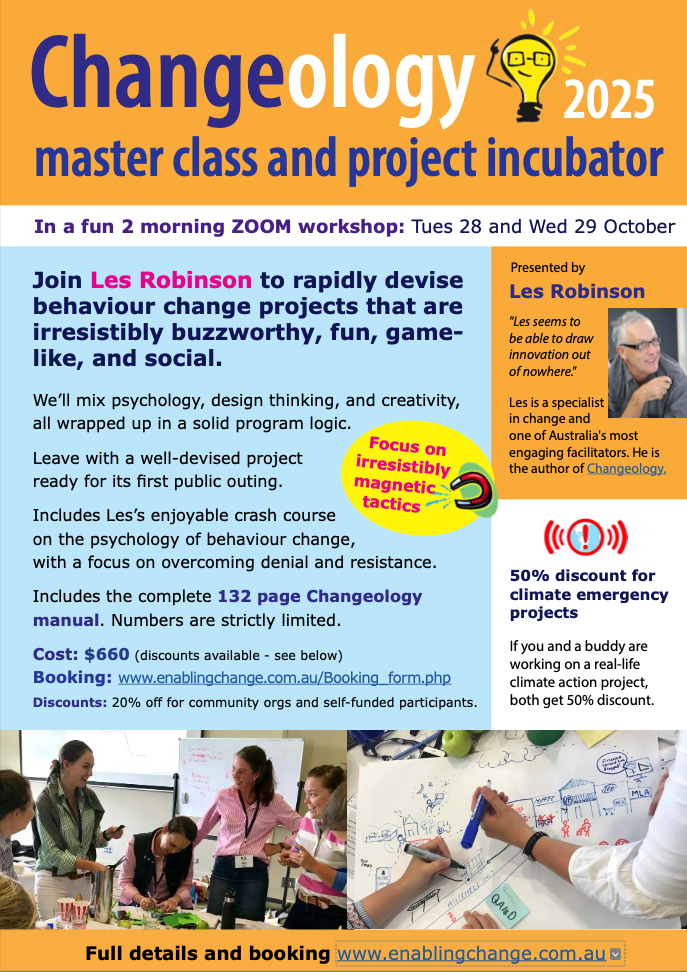
However, of course, keep in mind that theories only help us THINK better. They don’t tell us HOW to design real life projects. That’s about process and creativity – which is what we cover in the Changeology Masterclass and Project Incubator. The next masterclass is on 2 mornings, 28 and 29 October. Booking and details are here: www.enablingchange.com.au


Smiles do more than break the ice, they liberate imaginations
The difference between worrying brains and smiling brains is… well, it’s everything when it comes to facilitation.
The minute a group starts smiling, ideas arrive. Then someone laughs and more ideas pop out. Then everyone laughs and it’s an ideas riot.
Seriously, I’ve seen this so many times I’m amazed there isn’t a name for it.
There’s actually good science on this, from the researcher Barbara Frederickson, who showed that joy and playfulness broaden people’s range of thoughts and actions, and help form new relationships and skills – which is exactly what we want from facilitation.
Smiles literally break the mental box that groups so often find themselves trapped in. Their repertoire of possibilities increases and they start to play in a wider space.
By comparison, worrying brains are tunnel-vision brains. It’s not possible for people to worry themselves to interesting and original ideas.
Smiles are seriously powerful. Let’s facilitate for smiles.
But how? I think the answer is to be relaxed and a little silly.
This gives our group permission to be relaxed and silly too.
And also, vitally, make sure we excite their imaginations with left-field ideas BEFORE they start brainstorming https://www.tazio.com.au/store/. Usually a 20 minute slide show of inspiring examples is enough, followed by a short discussion.
And, oh yes, party hats are excellent too. Here’s me and others being silly, under the awesome influence of party hats.

This and much more at the next Facilitate with Confidence training, over 2 mornings on 20-21 October.
Together we’ll peer into the psychology of facilitation and get some friendly practice with kind colleagues. Details and booking here: www.enablingchange.com.au
You’ll never facilitate the same way again.
Besty wishes
Les Robinson
]]>
Engagement – it’s the make or break factor in a change project.
So, how to go about maximising engagement?
I recently interviewed 12 extension and natural resource management professionals in Qld, NSW and Victoria. They described 25 farmer engagement projects they felt were successful.*
‘Success’, here, was really about attendance. All these projects had high attendance from farmers – a tough crowd to attract!
Strikingly, 4 design factors were common to almost every project.
I’m pretty sure these success factors are universal.
You can download a One-pager about the model here: www.enablingchange.com.au
* This was part of a project funded by Department of Primary Industries, Qld – thanks Niall and team!
Here’s the model:

Here’s an example of the four factors in action:

Here’s detail on the factors:
Pop
To get people to notice and buzz about your event there should be at least one surprising aspect that breaks their expectations.
Even just an out-of-the-ordinary title can be enough.

Here’s an example: ‘Small Landholder Long Lunch’. Would this unexpected title grab your attention?
Power-up
Your project should promise to increase people’s power to act on a real scarcity, problem or frustration they’re facing. That’s the value you offer.
Notably, successful events were absolutely focused on positive solutions. They didn’t argue with people, instead they aimed to increase self-efficacy by depicting/demonstrating exactly how to perform pivotal practical steps people could immediately put into practice.
Nothing builds self-efficacy and lowers fears like seeing how to do something successfully.
“I learnt from the first event that the speaker had to offer take-home advice with actions they could put into place right away, not just entertain them.”
– Lori McKern, Hunter LLS
Ideally, it’s good to go beyond simple depictions/demonstrations and let your audience actually touch and feel, experiment, and play with new skills, products and technologies. Learning by doing is always best.
By the way, it’s also good to mix diverse content, so there’s something for everyone. It’s better to offer a taster of 5 subjects, rather than go into depth on one subject. For example, you might organise multiple stations so people could choose their own subject and get in-depth answers they want.
Peer role models
Real, ordinary peers honestly sharing their struggles, lessons and successes is the best way to generate hope and self-efficacy.
Virtually all the successful engagement projects highlighted respected peers who were ahead of the game but not too different from the audience, for example a similar farmer who’s experimenting with new fertiliser practices.
In fact, it’s best if the invitations are sent in the name of those respected peers themselves, rather than the government agency.
And, vitally, keep in mind that learning is a social process so the audience should also have a chance hear each others’ stories and achievements.
Pleasure
Make it fun. Your acid test should be, ‘Would I want to go even if I wasn’t being paid?’
Here’s some examples from the extension field:
• Farmers tasting wheatgrass juice from good and bad soils, comparing the sweetness. (Thanks James Diack, Soil for Life).
• Farmers digging up and tasing tillage radishes from good and bad soils. (Thanks James Diack, Soil for Life).
• Farmers seeing soil bugs in a microscope, with a microbiologist comparing dead (glyphosate) soil with live soil. (Thanks Helen McCosker, Carbon 8)
• Farmers bringing their own soil to get tested.
• A bus trip: “So much happens when they’re on the bus talking. Farmers share their huge knowledge and skills. They love to hear what others are doing! They chatted all day, with the facilitator occasionally prompting questions.” – Renee Madsen, Fitzroy Basin Association.
And remember the food! Food gets everyone’s attention. It’s the glue that builds relationships, aiding easy interactions. Always put the food in the invitation – it’s good to have people salivating when they’re reading about your event!
Here is a wonderful example from Phillip Island Landcare, ‘Bunny Boiler Challenge’. A rabbit control information night that’s simultaneously a fun social event with tasty rabbit stews, ‘pin the tail on the rabbit’ games, rabbit poems and more. There is so much pleasure here, it’s unmissable!

“We had 110 folks turn up in March with a mad scramble at the end for tables. It’s 90% fun and eating and 10% reality, with music, poetry and an expert talk in rabbit control techniques.” – Joel Geoghegan, one of the organisers.
I hope this model is useful folks. Feel free to offer comments and suggestions. – Les
]]>
I just found an inspiring example of a behaviour change advertisement.
When a catastrophic fire approaches, just turn to your partner and say these words: “We should leave.”
I could do that.
Anyone could do that.
Most emergency management ads want people to “Have a plan” – a vague and sprawling idea that raises a pile of perplexing questions and doesn’t answer any of them. By comparison, how beautifully simple is this alternative.
Of course, the creators were reporting to a state government, so they felt duty bound to include some conventional elements – a cinematic apocalypse and a meaningless slogan “How well do you know fire?” But let’s celebrate ad agency VML for finding one genius moment that does the work, delivering 100% of what that ANY video advertisement could possible do, which is to identify one simple, followable action, and model it.
Here is another wonderful example, from NSW Department of Communities and Justice. Again, the action is just to say a few words: “Can I kiss you?”
Anyone could do that.
Brilliant! It reduces all the (no doubt) fantastic complexity of sexual consent education to a simple, followable action. And, nicely, the voiceover even says “That’s how you do it” showing that the scriptwriters knew exactly what they were doing.
These are both examples of ‘I can do that moments’ – simple, crisp, followable depictions of the pivotal action.
I reckon ‘I can do that moments’ are the single most important components of a behaviour change project.
Why? Because they attack the #1 enemy of change – people’s fear of failure.
I like this quote: “In most cases, people hate change because they don’t like to suddenly become stupid.” (Jared Spool)
‘I can do that moments’ directly attack one of our deepest fears – the humiliation of getting it wrong. When we can see exactly how to perform an action, our self-efficacy grows and fear starts to evaporate.
And yes, you’re right, probably our biggest problem will be to decide which ONE pivotal action to focus on, and then convince our managers. I know that won’t be easy – but judicious use of focus groups (which we should be doing anyway) are sure to help.
Best wishes changing the world folks!
This, and a whole lot more, is covered in our next Changeology Masterclass on the mornings of 28 and 29 October 2025. You’ll get to design your next behaviour change project with some delightful colleagues.
Click here for Masterclass details: www.enablingchange.com.au