Here are 3 infographics that look deeper.


Engagement – it’s the make or break factor in a change project.
So, how to go about maximising engagement?
I recently interviewed 12 extension and natural resource management professionals in Qld, NSW and Victoria. They described 25 farmer engagement projects they felt were successful.*
‘Success’, here, was really about attendance. All these projects had high attendance from farmers – a tough crowd to attract!
Strikingly, 4 design factors were common to almost every project.
I’m pretty sure these success factors are universal.
You can download a One-pager about the model here: www.enablingchange.com.au
* This was part of a project funded by Department of Primary Industries, Qld – thanks Niall and team!
Here’s the model:

Here’s an example of the four factors in action:

Here’s detail on the factors:
Pop
To get people to notice and buzz about your event there should be at least one surprising aspect that breaks their expectations.
Even just an out-of-the-ordinary title can be enough.

Here’s an example: ‘Small Landholder Long Lunch’. Would this unexpected title grab your attention?
Power-up
Your project should promise to increase people’s power to act on a real scarcity, problem or frustration they’re facing. That’s the value you offer.
Notably, successful events were absolutely focused on positive solutions. They didn’t argue with people, instead they aimed to increase self-efficacy by depicting/demonstrating exactly how to perform pivotal practical steps people could immediately put into practice.
Nothing builds self-efficacy and lowers fears like seeing how to do something successfully.
“I learnt from the first event that the speaker had to offer take-home advice with actions they could put into place right away, not just entertain them.”
– Lori McKern, Hunter LLS
Ideally, it’s good to go beyond simple depictions/demonstrations and let your audience actually touch and feel, experiment, and play with new skills, products and technologies. Learning by doing is always best.
By the way, it’s also good to mix diverse content, so there’s something for everyone. It’s better to offer a taster of 5 subjects, rather than go into depth on one subject. For example, you might organise multiple stations so people could choose their own subject and get in-depth answers they want.
Peer role models
Real, ordinary peers honestly sharing their struggles, lessons and successes is the best way to generate hope and self-efficacy.
Virtually all the successful engagement projects highlighted respected peers who were ahead of the game but not too different from the audience, for example a similar farmer who’s experimenting with new fertiliser practices.
In fact, it’s best if the invitations are sent in the name of those respected peers themselves, rather than the government agency.
And, vitally, keep in mind that learning is a social process so the audience should also have a chance hear each others’ stories and achievements.
Pleasure
Make it fun. Your acid test should be, ‘Would I want to go even if I wasn’t being paid?’
Here’s some examples from the extension field:
• Farmers tasting wheatgrass juice from good and bad soils, comparing the sweetness. (Thanks James Diack, Soil for Life).
• Farmers digging up and tasing tillage radishes from good and bad soils. (Thanks James Diack, Soil for Life).
• Farmers seeing soil bugs in a microscope, with a microbiologist comparing dead (glyphosate) soil with live soil. (Thanks Helen McCosker, Carbon 8)
• Farmers bringing their own soil to get tested.
• A bus trip: “So much happens when they’re on the bus talking. Farmers share their huge knowledge and skills. They love to hear what others are doing! They chatted all day, with the facilitator occasionally prompting questions.” – Renee Madsen, Fitzroy Basin Association.
And remember the food! Food gets everyone’s attention. It’s the glue that builds relationships, aiding easy interactions. Always put the food in the invitation – it’s good to have people salivating when they’re reading about your event!
Here is a wonderful example from Phillip Island Landcare, ‘Bunny Boiler Challenge’. A rabbit control information night that’s simultaneously a fun social event with tasty rabbit stews, ‘pin the tail on the rabbit’ games, rabbit poems and more. There is so much pleasure here, it’s unmissable!

“We had 110 folks turn up in March with a mad scramble at the end for tables. It’s 90% fun and eating and 10% reality, with music, poetry and an expert talk in rabbit control techniques.” – Joel Geoghegan, one of the organisers.
I hope this model is useful folks. Feel free to offer comments and suggestions. – Les
]]>
I just found an inspiring example of a behaviour change advertisement.
When a catastrophic fire approaches, just turn to your partner and say these words: “We should leave.”
I could do that.
Anyone could do that.
Most emergency management ads want people to “Have a plan” – a vague and sprawling idea that raises a pile of perplexing questions and doesn’t answer any of them. By comparison, how beautifully simple is this alternative.
Of course, the creators were reporting to a state government, so they felt duty bound to include some conventional elements – a cinematic apocalypse and a meaningless slogan “How well do you know fire?” But let’s celebrate ad agency VML for finding one genius moment that does the work, delivering 100% of what that ANY video advertisement could possible do, which is to identify one simple, followable action, and model it.
Here is another wonderful example, from NSW Department of Communities and Justice. Again, the action is just to say a few words: “Can I kiss you?”
Anyone could do that.
Brilliant! It reduces all the (no doubt) fantastic complexity of sexual consent education to a simple, followable action. And, nicely, the voiceover even says “That’s how you do it” showing that the scriptwriters knew exactly what they were doing.
These are both examples of ‘I can do that moments’ – simple, crisp, followable depictions of the pivotal action.
I reckon ‘I can do that moments’ are the single most important components of a behaviour change project.
Why? Because they attack the #1 enemy of change – people’s fear of failure.
I like this quote: “In most cases, people hate change because they don’t like to suddenly become stupid.” (Jared Spool)
‘I can do that moments’ directly attack one of our deepest fears – the humiliation of getting it wrong. When we can see exactly how to perform an action, our self-efficacy grows and fear starts to evaporate.
And yes, you’re right, probably our biggest problem will be to decide which ONE pivotal action to focus on, and then convince our managers. I know that won’t be easy – but judicious use of focus groups (which we should be doing anyway) are sure to help.
Best wishes changing the world folks!
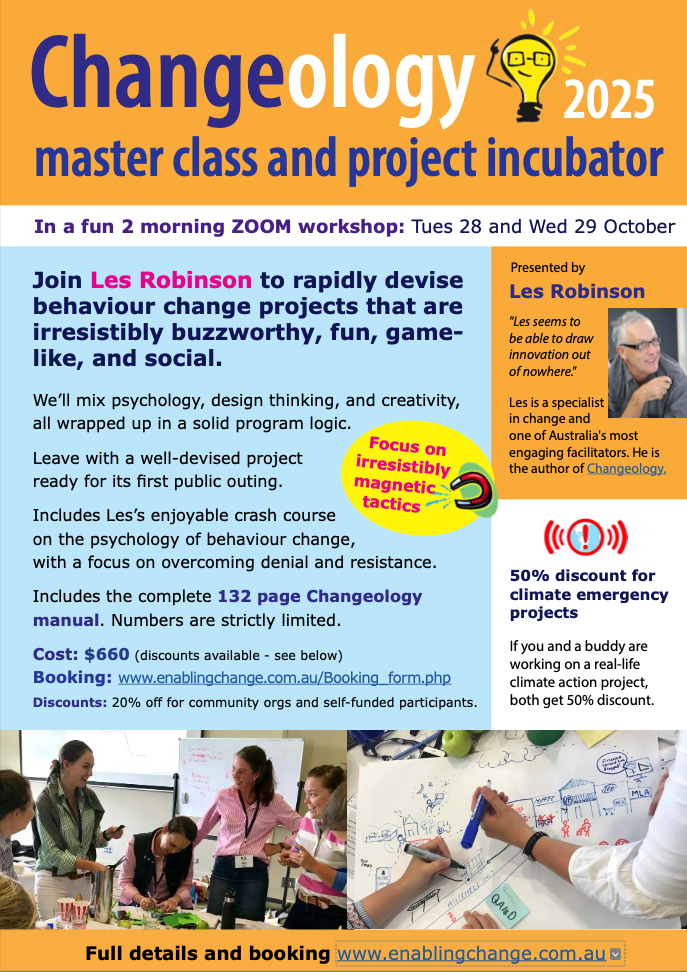
This, and a whole lot more, is covered in our next Changeology Masterclass on the mornings of 28 and 29 October 2025. You’ll get to design your next behaviour change project with some delightful colleagues.
Click here for Masterclass details: www.enablingchange.com.au

To everyone who sent in cool ideas: bloody well done! – both for your imagination and courage in breaking the unwritten rules about how we engage communities.
Hope you find these ideas inspiring.

A Regent Honeyeater soundscape, Lithgow
This mural – at the Capertee rest stop – uses a motion-triggered sound system to play the Regent Honeyeater’s call as you walk past. It’s so beautiful, you just have to play with it. (There are only 300 Regent Honeyeaters left.)
Thanks Viv Howard. This project was supported by Birdlife Australia, Central Tablelands Local Land Services and the National Landcare Program.
Re-loved food is sexy


These fabulous shots show some of Hidden Harvest’s work in changing perceptions about food waste. Their creative, fun, tasty approach is irresistible.
Thanks Berbel Franse. Hidden Harvest is a Wollongong-based NGO group that’s passionate about food waste.
Give nature a voice
These adorable, funny TV ads are a brilliant example of how to use charm and humour to grab and hold attention without causing resistance. Thanks for the inspiration, Water Corporation (WA).
Young people + creative action = climate adaptation

Banksia Gardens Youth Service, Broadmeadows, empowers young people on climate, by mashing ‘how-to’ workshops with youthful energy, fun and creativity.
CARYA – Climate Adaption Requires Youth Action project
“Bushcare is” – messaging, with a personal touch

“I loved doing this program and loved connecting with the people and seeing their responses.”
Thanks Erin Hall, Blue Mountains City Council. There’s something immensely engaging about the ‘voice’ of passionate lay people – always more honest and touching. We just WANT to read their words.
The Pink Nose Project, PNG
A genius, hi-viz idea that gives instant character and buzzworthiness to a project. It announces that women surfers are a cool, happening thing in PNG. The Pink Nose Project. So simple! An idea that really sparks my imagination. [Thanks Leigh Baker]

‘Our Home’ usable litter sculpture

These creative portable litter cages surely must uplift the buzzability of an otherwise boring subject – bushland litter. Passersby can’t help but pop litter inside – becoming agents of the solution – and there’s also a need social norming effect as we observe how many others have done the right thing.
Well done Melbourne Water.
A playful community consultation method

Well done Amy Brand of Let Me Be Frank. A simple, accessible way for people to express their visions for an urban tree strategy.
]]>So, it’s good to put together collections of mind-expanding ideas to get participants thinking optimistically and expansively – bubbling with possibilities – before they start putting their ideas down. Usually we start with a 20-minute show (though sometimes it might be a half-day of expert presentations!), then we have an initial open discussion to get more ideas out there. Only then do we have the brainstorm – which can be amazingly rapid if it’s done in silence.
Hope you find these collections useful …and fun.
1) Public signs with a difference

‘Be visible!’ Public signs are sustained legacies of our efforts – permanently visible reminders of changed social expectations. So making signs attention-getting is vital.
Here’s a collection of public signs that made me blink and think.
https://www.enablingchange.com.au/blog/strategy-2/uncategorized/signs-for-change/
2) Conversation starters, or what engages people?

This is my collection of irresistible engagement tactics. I use these to inspire participants in Changeology workshops. People are always asking for them.
3) A cavalcade of fun video ads
Here’s an amazing diversity of videos – all on the same subject.
If you’re preparing a public information campaign – no matter what the subject – this might be a useful stimulation.
Which approach is the most credible? Most enjoyable? Most memorable?
It was assembled for the Fight Food Waste CRC’s 2021 national food waste summit.
4) Innovating the volunteer experience

The secret to reinvigorating volunteer groups is to reinvent the volunteer experience – to modify what the group actually does.
Here’s a collection of reinvention ideas to put the zap back into volunteer groups, drawn from my Passion Mashing workshops with Landcare and bushcare groups.
http://www.enablingchange.com.au/If_not_then_what.pdf
Enjoy!
]]>Change is hard. We’re asking people to invest effort and negotiate risk. We know they’re liable to resist any form of pressure.
So what might work? Here are 8 rules and some tips.
You’ll immediately notice that change communication is likely to be more fun and interesting than inform communication!
Here is a 2 page practice sheet “Communication for Change”.
Hope you find it useful.
Warm wishes
– Les


PLUS Details of upcoming CHANGEOLOGY workshops in Sydney and Melbourne are now available.
It’s an enjoyable two days with a wonderful bunch of colleagues. Bring along a tricky environmental, social or health challenge. Leave with a prototype project ready for its first public outing.

Discounts for climate change projects: We’re offering 2 for 1 discounts for teams working on climate change projects. Plus full scholarships to a limited number of passionate volunteers working on similar projects. If you’re seeking a volunteer place, please start by sending me a short email explaining your project.
]]> How to make plastic-free society
With the Chinese recycling import ban, there’s a whole lotta behaviour change coming for Australian households and businesses. As they say on TV “this changes everything”. It’s a good time to pause and reflect on what works in waste-related behaviour change.
Here’s a neat summary of state-of-the-art principles for waste behaviour change from Louise Kloff at UNSW (thanks for quoting me Louise), published in The Conversation. She emphasises being positive, empowering, making action simple, and “make people feel that they are part of an inclusive movement that is supported by the community and relevant to their own lives.”
Nice work Louise!
P.S. I just viewed all her links…they are an education in themselves, including WA’s positive and empowering “What’s your bag plan” advertising campaign. https://www.der.wa.gov.au/your-environment/wa-plastic-bag-ban/491-plastic-bag-ban-shoppers

Corina and Jo show us how
Corina and Jo, two “completely average” Ryde mums, give us a lesson with their delightful and funny War on Waste Action Toolkit, Good for the Hood.
They made it for the ABC as part of Craig Reucassel’s War on Waste.
It’s the only action kit that I’ve ever wanted to read from beginning to end, and includes some hilarious “How not to…” video parodies of really bad campaigning, for example:
Corina and Jo…you are my role models.
(Conflict of interest declaration: Corina and Jo are Changeology graduates.)
 Chip and Dan Heath’s The Power of Moments
I’ve just started reading Chip and Dan Heath’s latest book The Power of Moments, about how we can consciously create change moments for other people, written in their signature engrossing style. Apart from the fact that these two have an amazing knack of nailing really central insights, it feels true that transformative experiences really only take a moment. We change makers need to pay more attention to what makes those moments special. Here’s a quote:
“Defining moments shape our lives, but we don’t have to wait for them to happen. We can be the authors of them. What if a teacher could design a lesson that students were still reflecting on years later? What if a manager knew exactly how to turn an employee’s moment of failure into a moment of growth? What if you had a better sense of how to create lasting memories for your kids?”
I have a strong feeling this book is going to change how I do what I do.
Kids + food = great community engagement. Brilliant!
Scott Forsdike, formerly of Willoughy Council, recently shared his secret for effective community engagement.
The challenge: how to get a broad cross-section to attend Willoughby City’s Community Strategic Plan workshop.
His team’s approach:
#1 “Include kids and you include families.”
#2 Have free yummy food.
#3 Add “bring a friend” on the invitation (which worked because of #1 and #2) *
The result: 100+ community members enthusiastically workshopping, with their kids in the middle of the room being looked after by community services staff and asked to imagine their own future of Willoughby (which involved rockets, bikes, parks).
I can just imagine the impact of those bright shining faces, present in the room where their parents could see them, on the vision and quality of the ideas.
Scott is now with the Greater Sydney Commission where he is working on a much broader pallete.
* So let me see: this is really a mashup of crèche, community dinner, and planning night!
Two new tools you might find useful
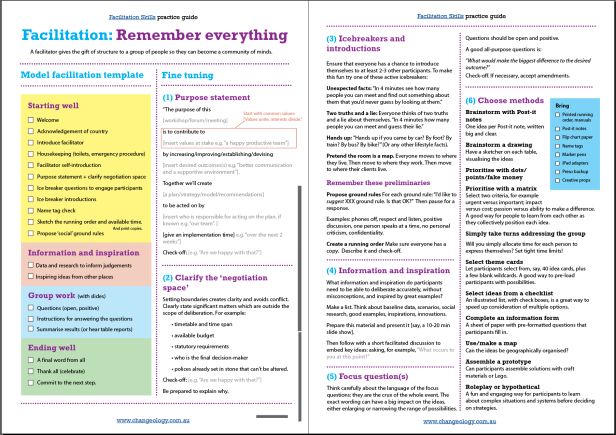
Facilitators’ Remember Everything tool
I got so sick of forgetting things when I facilitate, that I made a tool to remember everything. Hope you find it useful. Send me improvements and I’ll make a version #2.
 Transforming organisations, large and small
Been spending a bit of time in the organisational transformation space lately, and made this short study for the Municipal Association of Victoria, which aims to answer the question: “What’s your theory of change for transforming local government?”
Happy changemaking all!
Warm regards
– Les
P.S. The next series of Changeology and Facilitation training workshops will be in November. I haven’t set dates yet, but drop me your email address (to les@enablingchange.com.au) and I’ll notify you when they are set.
#1 Create ‘I can do that’ moments
#2 Tell of heroes, journeys and victories
#3 Be appreciative
#4 Work on one step at a time
#5 Break the rules to spark delight
#1 – Create ‘I can do that’ moments
Practically everyone knows why they should do be doing the ‘right’ things. Piling on more ‘whys’ probably isn’t going to make any difference (even assuming that people change because of reasons, which they don’t – see Mindspace). What people most commonly lack is the self-belief that they can pull it off and get a result without being embarrassed or creating too much uncertainty, hassle and stress in their lives. This is called having ‘self-efficacy’ or ‘agency’.
Instead of arguing risks and benefits, let’s aim to give people an ‘I could do that’ moment, where they see a similar person performing the exact physical actions, or hear them speaking the exactly right words, to the point where they could imagine doing or speaking them themselves. This is called social learning and it works because it activates mirror neurons.
People hate being persuaded, but they do love to learn new abilities, so ‘how-to’ demonstrations tend not to cause denial or resistance.
My favourite example, from the Food Safety Information Council:
(I feel so strongly about this point, Here’s a whole post about it, with more examples: https://changeologyblog.wordpress.com/2018/02/20/i-could-do-that-rule-1-of-good-communication-for-change/)
#2 – Tell of heroes, journeys and victories
Who’s stopped noticing campaign slogans, brand tag lines and messages? If single phrases or sentences ever had power over the human psyche it’s long since evaporated. Stories, by comparison, have always set alight human imaginations. In their mind’s eye, an audience puts on the armour of heroes, follows the journey, discovers how the dream was achieved, and feels the victory.
So, the next time we’re inclined to create a message, let’s talk about a hero, a journey and a victory instead.
Ending HIV, by ACON, is a great example of this approach. Are you ‘in’ for ending HIV?
Another is Buy a Pair, Give a Pair: “The whole story begins with you”,
And here’s a simply glorious example from Thai Life Insurance https://www.youtube.com/watch?v=uaWA2GbcnJU
#3 – Be appreciative
Who was ever belittled, humiliated or criticised into bettering their lives or worlds? Yet, that’s what we do whenever we inadvertently imply that people are doing the wrong thing. We find ourselves lecturing people. And they find themselves resisting and denying.
So let’s start by respecting, loving and believing in people. Let’s swap ‘I am right’ for ‘you are right’. That could be the hardest thing we do, but it puts us on the path to a healthy relationship with people.
A simple way to communicate this is by appreciating what they have already achieved. Here’s a nice example from Shellharbour City Council: https://vimeo.com/244280534
#4 – Work on one step at a time
Change is a journey, often stumbling, full of obstacles and setbacks. The only thing that predicts whether people will take the next step is whether the last step worked for them. So let’s not dilute our efforts by giving people 5, 10 or 20 possible first steps. Instead let’s focus all our resources on one step at a time, and make that as rewarding as possible.
So, for example, not ‘5 steps to recycle well’, but just ‘remove lids and tops’. Break it down, Remember that even one new behaviour can be very hard for people to adopt.
For example, Zoos Victoria Seal the Loop campaign focuses solely on recycling used fishing line, with bins located at boat launch ramps. Mobile Muster focuses solely on recycling mobile phones.
#5 – Break the rules to spark delight
When we stop behaving predictably, we surprise ourselves and our audiences. By breaking expectations about what our communications are supposed to look like we create a wave of pleasure or delight. And that delight causes people to notice us, start buzzing about our idea, and wanting to come and play!
But more than that, our audiences notice that our organisations can change too. That sends a special message about the world: that we welcome and believe in the possibility of change. And that helps people believe in themselves, because without that, nothing will happen.
Caro and Van’s Be an Unfucker is a strong example of this. They seriously broke the rules.
The classic is Dumb Ways to Die by Metro Trains, Victoria, the most viral public safety campaign in history. https://www.youtube.com/watch?v=IJNR2EpS0jw
P.S. Keep in mind, of course, that communication, by itself, is hardly ever the foundation of a successful change project. Sustained behaviour change, or even one-off actions, are really design challenges: about how we create systems that easily enable and support action? However, once the design is in place, then good communication is is vital to reach out and excite people to ‘come and play’.
Upcoming workshops flyer: http://www.enablingchange.com.au/2018_changeology_workshops.pdf


Reasons, benefits and arguments are not just overrated, they are dangerous and counter-productive. Worse, they harm and kill people.
I know that sounds extreme. Bear with me.
Reasons-based change communications are everywhere. You know, the typical Quit advert, or anti-domestic violence advert, or anti-drug message. They’re all based on an implied argument that “You should change because X cost and/or Y benefit”.
The problem with “you should” messages is that they pressure people, and pressure causes resistance. And resistance means that fewer people end up doing healthy, safe behaviours. So more people are harmed than would would be the case without the communication.
Listen to this perplexed researcher in an experiment that examined the effects of health warning labels on fatty products: (1)
“Warning people about the harmful effects of fatty products only made them want to eat the fatty product more…Although people don’t mind being informed about the potentially harmful risks associated with products, they don’t like to receive unwanted advice about how they should behave.”(1)
This is called the Boomerang Effect. It’s backed by a massive weight of empirical evidence through meta evaluations of many hundreds of behaviour change programs. The basic idea is quite intuitive really: we humans are averse to acting on advice intended to change our behaviour, especially when we are the ones who most need the advice. Why? Because that advice implies that we have made wrong decisions. Inadvertently, the advice belittles us. The psychologist Elliot Aronson wrote that most people have favourable views of themselves: they want to see themselves as competent, moral, and able to predict their own behaviour (2). When they receive information that inadvertently contradicts those self-perceptions, they tend to deny and resist it.
So what might be a better approach?
Don’t try to argue people into change, instead show them HOW to start their journey.
People don’t need to be told why they should change. They need to be shown how to start
Mostly, anyone who’s going to change as a result of our efforts already knows the reasons why they should change. In fact, large numbers of people are already highly motivated to improve their lives and make a difference in their worlds.
For example 70% of smokers already want to quit; 90% of overweight young women want to lose weight; 70% of Australians think climate change is a pressing problem etc. What they lack is self-efficacy: the belief that they can successfully carry out effective actions, and get a result, without the risk of failure or embarrassment.
Helping people over the hurdle of just starting is a more powerful change intervention that lecturing them about costs and benefits.
How can we create that self-efficacy? Well, having relationships with peer role models is undoubtedly the best way, but self-efficacy is something that communication can contribute to.
The trick is to depict the necessary actions so clearly that a typical listener could say:
“I could do that!”
This is a critical point. It’s not enough simply to demonstrate a behaviour. What’s vital is that we genuinely create an “I could do that” moment for our audience. This immediately tells us that the action we depict has to be simple and within their capacities.
Here are some nice examples of self-efficacy building communications.
This is my favourite, from The Food Safety Information Council. Notice how unnecessary the slogan is at the end.
https://www.youtube.com/watch?v=uvyRSQrfpJg
Shellharbour City Council gets it with this advert for their food waste collection service.
https://vimeo.com/196789244
The Quit campaign just made its first positive anti-smoking advert (well done!). It creates self-efficacy by letting viewers rehearse effective self-talk. (Though notice how the makers couldn’t help lecturing in the last few sentences).
https://www.youtube.com/watch?v=FQpcK5gL5W8
The beautiful thing about self-efficacy is that people willingly embrace new skills and abilities. We humans love to increase our power and agency in the world. Communications that increase self-efficacy therefore tend not to create resistance.
So next time we’re inclined to reason with our audiences, let’s think about creating an “I could do that!” moment instead. We’ll reduce the chance of resistance and create an opportunity for all to be part of the solution.
P.S. There’s another reason why ‘I could do that’ communications are a good idea.
Numbers
Let’s say our communication reaches 30% of the target population, and succeeds in getting an amazing 5% of those viewers to click to the next stage, or download the app, or call a 1300 number, or whatever. That sounds good, but wait a minute! We activated only 1.5% of the target population. We actually reached another 28.5% of target population but failed to give them any meaningful role in the solution. We didn’t involve them at all! That’s a terribly wasted opportunity. By building wide self-efficacy with our communication we greatly magnify our impact by giving everyone a do-able role.
References:
(1) Bushman, B. J. (1998) ‘Effects of warning and information labels on consumption of full-fat, reduced-fat, and no-fat products’, Journal of Applied Psychology 83, 97-101.
(2) Aronson, E. (1999) ‘Dissonance, hypocrisy and self-concept’, in E. Harmon-Jones and J. Mills (eds.), Cognitive Dissonance: Progress on a pivotal theory in social psychology. Washington, DC: American Psychological Association, 103-26.
 “Play Cricket” (fully endorsed by the Milo corporation) came to my son’s school yesterday. Here is a photo of our kitchen bin this morning. It contains a sheaf of stickers and coloured flyers.
I asked what happened. Our 8 year old said “There was these people who came to our school and gave us Milo.” I had to explain to our boy that “4.5 stars” doesn’t mean that Milo is “healthy food that’s low in sugar”. (Milo is actually 46% sugar).
 And there’s more. If we were to sign up our son to Milo-endorsed cricket he’d get a “Bonus Player Pack” with logo-emblazoned backpack, bat, ball, hat, T-shirt, water bottle and sachet of Milo.
Amazing!
Not really. It would all end up in the bin too. Along with the Surf Groms backpack, water bottle etc, with their Weet-Bix and Quicksilver logos. Along with the local rugby league’s child-labour produced footballs and sheets of KFC-logo’d stickers. It’s all going in the bin.
Here’s the thing. We parents are in an anti-corporate resistance. Our job is to put this stuff in the bin and de-program our kids when they get home.
Cricket, surfing and football, of course, are all good things in themselves. However, if our son wanted to sign up, it would because he was genuinely excited about cricket: Either a) he knew someone who loved cricket; b) it was a memorable experience when “Play Cricket” came to his school; or c) the “Play Cricket” ambassador had a magnetic personality our son wanted to be like.
In other words it would be because of experiences and relationships.
It would not be because of branded collateral: stuff with messages and logos. Maybe in the 20th century, when this idea was original, branded stuff might have meant something.
But in the 21st century almost everyone has enough backpacks, bottles, and hats. The corporate versions are just more clutter in already over-cluttered lives. They ONLY belong in the bin. A colleague who works for a very large and well-known NSW government agency told me: “Years ago we used to have to lock up the promotional gear otherwise our work colleagues would steal it. Nowadays we can’t give it away.”
I expect PR operatives (whose worldview is obsessed with brands and messages) to delude themselves branded stuff makes a difference. What is interesting is how often our public good projects do it too. I know. I used to be the brochure king. I used to design clever, die-cut brochures for all kinds of public good efforts. I was wrong. This stuff makes no difference to human behaviours. Experiences and relationships are what do the work.
Oh yes, there one other vital factor: unpredictability. It’s the unpredictable that “cuts through” and makes us notice things, buzz about them, and come closer to find out more. Collateral therefore has another fatal flaw: predictability. There is nothing memorable or buzzworthy about yet another plastic water bottle, colouring-in page, key ring, mouse pad, or set of stickers. People are going to forget about them the minute they look away.
I look at the boxes of branded water bottles, pens and stickers in the offices of government, council and NGO project managers, and wonder: Maybe if we invested less on stuff maybe we could invest more on experiences?
The secret life of the bell curve
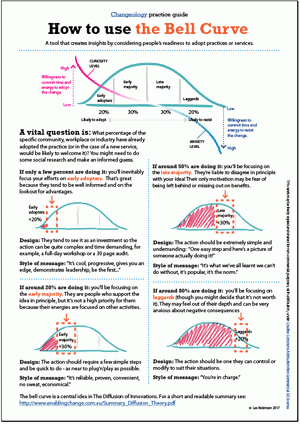
Revelations about the Bell Curve always seem to score well on the “yes I can still remember that the next day” scale in the Changeology workshop.
Graduates might recall our discussion about how knowing (or guessing) just one vital statistic – the current rate of adoption in your target audience – provides such valuable guidance for project design and the crafting of communications.
I’ve finally got round to properly illustrating this idea. Here’s a one pager that summarises it. I hope you find it useful. Click here to download a PDF version.
https://www.enablingchange.com.au/One_page_bell_curve.pdf
Upcoming CHANGEOLOGY and FACILITATION SKILLS workshops, Sydney and Melbourne
The workshops are on again in October. This time Changeology is looking more and more like a hybrid design workshop and a creativity camp. There’s still a grounding social psychology and step-by-step process, but the more I deliver it, the more I find I’m emphasising processes which push the imaginations of project designers into seekingly wacky places. As Albert Camus said: “All great deeds and all great thoughts have a ridiculous beginning.”
Changeology method hothouse
The 2-day master class in making change happen
Get the ideas, inspirations, processes and tools to devise projects that change the world. Full details.
Melbourne 17-18 October | Sydney 25-26 October
Book a place: Sydney or Melbourne.
Facilitate with Confidence
Facilitate any gathering with skill and authority
Lay a solid foundation for your role as a facilitator of meetings and workshops in any context. Full details.
Melbourne 19 October | Sydney 27 October
Book a place: Sydney or Melbourne.