
I just found an inspiring example of a behaviour change advertisement.
When a catastrophic fire approaches, just turn to your partner and say these words: “We should leave.”
I could do that.
Anyone could do that.
Most emergency management ads want people to “Have a plan” – a vague and sprawling idea that raises a pile of perplexing questions and doesn’t answer any of them. By comparison, how beautifully simple is this alternative.
Of course, the creators were reporting to a state government, so they felt duty bound to include some conventional elements – a cinematic apocalypse and a meaningless slogan “How well do you know fire?” But let’s celebrate ad agency VML for finding one genius moment that does the work, delivering 100% of what that ANY video advertisement could possible do, which is to identify one simple, followable action, and model it.
Here is another wonderful example, from NSW Department of Communities and Justice. Again, the action is just to say a few words: “Can I kiss you?”
Anyone could do that.
Brilliant! It reduces all the (no doubt) fantastic complexity of sexual consent education to a simple, followable action. And, nicely, the voiceover even says “That’s how you do it” showing that the scriptwriters knew exactly what they were doing.
These are both examples of ‘I can do that moments’ – simple, crisp, followable depictions of the pivotal action.
I reckon ‘I can do that moments’ are the single most important components of a behaviour change project.
Why? Because they attack the #1 enemy of change – people’s fear of failure.
I like this quote: “In most cases, people hate change because they don’t like to suddenly become stupid.” (Jared Spool)
‘I can do that moments’ directly attack one of our deepest fears – the humiliation of getting it wrong. When we can see exactly how to perform an action, our self-efficacy grows and fear starts to evaporate.
And yes, you’re right, probably our biggest problem will be to decide which ONE pivotal action to focus on, and then convince our managers. I know that won’t be easy – but judicious use of focus groups (which we should be doing anyway) are sure to help.
Best wishes changing the world folks!
This, and a whole lot more, is covered in our next Changeology Masterclass on the mornings of 28 and 29 October 2025. You’ll get to design your next behaviour change project with some delightful colleagues.
Click here for Masterclass details: www.enablingchange.com.au

The 4 Clarities Collaboration Inception Tool, updated
I use this tool to plan multi-stakeholder workshops. It emerged from training with the Greater Sydney Commission in 2018. It’s based on an ah-hah! realisation that stakeholder consultations and partnerships fail before they begin because of a lack of 4 clarities:
- Clarity of purpose
- Clarity of negotiation space
- Clarity of roles and authority
- Clarity of language
Get these right and I’ve laid down the foundations for success. I’ve updated this tool after some more work with the Victorian Essential Services Commission. I hope you find it useful. Here it is.
System-thinking is oh sooo important, but oh so serious

I can’t stop reading John Gall’s delightful, hilarious, Systemantics, the Systems Bible, published way back in 1975. At first I couldn’t work out if he was being serious or satirical. Then it slowly dawned on me that Gall has found a simply awesome way to communicate incredibly important material. Yes, “Systems in general work poorly or not at all.” and this is a complete course in systems wisdom.
Here’s a taste of his style:
“Russians, Chinese, Americans, Africans, may differ on everything else in the world, but the one thing they all agree on is that whatever the problem may be, the answer lies in setting up some system to deal with it..
and
“Systems are seductive. They promise to do a hard job faster, better, and more easily than you could do it by yourself. But if you set up a System, you are likely to find your time and effort now being consumed in the care and feeding of the System itself. New Problems are created by its very presence.
[ a.] Once set up, it won’t Go Away; it Grows and Encroaches.
[ b.] It begins to do Strange and Wonderful Things
[ c.] and Breaks Down in Ways You Never Thought Possible.
[ d.] It Kicks Back, Gets In The Way and Opposes Its Own Proper Function.
[ e.] Your own perspective becomes distorted by being In The System.
[ f.] You become anxious and Push On It To Make It Work.
[ g.] Eventually you come to believe that the misbegotten product it so grudgingly delivers is What You Really Wanted all the time.”
Here is a perfect maxim that should be engraved above every minister’s office (or forehead):
“A complex system that works is invariably found to have evolved from a simple system that worked. A complex system designed from scratch never works and cannot be patched up to make it work. You have to start over with a working simple system.”
If only.
That’s just staggeringly clear thinking.
Free scholarships for passionate volunteers

I love having volunteers in my training. They bring soul, spirit, different thinking and enrich the experience for everyone. I’m offering free scholarships for keen volunteers in the next cycle of inspiring training events (6 per workshop).
Changeology: Melb 8-9 April; Sydney 1-2 May
Facilitate with Confidence: Melb 10 April, Sydney 3 May
Full details here: www.enablingchange.com.au
If you know a volunteer who might enjoy this, ask them to send some details about their background and volunteer activities to les@enablingchange.com.au
Everything’s connected
I found these two intriguing examples of non-straight-line results, revealed in academic studies:

• Students who did Stephanie Alexander Kitchen Garden programs showed a 50% reducing in bullying behaviours. Source: University of Wollongong.
• Students who did school arts programs gain a full year in NAPLAN scores in reading. and 65% less absenteeism. Source: Victorian Parliament Music in Schools Inquiry 2013.
Now, of course, school gardens are not meant to be anti-bullying initiatives, and arts programs are not meant to be reading and absenteeism initiatives.
And, of course, our funders might be uninterested in these kind of unexpected results, but they’re exciting and memorable. Let’s watch out for them and proudly shout them to the public and our participants.
They’re telling us that real change need not be linear, simple or predictable.
A fiesta of activism, coming soon
Soon, an inspiring week-long fiesta of events and creativity for campaigners and activists. The focus is on building skills and making connections. I’ll be there sharing some changeology and innovation tricks. To join in, start here: Festival of Change, Beechworth, 1-4 April
People love certain kinds of stories

I like this list of “content people crave” from marketer Scott Aughtmon: 21 types of content we all crave. It’s stuck on my wall.
Gee whiz
I’m in awe of Jessamy Gee. She just “graphically recorded” a Passion Mashing session for enviro volunteers at Knox City. All the complexity of the day went into her brain, and sprang out through her fingers, so quickly, so beautifully, and so well explained! I’m now a firm believer in the power of graphic recording and Jessamy is brilliant at it.

 How to make plastic-free society
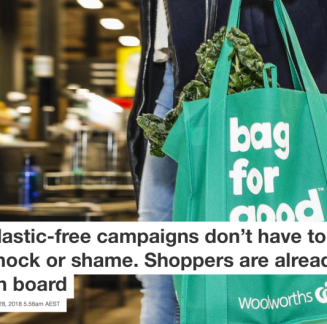
With the Chinese recycling import ban, there’s a whole lotta behaviour change coming for Australian households and businesses. As they say on TV “this changes everything”. It’s a good time to pause and reflect on what works in waste-related behaviour change.
Here’s a neat summary of state-of-the-art principles for waste behaviour change from Louise Kloff at UNSW (thanks for quoting me Louise), published in The Conversation. She emphasises being positive, empowering, making action simple, and “make people feel that they are part of an inclusive movement that is supported by the community and relevant to their own lives.”
Nice work Louise!
P.S. I just viewed all her links…they are an education in themselves, including WA’s positive and empowering “What’s your bag plan” advertising campaign. https://www.der.wa.gov.au/your-environment/wa-plastic-bag-ban/491-plastic-bag-ban-shoppers

Corina and Jo show us how
Corina and Jo, two “completely average” Ryde mums, give us a lesson with their delightful and funny War on Waste Action Toolkit, Good for the Hood.
They made it for the ABC as part of Craig Reucassel’s War on Waste.
It’s the only action kit that I’ve ever wanted to read from beginning to end, and includes some hilarious “How not to…” video parodies of really bad campaigning, for example:
Corina and Jo…you are my role models.
(Conflict of interest declaration: Corina and Jo are Changeology graduates.)
 Chip and Dan Heath’s The Power of Moments
I’ve just started reading Chip and Dan Heath’s latest book The Power of Moments, about how we can consciously create change moments for other people, written in their signature engrossing style. Apart from the fact that these two have an amazing knack of nailing really central insights, it feels true that transformative experiences really only take a moment. We change makers need to pay more attention to what makes those moments special. Here’s a quote:
“Defining moments shape our lives, but we don’t have to wait for them to happen. We can be the authors of them. What if a teacher could design a lesson that students were still reflecting on years later? What if a manager knew exactly how to turn an employee’s moment of failure into a moment of growth? What if you had a better sense of how to create lasting memories for your kids?”
I have a strong feeling this book is going to change how I do what I do.
Kids + food = great community engagement. Brilliant!
Scott Forsdike, formerly of Willoughy Council, recently shared his secret for effective community engagement.
The challenge: how to get a broad cross-section to attend Willoughby City’s Community Strategic Plan workshop.
His team’s approach:
#1 “Include kids and you include families.”
#2 Have free yummy food.
#3 Add “bring a friend” on the invitation (which worked because of #1 and #2) *
The result: 100+ community members enthusiastically workshopping, with their kids in the middle of the room being looked after by community services staff and asked to imagine their own future of Willoughby (which involved rockets, bikes, parks).
I can just imagine the impact of those bright shining faces, present in the room where their parents could see them, on the vision and quality of the ideas.
Scott is now with the Greater Sydney Commission where he is working on a much broader pallete.
* So let me see: this is really a mashup of crèche, community dinner, and planning night!
Two new tools you might find useful
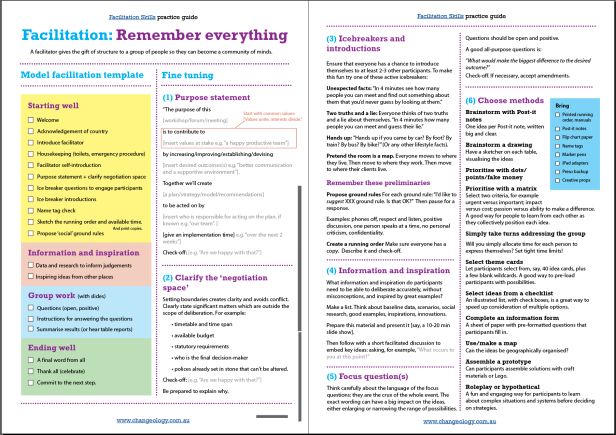
Facilitators’ Remember Everything tool
I got so sick of forgetting things when I facilitate, that I made a tool to remember everything. Hope you find it useful. Send me improvements and I’ll make a version #2.
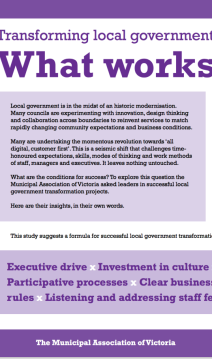 Transforming organisations, large and small
Been spending a bit of time in the organisational transformation space lately, and made this short study for the Municipal Association of Victoria, which aims to answer the question: “What’s your theory of change for transforming local government?”
Happy changemaking all!
Warm regards
– Les
P.S. The next series of Changeology and Facilitation training workshops will be in November. I haven’t set dates yet, but drop me your email address (to les@enablingchange.com.au) and I’ll notify you when they are set.
 Refugees, Aborigines, and the unemployed will change their behaviour if they are treated cruelly enough. At least that’s according to the wisdom of those who design multi-billion dollar Australian Government programs. I’d like to meet some of those people.
The latest torment-based innovation is drug-testing for welfare recipients. Absolutely no informed person thinks it will work, or is fair, or will produce anything other than greater human suffering. The head of the Australian Medical Association gave it a “Nasty star” as “mean and non-evidence-based”. Matt Noffs from the Ted Noffs Foundation wrote “This model doesn’t have heart, and certainly not brains. It is designed to punish the poor, the marginalised, for their circumstances when they need support and options.” Nadine Hazzard, clinical director at the St Vincent’s Hospital wrote “Can the government point to a single piece of evidence – here or overseas – that shows the likelihood of this succeeding? They can’t because it doesn’t exist…By definition, people with clinical disorders are unable to modify their behaviour, even in the face of negative consequences.”
Meanwhile, NSW high school students are being threatened with no HSC if they don’t achieve ‘band 8/10’ in reading, writing and maths in their standardised NAPLAN tests – which is quite a high score. A horrifying 68% of 15-16 year olds, at the most vulnerable time of their adolescence, have just been humiliated and belittled by being told to sit additional NAPLAN tests until they get the desired score. How many mental health experts were involved in that decision?
And refugees who’ve come to Australia for medical attention are about to have their miserable $100 a week survival support removed if they don’t go back to the living hell of Manus Island. Meanwhile, indigenous people aren’t even threatened, they just have their financial autonomy obliterated, via BasicsCard, irrespective of their behaviour, just because they happen to live in certain communities. They’re being punished for being, just, indigenous. How would you feel about being punished for simply being who you are?
For some reason, “Tough love” and “Cruel to be kind” are the folk remedies of preference for white, church-going, patriarchal, establishment males who are trying to control an uncompliant population. Why on earth? Is it caused by too much Old Testament, or does conservative politics somehow auto-select believers with lack of human empathy plus stupidity?
Really, even if BasicsCard or NAPLAN were good ideas, there’s no science to justify the use of threats and punishments to influence human behaviour. Behavioural science is unusually clear on this: threats and punishments cause denial, active resistance, and superficial compliance of the most reluctant and temporary kind. (For example: Elliot, B. (2003) The Psychology of Fear Appeals Revisited, http://acrs.org.au/files/arsrpe/RS030056.pdf)
If you seriously wanted to change the world (and not simply be bastards) threats, cruelty and humiliation would never be your tools of choice.
Instead you’d offer people desirable goals and then construct paths that were within their capacities, to reach those goals. All your efforts would go into creating and smoothing those paths for people. To help long-term unemployed into work, for example, you’d provide intensive counselling, support and training to help them build their capacities, as well as actually having jobs available for them (according to an authoritative 2014 study by Anglicare).
To illustrate the point clearly, let’s use hungry people and a bear to explain the difference between these two approaches.
First, a positive approach: Let’s offer people goals they value and then design pathways, that are within their capacities, to get to those goals. What’s the result?
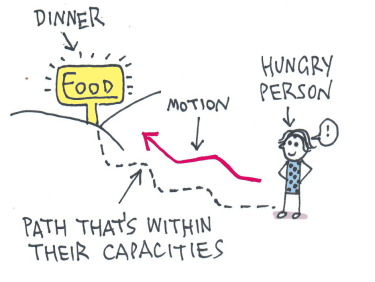
Notice how a clear, desirable goal motivates just ONE action: towards the goal. Provided the path is follow-able, the results relatively certain, and the demands not onerous, we can be pretty sure than large numbers of people will head off, with a will, towards that goal. There are only two behavioural choices, approach the goal or do nothing, and the determining factors are the attraction of the goal and the easiness of the path.
Now, let’s see what a threat does.
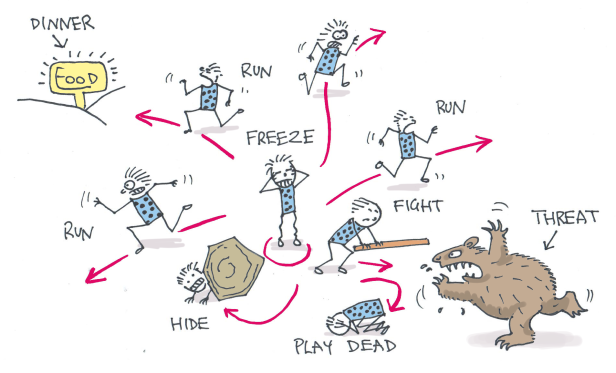
Presumably, some people will randomly head off in the ‘right’ direction, but this is almost accidental: most people will do something the program designer didn’t think would happen, or want. Most especially, they’ll use all their human wiles to avoid and resist the threat. And, in the meantime, they won’t be thinking about achieving a positive goal that betters their lives, they’ll be thinking about immediately escaping the threat.
It’s also well known that threats reduce people’s attention and brain power so they tend to make more dumb, short-term choices and less sensible choices that require long-term staying power. There’s a pile of science on this too. That’s another undesirable result of threats. See Scarcity by Mullainathan and Shafir: https://changeologyblog.wordpress.com/2015/08/04/in-the-tunnel-how-scarcity-changes-minds/
The proliferation of torment-based programs is a big lesson about the void of compassion, rationality and curiosity in conservative politics. Experience, science and empathy seem to have become inherently alien to conservative political culture. Add a predilection for cruelty and governments are continually wounding large numbers of people for little or no social gain. But those politicians and their advisors are in for a surprise: cruelty is a boomerang. The punished always find ways to punish back their punishers. There’s a pile of science on that too.
P.S. Two perfectly case-in-point articles in the Sydney Morning Herald about a week after this post:
http://www.smh.com.au/comment/the-cashless-welfare-card-may-not-be-quite-the-success-it-seems-20170905-gybm0q.html
http://www.smh.com.au/federal-politics/political-opinion/sign-of-the-times-one-standard-for-regular-people-another-for-mps-20170905-gyaysp.html ]]>
This little piece of genius, from a Swiss canton, shows that meeting a real person can be a most persuasive kind of persuasion.
The human brain becomes awake and present when we meet a real person, in ways that impersonal media can never achieve.
So how can we arrange for our audiences to interact with real faces? There must be scores of ways we could emulate the underlying idea. Who wants to give it a go?
Love Makes a Way
The Love Makes a Way movement caused 3,500 older Australians to travel to their MPs offices, and stay and pray until they got arrested or expelled, in the name of releasing refugee children from detention. This is an inspiring Christian movement based on civil disobedience.
We always say that actions should be designed to be easy. But this story made me realise it’s not always true. Onerous actions have a place – especially where causes are strongly motivating and we come together in groups. So maybe Love Makes a Way illustrates how the hardness of the action can be equal to the actors’ passions. Where people care strongly, the ask can be hard.
What’s a ‘design lab’?
Design is the hot thing (designing projects, solutions to social problems, services) for good reason – it’s a really useful approach to change work. We’ve all heard of a ‘design lab’. But what is that? Here’s a slideshow that comprehensively describes what the UK Government’s Policy Lab does (they innovate programs and services). Including the tools they use. This is an excellent overview.
They’ve also provided an open policy tool kit which is full of useful processes. Including what to do in a one day workshop – this is really great model and something that’s easy to adopt.
Effective brainstorms – it’s all in the wording
Here’s the best video I’ve seen on what a design workshop looks like. Notice the finessing of conventional workshop: the precise wording of the instructions matter.
For a word-for-word script for effective workshopping, this post might be useful. There is a lot to keep in mind, so a script can help.
I can’t emphasis the importance of instructing participants to be ‘concrete, specific, and refer things we can see and touch’. Don’t say ‘educate’, instead say ‘set up a billboard outside the IGA’. (Ah-hah, now I know what you mean!)
Fluffy ideas are useless because project managers can’t act on ideas they can’t see in their mind’s eye. True, those ideas will die in the prioritisation phase anyway…but I hate to think of great ideas dying just because of the abstract language used to describe them.
Term of the month: “high serendipity”
(Adj.) Refers to environments where there’s a high chance of a happy or beneficial accidental encounter. Can we design high serendipity experiences for ourselves and others? This term doesn’t pop up in Google, which means I just invented it. I know it’s gotta be useful.
A fantastic health promotion job in northern rivers NSW
My friend Jillian Adams, the health promotion manager of Northern NSW Local Health District, has a fab job going for a health promotion communicator.
Upcoming CHANGEOLOGY and FACILITATION SKILLS workshops, Sydney and Melbourne
The workshops are on again in October. This time Changeology is looking more and more like a hybrid design workshop and a creativity camp. There’s still a grounding social psychology and step-by-step process, but the more I deliver it, the more I find I’m emphasising processes which push the imaginations of project designers into seekingly wacky places. As Albert Camus said: “All great deeds and all great thoughts have a ridiculous beginning.”
Changeology method hothouse
The 2-day master class in making change happen
Get the ideas, inspirations, processes and tools to devise projects that change the world. Full details.
Melbourne 17-18 October | Sydney 25-26 October
Book a place: Sydney or Melbourne.
Facilitate with Confidence
Facilitate any gathering with skill and authority
Lay a solid foundation for your role as a facilitator of meetings and workshops in any context. Full details.
Melbourne 19 October | Sydney 27 October
Book a place: Sydney or Melbourne.
It’s quite a radical concept, and I’d love some feedback.
The idea is that humans are bodies in motion. It’s a fundamental, universal observation: humans are busy.

It’s extraordinary what can be derived from this one simple idea.
First, human motion must always follow a path through the real, physical world, as we travel, shop, move about the house, work, farm, socialise.
Secondly, our paths have destinations that promise satisfaction. Every journey is aimed at a place where we believe a desire or need or frustration can be satisfied.
Thirdly, we choose our destinations conservatively. With high levels of motivation and/or high self-efficacy we are up for adventurous destinations. But when our motivation and/or self-efficacy are low, we stick in the easy, low risk, familiar destinations (a.k.a. the rut of habit).
Fourthly, the actual path followed depends on the environment or landscape. The landscapes we move through have numerous pushes and pulls. Difficult paths inhibit motion.
‘A push or pull’ involves a potential fork in the path where each fork has different degrees of familiarity, certainty, self-esteem, and cost. Naturally, people tend to make whatever choice is most familiar, most certain, least costly, and adds most to self-esteem.
Fifthly, a change project only sometimes involves changing people’s destinations, but it ALWAYS means changing their paths to get there.
A shopping trip is a good example. We start off just aiming to satisfy imagined hunger but the supermarket is a landscape full of pushes and pulls that influence the food-acquiring path we follow and the products we end up taking home. Also, there is a degree of serendipity exposing us to new products along the way, creating the possibility of spontaneous path variation. Then, what if a fruit and vege store pops up just next to the supermarket? Now a major path variation is likely, and a different set of take-home products.
It’s what’s on the path, not the destination, that determines the environmental, social and health costs. How could we change what’s on a path? For example: here’s a neat piece of research (from New Scientist 10 Jan 2015): did you know that women who keep cereal packets visible in the kitchen weigh on average 9.5 kilos more than the who don’t? And those who leave fruit out weigh 3kg less. There’s a simple path twerk that makes a difference to the outcomes. Once you start thinking like this it opens up a world of behavioural interventions that don’t involve changing people’s destinations.
This model gives us a simple theory of change. A successful change project must:
– design new paths and make sure those paths is as effortless as possible (familiar, certain, adding to self-esteem, low cost);
– and this is the important part, aim to MODIFY what’s along the path, so that travelling along that path results in better environmental, social or health outcomes;
As well as, obviously, these things:
– use human stories to increase motivation (motivation is often blunted by remoteness in time and space of consequences. If that’s the case, logic doesn’t work: instead focus on the impact on people close to us, on fairness, on social proof, on passion, and urgency); and
– increase people’s self-efficacy or confidence to perform the necessary journey (so they can see exactly what they’ll need to do to succeed).
I like the idea of bodies in motion along paths because it pulls us down from the fluffy clouds of abstraction into the hard-edged, time-and-motion, physical world that people really inhabit. And we can more readily design prototypes and perform real world experiments.
From now on, the ‘thinking’ part of the Changeology training will have three lenses:
– Bodies in Motion (‘path theory’)
– We hardly ever change alone (Diffusion of Innovations)
– The risk perspective (denial, resistance, and how to avoid them)
]]>