[Of course, no one expects visibility alone to change the world, but if we’re invisible we’re not even in the game!]
Playing in the wacky zone
The trick to grabbing attention is
 to surprise and break stereotypes, which means that, as communicators, we need to be able to surprise ourselves!
So how could we do that? I’ve been experimenting with some simple ways to encourage out-of-the-box creative thinking. Last year I did a crowd-sourcing experiment that provided a pile of cool ideas. Since then I’ve been trialling some in workshops with professional agency staff. Here’s a post that shows a few methods that definitely work (and are fun).
Some cool examples of wacky (stereotype-busting) campaigns:
A recent Australian classic is, of course, McCann Melbourne’s “adorably morbid” Dumb Ways to Die for Melbourne’s Metro Trains. 70 million Youtube views and scores of parodies, can’t be wrong. If (somehow) you haven’t seen the original, this is it. Enjoy.
 And here’s the Rio version.
The poo fairy won’t pick it up for you!
Mosman Council borrowed “There’s no such thing as the poo fairy” campaign from Keep Britain Tidy’s effort. Here’s how it looks in Mosman parks…with little flags on the doggy poos. Nice work.
 Crapman, every kid’s role model
Zoo Victoria conservation campaigns put most of us to shame for their sense of fun and adventure in support of important causes. A nice example is Wipe for Wildlife that encourages kids to badger their parents to switch to recycled toilet paper. According to Director, Rachel Lowy, 33% of participating families switched.
http://www.zoo.org.au/get-involved/act-for-wildlife/wipe-for-wildlife
Incidentally, I’m love Zoo Victorian’s strategic thinking. Here’s an example:
Illegal mining of Coltan, the source of tantalum capacitors used in mobile phones, funds militias which are destabilizing the eastern border of the Democratic Republic of Congo, threatening gorillas with extinction. Zoos Victoria’s They’re Calling on You campaign has so far recycled 95,000 mobile phones to raise over $180,000 for gorilla conservation. That’s a different angle on “closing the loop”.
 Visualising a bad cactus
Harrisia is a bad cactus that’s causing havoc on farmlands around Goondiwindi in Qld, and over the border in NSW.
Waggamba Landcare needed a simple way to to alert farmers to the threat. The solution was to demonise it. The resulting poster uses shame to motivate action by farmers who are “growing it”. It’s a simple image that efficiently communicates: “This guy is muscling onto your good land. Run him outa town!”
(Les helped create it for Waggamba Landcare.)
 What killed Dino?
Heatwaves are set to take an increasing toll on Australians’ health. Typical Emergency Services communications are unlikely to be effective to getting people to prepare, for lots of reasons, one of which is that they are so predictable they are almost invisible.
Here’s an alternative visual approach (developed by Les for the City of Port Phillip’s Weather Ready program).
It aims to be fresh, noticeable, and get to the point quickly, without the usual explanations, background, justifications and cognitively demanding “5 step action plan”.
 Communicating good cycling behaviour
With so many men turning to bikes for exercise, and many having not a clue about good behaviour on shared paths, it’s getting scary to be a pedestrian, especially with children around.
To communicate shared path protocols, the message has to both be easily seen and simply, precisely communicate what the desired action is.
Here’s a way to do it:
http://changeologyblog.wordpress.com/2013/11/19/communicating-good-cycling-behaviour/
Sweden’s Largest Energy Experiment
One of the challenges with designing energy conservation campaigns is that energy is invisible.
 E.ON, the Swedish energy company, reduced energy use by 12% (a HUGE amount!) with a campaign that was also an experiment: what if people could see how much energy they were using?
10,000 participants were given an app, connected to a smart meter in their homes, that visualized their household energy use in different ways:
– real money spent in real time
– a virtual battle with other households to save energy
– a mean coach spurring them on to save more
– a cute Tomogouchi that died if you didn’t save enough.
 What visualisation worked best? The company didn’t say…but altogether the 10,000 participants cut their energy use by a wopping 12%.
Another nice idea they used was to invite the public to share their energy saving tips. The campaign converted them into cool cartoons, printed in booklets, distributed nationally, and displayed on billboards.
The video is worth watching: http://www.youtube.com/watch?v=DW7cG2yEV84
About the campaign: http://www.fb.se/work/eon/swedens-largest-energy-experiment
 Take 3
Here’s another neat angle on visualisation. What if the name of the campaign, alone, told you exactly what to do?
This is the beach anti-littering campaign of highly-motivated surfer, Tim Silverwood.
Take 3 is a simple idea “take three pieces of rubbish with you when you leave the beach.”
All you need to know is the name (plus Tim’s cool surfing charisma).
Making climate change visible
With super cyclone Haiyan smashing the Philippines, and a burning hot summer at home, Climate Change is getting very real, but for a lot of people it’s still invisible and often happening somewhere else. How can we help people see it?
 What I love
To help climate change touch home, here’s a nice idea from The Climate Reality Project. Just like iconic species have helped rally efforts to save biodiversity, so maybe climate change has its iconic threatened species too…like cheese, beer, rice, coffee and skiing!
Select 8 things you love (water, bananas, freedom, home improvement, Tokyo) and see what climate change will do to them, then do something about it.
http://www.whatilove.org/
 Globaia: visualising climate change
Globaia is a data visualisation company that have produced some beautiful and awe inspiring videos depicting impacts of climate change. Here are a couple that would make any audience take notice.
Welcome to the Anthropocene: http://vimeo.com/40940686
Climate Change – The state of the science: http://vimeo.com/75038049
Sydney: 1-2 April
Melbourne: 29-30 April

Innovation Seedbox: Creative solutions for tricky problems
A one day “innovation lab” to put an inventive zap into your service or project. Our promise: you’ll be excited by the solution you create! Plus you’ll prepare the perfect pitch to sell your idea. Full details.
Sydney: 10 April
Melbourne: 2 May
Facilitation Skills: Facilitate any gathering with confidence
Facilitation is a change maker’s core skill. Les shares the skills and tools to productively facilitate almost any group in almost any situation. Full details.
Sydney: 8 April
Melbourne: 1 May
I wanted to see for myself because there was debate at the time whether it was a massive wind or an actual tornado.
The first thing that surprised me was the width of the path of destruction, around 200 metres. Within this zone every tree under around 500mm diameter, mostly Eucalypts (Southern Mahoganies and Blackbutts – which are impressive trees) were snapped off near the base or pulled out of the ground. In the middle of the site was a large grove of Casuarinas around 200-300mm diameter. Every one was laid flat, mostly ripped out of the ground with their roots exposed.
The interesting thing is that virtually every tree was laid down at right angles to the path of destruction, left to right, consistent with a clockwise twisting force – which is the usual direction of tornados in the southern hemisphere (the Coriolis effect). The parallel rows of flattened trunks made it look like a scene from the Tunguska event. So I would say it was definitely a tornado.
In these photos the big Eucalypts still standing were stripped of all but their largest branches. (The foliage visible is regrowth since the event.)
Judging from pictures of smashed housing, the tornado that struck suburban Kiama at the same time must have been much smaller and weaker. The path of destruction there was much narrower, only one or two houses wide, and the wind, though enough to remove roofs and smash walls, had nothing like the fantastic force required to snap fully grown Eucalyptus trees.


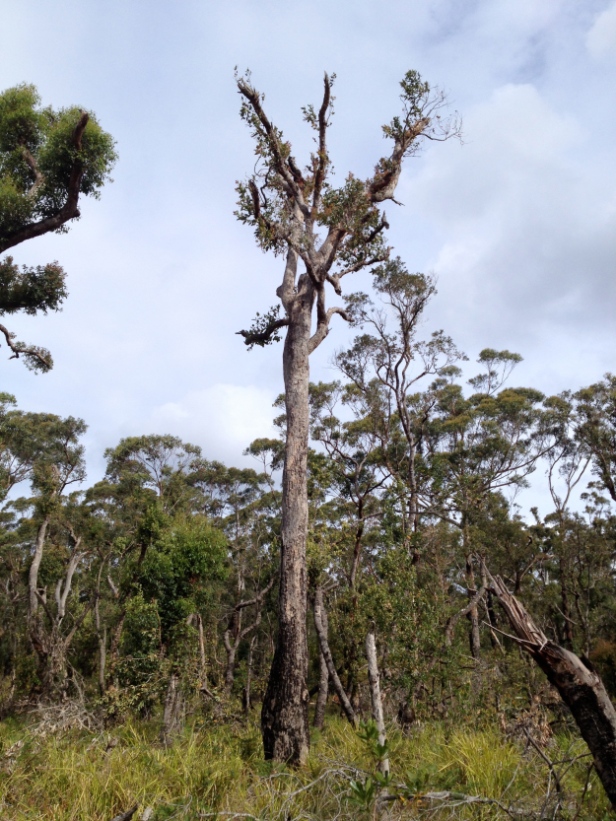 ]]>
]]>And more at – http://climatebonds.net/category/blog/
For example (his latest post):
———–
Qatar is the world’s highest per capita greenhouse gas emitter; so, to mark the UN Kyoto negotiations, it announced this week that it was going to spend up to $20bn growing solar from 0% to 16% -1.8 gigawatts – of national power generation. Tenders will be in 2014. The country does seem to have nearly as much solar resource above ground as gas below ground – there’s a lot of desert here.
———–
I’m sitting through a Saudi Arabian presentation on their solar energy plans – they say they’ll have 16 Gigawatt of solar installed by 2022 – from a zero base. That’s a lot of solar.
That will involve some $109bn in investment – compared to $136bn invested worldwide in solar in 2011.
Don’t get me wrong; this doesn’t make up for all those oil exports destined for our atmosphere (sorry Saudi, but we’re going have to leave the bulk of that in the ground). But it’s very good news for a solar industry that we all need to grow quickly, and for the prospects of further driving down costs with larger scale deployment.
—————
Then talk turns to the enormous energy efficiency gains to be made in the Gulf. The conversation ends up being exactly the same as in Europe or the US: how hard it is to get people to do something that will so obviously save them money (putting aside those places that provide free energy). They talked about how they needed to learn from Europe and the US who “know how to do it”. Unfortunately that’s wishful thinking; every country we work in talks about the importance of energy efficiency, but finds it fiendishly difficult to get things moving at speed and scale.
Government in the North as well as the Middle East et al are going to have to face up to the fact that adequate urban and industrial emission reductions are not going to be achieved just through “education” or “presenting business cases”.
We need a mix of mandation, well-signalled a few years before it starts to bite, combined with a range of up-front enabling financial and regulatory measures – and solid work to ramp up capability provision. It has to be really easy to save money now and avoid the sting of penalties later.
We’re not much of a fan of pure mandation either; solutions provision still requires significant policy engineering (like removing “principle agent” problems) if the change is to actually happen at speed. But, if it genuinely saves people money and everyone is in, we believe it can be packaged as a vote winner.
—————
The OECD have been fantastic over the past two years, working hard to press member Governments to pursue green growth policies, and exploring how those financially stressed Government can leverage private sector finance for climate solutions. But we’ve still got some way to go with change.
At an OECD breakfast this week I asked them about whether they were doing any modelling to show the “economic multiplier” benefits of green growth (they do have 1500 economists wandering around the corridors of their Paris HQ; might as well get them doing useful stuff).
I asked because Treasuries around the world are full of economists trying to restrict their thinking to immediate national growth prospects, and green growth proposals, without quantitative multiplier arguments, are all-too easily dismissed. Witness what’s happened in the UK over the past two years.
Those of us taking the fight to Treasuries around the world need narratives backed by stronger economic modelling arguments.
The good news is that it seems OECD are now looking at this and we can expect to see their take in 2013.
———-
Philippines negotiator Naderev Sano broke down yesterday as he read a statement to the Conference: ”We are experiencing climate change; we have never seen a storm like the one hitting the Philippines now. As we sit here in these negotiations, even as we vacillate and procrastinate here, the death toll is rising.” Watch the video here.
———-
A couple of days ago I posted that: “90% of buildings that will exist in India in 2050 are not yet built”. I’d originally thought he’d said 2020, but it didn’t look right so I put 2050. Then I chased down Kersten-Karl Barth of Siemens to double-check. It’s actually 2025! Yikes!
A friend at the EIB emailed to say he was wondering whether he should be giving up on banking and starting a construction company in India – or at least servicing that sector. Hmmm.
———-
Finally, just thought you’d like to know: The Qatar National Convention Centre, where the conference is being held, is the most amazing building – all polished stone, coloured glass and facilities that actually work. Even the toilets are beautiful. And it’s highly energy efficient LEED certified (part of it is LEED Gold).
In fact Doha is full of impressive LEED certified buildings. But slightly awkward that it’s all (literally all) being paid for by huge fossil fuel exports. Sigh.
]]>
> Huge study confirms climate science. The Koch Brothers are famous for funding Tea Party activists and climate change deniers. They contributed $150k to a project led by sceptic Dr Richard Muller with science centre Novim and Nobel prize-winner Saul Perlmutter, to open source and review 1.6 billion climate data records to see whether the world was really warming. Climate Bonds director Bryan Martell helped put together the project. Project’s founder and sceptic Richard Muller, said in the statement: “Our biggest surprise was that the new results agreed so closely with the warming values published previously. This confirms that these studies were done carefully and that potential biases identified by climate change skeptics did not seriously affect their conclusions.” Surprise! It’s all in the Economist. http://www.economist.com/node/21533360
]]>In a spirit of openness, Pat Armstrong shares climate change communication principles developed by a small group of participants in a workshop run by Prof Bob Stevenson at the World Environmental Education Congress 2011 in Brisbane, as recorded by Pat.
I like these a lot, especially the first five.
Be positive
Remain positive. Using fear tactics will only alarm people and may even lead them to turn off completely.
Report on success stories
Report success stories from the local community and from other countries that are appropriate to the audience (e.g. savings from energy efficiency measures in a local business).
Encourage meaningful actions
Give people ideas for practical, positive and meaningful actions to address climate change. Taking actions can help lead to changes in attitude which can lead to further actions.
Walk the talk
Be prepared to explain what steps you are taking to address climate change in your own life at home and at work (e.g. downsized your car or even sold your car and now use a bicycle and public transport, eat one non-meat meal a week). You don’t have to be perfect, just show that you have made and are continuing to make changes, but despite these changes, you still have a good quality of life.
Support local champions
Identify and support local champions in the various sectors of the community (including different cultural groups).
Clarify the consequences
Help people to recognise the predicted consequences of climate change – in the short-term (e.g. hotter summers) and long-term (e.g. changes in local agriculture and ecosystems)
Personalise
Respond to people’s concerns and questions (e.g. I have more immediate concerns than to worry about something that may happen 100 years from now. Should I turn off a fluorescent light when I leave a room?)
Build on prior learning
Build on and acknowledge people’s prior experience and knowledge of climate change, the impacts of climate change in their local area (e.g. the huge increase in the cost of bananas after the hurricanes in Queensland) and their actions at home and work to address climate change (e.g. installing water tanks, turning off lights, taking public transport etc.)
Use locally relevant data
Back up the science of climate change with locally relevant and substantiated data (e.g. rainfall records, temperature records, extreme weather events (e.g. fires, droughts, floods, coastal high tide lines), biodiversity changes (e.g. time of flowering of local plants, nesting times of birds, movement of species, loss of species, appearance of new species, etc.), diseases that have not previously been seen an area (e.g. malaria)
Communicate appropriately
Communicate about climate change in ways that are socially and culturally appropriate, relevant and respectful (e.g. working with leaders of different cultural groups to find culturally sensitive ways of explaining the issues and solving problems)
]]>
There’s always been a debate about whether comics and animations are suitable for adults. Here’s proof. An animation grabs attention because it’s surprising and the intelligent and respectful commentary ensures the audience aren’t demeaned.
This is great science communication.
http://www.new.dpi.vic.gov.au/agriculture/farming-management/weather-climate/…
]]>I just read Newell and Pitman’s article The Psychology of Global Warming. Read it twice actually. Had to. It was that hard to find the chewable bits.
Newell and Pitman, psychologists at UNSW, have done a good job of restating “confirmation bias” theory – that people focus on facts and memories that confirm their worldviews (a.k.a. denial) as well as “sampling bias” and a few other effects that distort people’s reception of information. But what to do about these biases? Their most useful advice is to ensure communications are concrete, visualised, pay attention to loss aversion and avoid creating despair or emotional numbing.
But I think they’ve missed a vital point. It’s not the data that matters. It’s the interpretation.
Here’s some data:
“Sea level rises of 0.37 to 0.75 metres are probable by 2090 with the likelihood of increased flooding and erosion from high tides and storm surges.” Source: CSIRO
That’s a typical scientific statement, emotionally cold, heavily qualified and expressing scientific uncertainty. But what does it mean in terms of action? What decisions, if any, should a reasonable person take on the basis of it?
The problem is that action comes with risk. People risk their reputations, time and money by acting. So, when the data is expressed in terms of uncertainty it’s perfectly reasonable for people to seek assurance about their own risks of action.
If the risks seem too high, then people will stick with business-as-usual and adopt justifications for inaction (that’s that “denial” means).
Where to seek that assurance from? Early adopters seek it from their own knowledge and contacts. Early adopters also tend to be more confident with a particular risk – that’s what makes them early adopters.
But the remaining 80% lack the knowledge to assess risk themselves. They rely on others for that assurance. What others? Certainly not scientists. Scientists aren’t taking the same risks they are. Inevitably, they will want to hear from people similar to themselves who are taking similar risks.
Similarity is the key. Without similarity they have no way of removing the uncertainty from potentially risky personal, political or business decisions. And until that uncertainty is removed they are unlikely to act.
Hence stories and testimonials from similar people are vital components of a credible climate change communication.
If the audience are local government councillors they’ll want to hear:
“The CSIRO predicts that the sea level rises of 37 to 75 centimetres are probable by 2090 with the likelihood of increased flooding and erosion from high tides and storm surges.”
Followed by a statement from a similar person:
“Coastal councils have a responsibility to protect ratepayers’ property and lives. There’s uncertainty about the exact extent of rises, but the risk is still too great for inaction. That’s why we’ve adopted a sea level rise planning benchmark of 100 centimetres .” – councillor Mark Hall, Mayor of Coastal Shire Council
This statement crystallizes a prudent decision out of uncertain data, demonstrating how a reasonable person could act and manage their risk.
A clear, low risk course of action, demonstrated by the living example of a similar person, creates assurance, reducing the fear and uncertainty that drives denial. Good climate change communication is not just about facts. It needs stories too.
]]>
This is called “framing around agency”.
Here’s a step-by-step example of how to craft an action-based climate change communication based on lessons from behavioural psychology.
http://www.enablingchange.com.au/How_to_craft_a_climate_change_communication.pdf
]]>
1. IT’S NOT AN ENVIRONMENTAL ISSUE, IT’S A BUSINESS ISSUE.
This is an overarching message, which refocuses the debate away from environmental and scientific issues toward business issues.
2. EFFICIENCY IS WHAT’S AT STAKE
As identified in the Forum, efficiency is key to Australia’s long term prosperity.
3. IT’S AN INNOVATION OPPORTUNITY
Every change in the landscape provides leadership opportunities. And the bigger the change, the bigger the opportunity.
4. INTERNATIONAL COMPETITIVENESS IS WHAT IS AT STAKE
The Forum determined that international competitiveness is a key outcome. This argument expands on that point.
5. JOB CREATION IS A KEY BENEFIT
The Forum determined that job creation is a key outcome. This argument expands on that point.
6. EMPLOYEE ENGAGEMENT IS A KEY OUTCOME
An extension of the job creation argument, this section considers the role of a low carbon economy in attracting and retaining key employees.
Dr Mark Diesendorf knows his stuff. And his opponent, a Newcastle Uni academic, managed, from his first sentence, to convert the story into a maze of complication with variations in the climate data from 1940 and 1975 or something. In fact I’m not sure because I couldn’t follow the debate, and neither could the Sunrise presenters or anyone else. As a result the audience went away thinking there’s no clear answer.
Here’s the point – this is incredibly easy to do. In fact, data-based public cases are gagging for this kind of attack.
It ignores the most important element the public messages – the messenger. In a recent post I noted that the messenger needs to be passionate-similar-connected-respected. Dr Mark Deisendorf ticks only one of these qualities – respected. And that’s only because the presenters told the audience that he’s a respected expert. But then, they practically told the audience the same thing about the other guy – simply by inviting him on the show. The result is that the audience have no way of testing who they believe.
So here’s a different approach. Stop marching scientists before the camera because this sort of thing will happen every time. And don’t parrot their arguments because that’s only slightly more useless. Instead, find someone passionate-similar-connected-respected and give them the opportunity to simply say this: “I believe the data. I care about my children’s future. And I’m already acting to reduce the amount of energy I use and the amount of miles I drive.” There are no lack of stories you could tell.
Why has Intel purchased $2.5 billion in carbon credits? Why is the City of Sydney spending millions on gas turbine technology to get off the grid? Why has the entire population of Armidale installed compact fluoro light bulbs? and so on… These stories are winning arguments that are impossible to defeat. They are about respected institutions and people that believe the data and have put their money on the table.
Can we do that a little more often?
]]>