Even though I’m a ‘behaviour change’ guy and I think ALL change is behavioural, I’ve come to believe that 90% of behaviour is in turn driven by physical, social and technological settings. But communication, participation and marketing are nevertheless integral because a) public participation drives political change; and b) it’s no good having great technologies if no one uses them.
This 2007 statement by 28 concerned social scientists neatly summarises a case against dismissing voluntary behaviour change in favour of an exclusive focus on policy and technology:
In part, they wrote:
“Dismissing the importance of small personal behavior choices in favor of a sole focus on policy change is a big mistake:
• Small behaviors are important not only for the direct environmental impact they have, but because they often lead to more and more pro-environmental behaviors over time.
• Numerous psychological studies have shown that people are more likely to agree to take a big action if they’ve previously agreed to smaller, similar actions.
• People reject scary messages like the danger of global warming if they don’t think there is anything feasible they can do to fix it.
• Restrictive policies engender resentment and actions to restore threatened freedoms, such as ditching the policies themselves or creative disobedience. Witness efforts to dismantle the Endangered Species Act, and the creative efforts to skirt its requirements.
“The history of racial policy and WWII demonstrate the importance of both policy and voluntary actions. Much public debate and many small individual actions transpired to make racial discrimination less and less socially acceptable in the century and a half before LBJ signed the Civil Rights Act. Try telling descendents of those rescued by the underground railroad that it didn’t matter. Even in the more urgent crisis of WWII, in addition to the mandatory policies, mass persuasion campaigns encouraged voluntary actions. Politicians realized they needed public support for the war effort, and for legislation.
“Remember the “We can do it!” poster encouraging women to join the labor force? The victory gardens? Voluntary actions provided direct physical support, strengthened the norm of supporting the war effort, and boosted morale. Both voluntary action and policy changes were crucial to winning the war.”
One reason we have this pathological separation between policy and the social sciences is that policy-bods and communications-bods hardly ever work together. I’ve said it lots of times, I’ll say it again: “scratch a supposedly insoluble real world problem and you’ll find an institutional failure.” Multi-disciplinary teams aren’t just fun, they might just save the world.

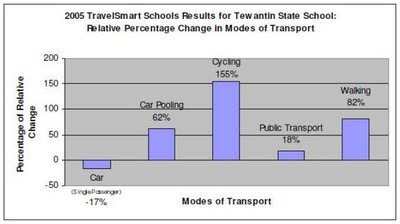
Walk to School programs have a checkered history. A large recent program in inner Sydney schools, for instance, focusing on educational interventions, produced ‘mixed results’ for major a 2 year effort.
Yet here is an example from Queensland that met with outstanding success.
Just check these results, for a 12 month effort…..(see graph).
I just had a look at the evaluation of this program and one thing stands out: getting the SETTING right.
Before the project began, the Travelsmart team conducted a site audit at the Tewantin school, along with officers from the Qld Transport Road Safety Office and Noosa Council. The audit resulted in an agenda of road infrastructure improvements around the school. Specifically: speed signs, road markings, threshold treatments, and intersection improvements, all focused on safety. This physical investment (amounting to $78k) “to improve the environment for walking and cycling around Tewantin School meant that there were little physical barriers to address”.
The Travelsmart program then rolled out, with a volunteer parent-teacher working group and $27k spent on activities including an access guide, a poster, a cycle skills course, teaching units, a TravelSmART competition, a staff Walk to Work day, a Walk and Ride Wednesday, an interschool class challenge and a celebration assembly.
This points to a valuable principle of behaviour change projects: a major factor that enables behaviour is THE SETTING…a principle that goes way back to the Ottawa Charter (‘Creating Supporting Environments’) – one that’s now very well recognised in health promotion projects.
Most of the Trewantin TravelSmart activities focused on ‘salience’ (bringing cycling and walking to front-of-mind) and ‘buzz’ (getting people talking). However I suspect at least two would have had a big impact on self-efficacy: the changes to the physical road setting around the school , and the cycle skills course. These would have changed the environment-of-decision-making for parents, lowering their fears of letting their little ones walk or cycle on their own. After all, it’s largely mothers who make the decision about how to commute to school, and safety is a big consideration. A 2005 study in the American Journal of Health Studies noted that a “theme that emerged from all three focus groups was one of (real of perceived) personal safety issues and concerns, including recent or memorable kidnappings, crimes in the neighbourhood, and heavily trafficked streets.” It concluded that distance, safety and traffic concerns were the biggest influences on travel to school choice.
Interestingly, there was little enthusiasm at Tewantin State School for formal walking, cycling or car-pooling programs because of fears that parents would be unwilling to volunteer for those duties. Informal arrangements were preferred – a useful lesson.
An nice touch was writing “TravelSmart Coordinator” into the job description of the newly appointed Deputy Principal.
The evaluation doesn’t seem to have been published, but you can probably get a copy from Graham Lunney, TravelSmart Manager, Queensland Transport.
You could ask him for a copy of the TravelSmart School Training Manual that was developed from the program.
TravelSmart Noosa’s web page gives a summary of the project.
