Designing SUSTAINED change always means intervening in systems. But what is a ‘system’?
To clarify what ‘system’ means, I’ve discovered/thought of 28 statements about systems.
Most of these are well known and can be discovered by Googling ‘system thinking’. Some are based on Donella Meadows‘ work and System Dynamics. Some are from books on resilience thinking. Some are my own.
1) A system is a set of components, or actors, that works as a whole to transform resources (inputs) into products and wastes (outputs).
2) Systems include cells, plants, ecosystems, catchments, people, communities, associations, corporations, institutions, states and economies, as well as non-living systems like factories and distribution networks.

3) Systems are often life support systems for their actors. What makes a system a system is the flow of information, energy, materials and services between the actors.
4) Systems are hierarchically nested within other systems. The actors of systems are themselves kinds of systems.
5) Although a system’s function is determined by its products, the goal or purpose of a human system depends on the worldviews of the actors and observers. One system can have many purposes, depending on the perspectives of the observers.
6) Efficiency, effectiveness, sustainability, resilience, productivity, addiction, health, sickness, and failure are all qualities or manifestations of systems.
7) Systems can be persistent or temporary (transient). Persistent systems (like associations, corporations and states) have specialised actors carrying out coordination functions. Transient systems do not.
8) Persistent systems, even poorly functioning ones, never give up until they die or are killed (their actors physically destroyed). This explains how human progress is slow and often generational: as J. K. Galbraith observed “like the Old Guard, the conventional wisdom dies but does not surrender.”
9) While some actors have coordination functions, no one is actually in control of a whole system. “While we can hold parts of the system in a certain condition, the broader system is beyond our command. Indeed, no one is in control; this is a key aspect of complex adaptive systems.” (Walker and Salt, Resilience Thinking p29)
10) Natural systems like cells and catchments are tangible. Human systems like communities, corporations and economies are intangible: their actors (individual humans) are bound together simply by agreed laws and social norms. Because human systems depend on the intangible mental states of their actors, their beliefs, values, goals and worldviews can be tremendously important and contested.
11) There are no such things as ‘externalities’. The boundaries of a system are entirely a matter of the convenience and biases of the observers. Who is in and who is out of a system is a subjective decision of the observer, which is why ‘window’ is a better term than ‘boundary’.
12) Closed system windows produce closed thinking (or silo thinking) with impoverished behavioural and cognitive repertoires which lower system adaptiveness. In-system actors are biased towards perceiving closed windows because that makes their decision-making easier.
13) Permeable systems welcome out-system actors. They are always more adaptable.
14) Systems are adaptive. Variation and novelty are constantly being added. Selective pressures are constantly driving evolution of individual components and the whole system.
15) Systems do not change in linear, predictable, incremental fashions.
16) Every system has the capacity to exist in a number of alternate stable states or regimes with different functions, structures and feedbacks. Sudden “regime shifts” can happen when shocks and disturbances push a system across a threshold into a different regime, frequently with unwelcome surprises. (Walker and Salt p31, p37)
17) How effectively systems adapt to changing environments and shocks depends on the timeliness of feedback loops, the existence of buffers, and the diversity of capabilities, ideas and ways of being. The more diverse the actors and abundant the buffers, the richer the adaptive possibilities.
18) Buffers of un-utilised resources, time, energy, are essential for adaptation and innovation. Buffers are also vital for system resilience. The larger the buffers, the more shocks a system can absorb before being pushed over a threshold into a different regime.
19) Diversity is also essential for resilience. “Functional diversity” means having a diversity of actors, each with a different response to changed conditions. This creates a wide repertoire of possible adaptive responses.
20) Systems that sacrifice diversity and buffers for optimised productivity have poor resilience. “Be aware that simplifying the system for increased efficiency reduces the system’s diversity or possible responses to disturbance, and the system becomes more vulnerable to stresses and shocks.” (Walker and Salt p123)
21) Systems always grow in size, resource consumption, and output, subject only to resource limits and competition from other systems. It is debatable whether expansion is innate to systems. However in turbulent, competitive environments with high unpredictability expansion is practically mandated by the actors’ innate need for safety.
22) Because a system’s actors are themselves systems that seek to expand, accumulating resources, information and energy, natural systems have complex feedback and control mechanisms to maintain internal balance (homeostasis) and limit the gain to dominant actors. Failure of these mechanisms leads to uncontrolled growth of some actors, starvation of others, and friction (conflict), reducing the overall productivity of the system.
23) Feedback loops are how systems manage their internal processes. Absent or poorly designed feedback loops lead to boom/bust oscillations.
24) A system is an entropy engine: it takes resources and splits them into a stream of more refined products (with lower entropy or disorder) and a stream of wastes (with higher entropy or disorder).
25) The products and wastes of natural systems are usually inputs into other systems. That’s what the ‘web of life’ means.
26) Systems always produce wastes. The ability of environments to absorb wastes depends on ‘sinks’ in the environment. Usually these sinks are themselves natural systems (for example carbon sinks are photosynthesis by plants and chemical and biological processes in the oceans).
27) System stability depends on resource stability. Cut, or dramatically increase resources, and the result is increasing internal conflict until the system passes a resilience threshold into a different stable state. This explains why discovering oil causes civil disorder, and why the inflow of New World silver pushed sixteenth century Europe into chaos.
28) The dysfunctions of systems are internal (siloing, failure of feedback loops, actors hoarding information and energy), or external (exhaustion of resources, competition, pollution of the environment by wastes).
There. That’s a pretty thorough definition of “system”.
Dear readers: Can you think of any more statements? Have I got anything wrong?
]]>Here’s an entertaining compendium of 9 reasons why failure is not fatal by Carmel Hagen
Includes these quotes from an interview with Sir James Dyson, inventor of the world’s best vacuum cleaner:
You once described the inventor’s life as “one of failure.” How so?
I made 5,127 prototypes of my vacuum before I got it right. There were 5,126 failures. But I learned from each one. That’s how I came up with a solution. So I don’t mind failure. I’ve always thought that schoolchildren should be marked by the number of failures they’ve had. The child who tries strange things and experiences lots of failures to get there is probably more creative.
Not all failures lead to solutions, though. How do you fail constructively?
We’re taught to do things the right way. But if you want to discover something that other people haven’t, you need to do things the wrong way. Initiate a failure by doing something that’s very silly, unthinkable, naughty, dangerous. Watching why that fails can take you on a completely different path. It’s exciting, actually. To me, solving problems is a bit like a drug. You’re on it, and you can’t get off. I spent seven years on our washing machine [which has two drums, instead of one].
And also… To increase the success rate you have to increase the failure rate.
]]>
Of course, innovation seems to be all about expensive consultants and time consuming processes. The challenge for the rest of us is to remake innovation/design thinking so we can apply it to our garden variety cash- and time-starved council or agency projects.
Recently, the City of Sydney cycling team asked me to facilitate a brainstorm for a campaign get cyclists using their bells and generally behaving more considerately on shared paths.
My response was: “If you have a brainstorm, you’ll get a slogan. Why not try something more interesting?”
So, instead of one 2-hour brainstorm, we took three mornings, a week apart. We invited a diversity of people along, 19 in all, including council staff, shared path users, interested players and experts.
Here’s what we did:
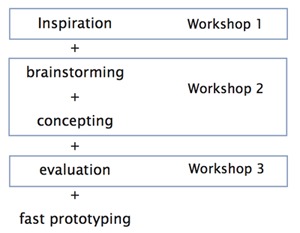
Morning 1: Information and inspiration
We briefed the participants on:
– the results of the social research and field observation council had previously undertaken on shared paths;
– our theory of change, which was that “if cyclists believe bell use is expected by other shared path users, then bell use will increase”; and
– inspiring campaign ideas from overseas, including ideas completely unrelated to cycling.
Morning 2: Brainstorming and concepting
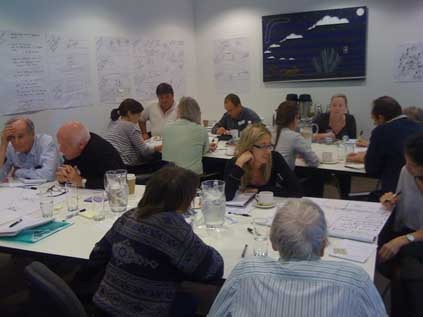
In four teams, with the theory of change in mind, we went through a series of brainstorms that generated 12 different concepts for the campaign.
Here is how the workshop looked:
Morning 3: Evaluation A smaller group sat down, decided on criteria for assessment, and sorted through the concepts, coming up with a “winning set” – which is depicted in the illustration below.
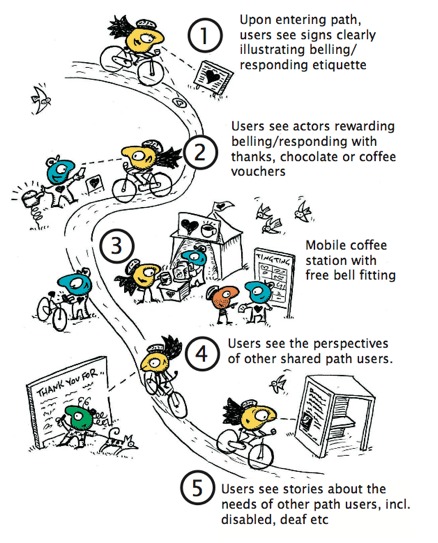
In a spirit of openness the City of Sydney team have given me permission to share the full briefing, brainstorming process and 12 initial concepts. They’re all in the PDF file that appears at the end of this post.
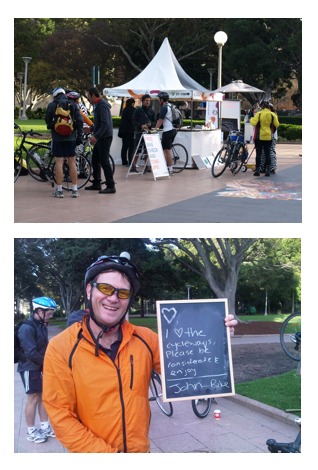
Fast prototyping followed. On the principle of “fail early” we asked “What can we put in the field next week, even if we have to draw it by hand?” Actually, we had to wait a couple of weeks for benchmarking (measuring how many people already use bells etc) to be completed. The fast prototyping is now under way.
When it’s finished, we’ll ask: what have we learned? Then we’ll improve the recipe and repeat.
Here is the fast prototyping schedule. Maybe they’ll see you there!!!
Week 1 – 2: 21 – 23 June and 28 – 30 June (Tues, Wed, Thurs AM 7:30 – 9:00am) Where: College Street Shared path, across from St Mary’s Cathedral and down from the Archibald fountain.
Week 3 -4: 5-7 July and 12-14 July (Tues, Wed, Thurs AM 7:30 – 9:00am) Where: Cleveland Street Shared Path, Moore Park (near the Golf course exit).
Week 5-6: 19-21 July and 26 -28 July (Tues, Wed, Thurs AM 7:30 – 9:00am) Where: Prince Alfred Park, Chalmers Street entrance.
Overall: I’m pleased with this attempt at innovation-for-the-rest-of-us. It was a little more time consuming than a standard brainstorm, but the results speak for themselves. It activated the three necessary conditions for creativity: diversity of participants; informed and inspired participants; and enjoyment. And It came up with ideas that could never have arisen in a garden variety brainstorm.
What would I do differently next time? I think I’d work even harder to activate creativity. I’d start with a quick game to activate playfulness. Then I’d have a short “getting in the mood” brainstorm where the rule was that the answers had to appear ludicrous to the speaker. I think that would loosen people’s imaginations up even faster.
Here are some photos from the first day of fast prototyping.
]]>

Is enjoyment the secret to creativity, imagination and productivity?
Reading Switch by Chip and Dan Heath (easily the best of the rush of change books that have hit the market in recent years – honestly, just go ahead and order it), I got excited by their reference to the work of psychologist Barbara Fredrickson. She asked “What good are positive emotions?” and the answer is amazing.
To start with, Fredrickson was intrigued by an experiment by Marcial Losada who observed business teams developing their annual plans. He used one-way mirrors and had his research team categorise every utterance they made. Strikingly, the biggest factor that predicted successful performance by each team in following months was the number of emotionally positive remarks they made.
Fredrickson looked for other research into the effect of positive emotions on performance and wrote an article called What good are positive emotions?
Quoting Chip and Dan Heath, ”Among the studies Fredrickson cites: Doctors experiencing positive emotions solve a tricky medical dilemma more flexibly and quickly. Students in a positive mood devise more innovative solutions to a technical challenge. Negotiators in a positive state of mind are more successful and creative negotiators; they find “win-win” solutions more often. Positive emotion also makes it easier for people to make connections among dissimilar ideas, and it makes them less likely to slip into an “us versus them” mentality.”(p279)
Fredrickson called her theory the Broaden-and-Build Theory of Positive Emotions and summarized it like this:
“positive emotions broaden an individual’s momentary thought-action repertoire: joy sparks the urge to play, interest sparks the urge to explore, contentment sparks the urge to savor and integrate, and love sparks a recurring cycle of each of these urges within safe, close relationships. [This contrasts with] the narrowed mindsets sparked by many negative emotions…such as attack or flee. By broadening an individual’s momentary thought-action repertoire – whether through play, exploration or similar activities – positive emotions promote discovery of novel and creative actions, ideas and social bonds, which in turn build that individual’s personal resources.
Fredrickson then asked an interesting question: How much positive emotion makes the difference?
Teaming up with Marcial Losada, they showed that the flip in performance is likely to happen when the ratio of positive to negative emotions exceeds 3:1. In other words, three positive emotions for each negative emotion. Below three, they wrote, people tend to languish in a self-absorbed, predictable rut. Above three they tend to flourish, becoming “generative, creative, resilient, ripe with possibility and beautifully complex.”
If you’re acquainted with Martin Seligman’s work on Positive Psychology, you’ll immediately see the parallels.
Tellingly, the ratio does not have to fall much below 3:1 before the decline sets in. A ratio of 2.3:1 was enough to pitch people into a rut.
And interestingly, they also found that too much positivity might be a bad thing. When the ratio exceeds around 11:1 the “dynamic of human flourishing” starts to disintegrate. It seems we all need a little negativity and conflict in our lives.
So, 3:1.
I think it’s a exciting number and I’m telling everyone about it.
It suggests you can shift a group towards creativity simply by increasing their en-joy-ment while they’re doing an activity so that positive emotions exceed negative emotions by more than 3:1, something that ought to be quite easy for a facilitator or leader to accomplish, for instance with a light-hearted touch, food, games, ground rules against negative remarks, and processes that focus relentlessly on positive outcomes, assets and strengths.
So here’s my theory of change for maximising the innovativeness and creativity of groups:
D + II + E = INNOVATION and CREATIVITY
Where:
D = diversity of participants’ values and life experiences, so they can challenge each others’ assumptions;
II = informed and inspired participants, so the boundaries of their narrow life experiences are blown away; and
E= en-joy-ment.
And it gets even deeper. Watching a team brainstorming a tricky creative challenge last week, I saw their knitted brows and unhappy faces until the moment they got their first creative spark. Then they started laughing, and the happier they got, the more creative ideas flowed, making them even happier until they were a five person riot. I noticed it was a two way flow. Happiness increased creativity. But creativity also increased happiness! It’s easy to reflect that, once a group experiences success on a creative task, it’s a virtuous circle.
Fredrickson, B.L. (1998) What Good are Positive Emotions? Review of General Psychology 2 pp300-319
http://www.unc.edu/peplab/publications/what_good.pdf
Fredrickson, B.L. (2004) The broaden-and-build theory of positive emotions, Philosophical Transactions of the Royal Society 359 pp1367-1377 http://www.ncbi.nlm.nih.gov/pmc/articles/PMC1693418/pdf/15347528.pdf
Fredrickson, B.L and Losada, M.F. (2005) Positive Affect and the Complex Dynamics of Human Flourishing, American Psychologist 60(7) pp678-686
http://www.unc.edu/peplab/publications/human_flourishing.pdf

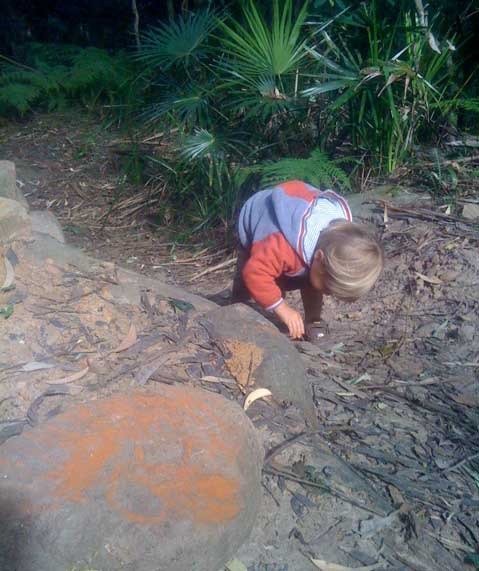
16 minutes into the walk he found a piece of ochre and invented rock art.
1 minute later, using the same piece of ochre, he invented body art and cosmetics.
8 minutes later, with one foot on each of daddy’s shoes, he invented dance.
And, needless to say, if there had been anything edible, he would have discovered it, thus inventing cuisine, Man vs Wild and Master Chef.
But seriously, why do toddlers display such a massive rate of innovation?
Well, obviously, they are close to the ground, so they spot things.
Secondly, being free from the curse of knowledge, they don’t know what’s not possible, perfectly equipping them to discover things they don’t know they don’t know.
Thirdly, they are infinitely playful and experimental and don’t care whether they succeed or fail. By endlessly foraging and fiddling for the sheer pleasure of it, they discover uses for things we’d never imagine.
Looking at Bugsy’s joyous little face, I wonder if the secrets of innovation might just be the same things – staying close to the ground; not being an expert; being playful; and not caring about whether I succeed or fail. In facilitating groups of adults, most of these can probably be synthesised…except playfulness. The state of egolessness needed to be playful might be the toughest call of all. Anyone have any ideas? [actually, I did get an idea later, see: https://www.enablingchange.com.au/blog/facilitation-2/what-good-is-enjoyment/]
The Australian Innovation Exchange
An initiative led by Steve Lawrence, ex-CEO of WorkVentures. The site is energetically leading the creation of a community of practice amongst social innovators in Australia. Read their feed at http://www.asix.org.au/page/rss-feeds
The Australian Centre for Social Innovation
Beginning as an initiative of the SA government, it’s now announced the 8 winners of its $1m social innovation challenge. Read their feed at feed://www.tacsi.org.au/home/rss
A consultancy of Sarah Schulman and Chris Vanstone, ex of the USA and UK respectively, who bring a heap of experience at the leading edge of social innovation in government.
I’m really excited by InWithFor’s arrival and their imaginative, clear-headed approach. Just check some of their back-projects at http://www.inwithfor.org/what
Their website, itself a nice example of user-centred communication, has a diagram (below) that beautifully illustrates what on earth innovation has got to do with the design of social change programs. It shows how transforming the problem definition and the outcomes are just as important as coming up with smart tactics.
Read their feed at http://www.inwithfor.org/feed/
Given the so often myopic approach to social change in Australia – something so amply illustrated by the NT Intervention – these are great initiatives.

This example is based on their work on Loops project in the UK.
]]>
Joulebug is an app that mashes game design, online community building and your typical household sustainability program. It’s a smart and original idea that aims to make daily eco-actions fun, sharable and competitive.
[There’s been a lot of talk lately about using game design to solve social and environmental problems – this is an example.]
The video explains it beautifully:
RecycleMatch is a website that borrows eBay’s business model, but instead matches buyers and sellers of WASTE.
Brilliant.
]]>
The most exciting thing happening in the field of social change is the convergence of behaviour change practice, design thinking, community participation practice and Web 2.0. This book exemplifies the new world of possibilities.
]]>“To increase the success rate you have to increase the failure rate.”
I said: “Did you think of that yourself?”
She said: “Yes.”
I said: “Just then?”
She said: “Yes.”
I said: “Can I use it?”
She said: “Yes.”
To increase the success rate you have to increase the failure rate. Something to carve on the heads of politicians and bureaucrats who are terrified of risk.
Failure is good. It’s how you learn. The only real failure is a failure to learn from experience.
Which reminds me of my friend Geoff Brown’s comment on a previous post which read:
Lately I have been communicating the need for a mindset shift to tackling these complex problems. Like you say in this post, we need to be trying lots of different things and be aware that most of them will fail. Dave Snowden (Google Cognitive Edge) talks about a shift away from Fail-Safe strategies (where control of outcomes is assumed) to Safe-Fail strategies (where failure won’t end in disaster, but we quickly learn from them). I like Clay Shirky’s quote on this when he talks about the complexity of getting stuff to spread on the internet … “We need to learn to try lots and lots of new things and fail informatively so that you and others can find a skull on a pikestaff somewhere”.

