limit-login-attempts-reloaded domain was triggered too early. This is usually an indicator for some code in the plugin or theme running too early. Translations should be loaded at the init action or later. Please see Debugging in WordPress for more information. (This message was added in version 6.7.0.) in /home1/enabling/public_html/blog/wp-includes/functions.php on line 6121In a spirit of openness, Pat Armstrong shares climate change communication principles developed by a small group of participants in a workshop run by Prof Bob Stevenson at the World Environmental Education Congress 2011 in Brisbane, as recorded by Pat.
I like these a lot, especially the first five.
Be positive
Remain positive. Using fear tactics will only alarm people and may even lead them to turn off completely.
Report on success stories
Report success stories from the local community and from other countries that are appropriate to the audience (e.g. savings from energy efficiency measures in a local business).
Encourage meaningful actions
Give people ideas for practical, positive and meaningful actions to address climate change. Taking actions can help lead to changes in attitude which can lead to further actions.
Walk the talk
Be prepared to explain what steps you are taking to address climate change in your own life at home and at work (e.g. downsized your car or even sold your car and now use a bicycle and public transport, eat one non-meat meal a week). You don’t have to be perfect, just show that you have made and are continuing to make changes, but despite these changes, you still have a good quality of life.
Support local champions
Identify and support local champions in the various sectors of the community (including different cultural groups).
Clarify the consequences
Help people to recognise the predicted consequences of climate change – in the short-term (e.g. hotter summers) and long-term (e.g. changes in local agriculture and ecosystems)
Personalise
Respond to people’s concerns and questions (e.g. I have more immediate concerns than to worry about something that may happen 100 years from now. Should I turn off a fluorescent light when I leave a room?)
Build on prior learning
Build on and acknowledge people’s prior experience and knowledge of climate change, the impacts of climate change in their local area (e.g. the huge increase in the cost of bananas after the hurricanes in Queensland) and their actions at home and work to address climate change (e.g. installing water tanks, turning off lights, taking public transport etc.)
Use locally relevant data
Back up the science of climate change with locally relevant and substantiated data (e.g. rainfall records, temperature records, extreme weather events (e.g. fires, droughts, floods, coastal high tide lines), biodiversity changes (e.g. time of flowering of local plants, nesting times of birds, movement of species, loss of species, appearance of new species, etc.), diseases that have not previously been seen an area (e.g. malaria)
Communicate appropriately
Communicate about climate change in ways that are socially and culturally appropriate, relevant and respectful (e.g. working with leaders of different cultural groups to find culturally sensitive ways of explaining the issues and solving problems)
]]>
There’s always been a debate about whether comics and animations are suitable for adults. Here’s proof. An animation grabs attention because it’s surprising and the intelligent and respectful commentary ensures the audience aren’t demeaned.
This is great science communication.
http://www.new.dpi.vic.gov.au/agriculture/farming-management/weather-climate/…
]]>I just read Newell and Pitman’s article The Psychology of Global Warming. Read it twice actually. Had to. It was that hard to find the chewable bits.
Newell and Pitman, psychologists at UNSW, have done a good job of restating “confirmation bias” theory – that people focus on facts and memories that confirm their worldviews (a.k.a. denial) as well as “sampling bias” and a few other effects that distort people’s reception of information. But what to do about these biases? Their most useful advice is to ensure communications are concrete, visualised, pay attention to loss aversion and avoid creating despair or emotional numbing.
But I think they’ve missed a vital point. It’s not the data that matters. It’s the interpretation.
Here’s some data:
“Sea level rises of 0.37 to 0.75 metres are probable by 2090 with the likelihood of increased flooding and erosion from high tides and storm surges.” Source: CSIRO
That’s a typical scientific statement, emotionally cold, heavily qualified and expressing scientific uncertainty. But what does it mean in terms of action? What decisions, if any, should a reasonable person take on the basis of it?
The problem is that action comes with risk. People risk their reputations, time and money by acting. So, when the data is expressed in terms of uncertainty it’s perfectly reasonable for people to seek assurance about their own risks of action.
If the risks seem too high, then people will stick with business-as-usual and adopt justifications for inaction (that’s that “denial” means).
Where to seek that assurance from? Early adopters seek it from their own knowledge and contacts. Early adopters also tend to be more confident with a particular risk – that’s what makes them early adopters.
But the remaining 80% lack the knowledge to assess risk themselves. They rely on others for that assurance. What others? Certainly not scientists. Scientists aren’t taking the same risks they are. Inevitably, they will want to hear from people similar to themselves who are taking similar risks.
Similarity is the key. Without similarity they have no way of removing the uncertainty from potentially risky personal, political or business decisions. And until that uncertainty is removed they are unlikely to act.
Hence stories and testimonials from similar people are vital components of a credible climate change communication.
If the audience are local government councillors they’ll want to hear:
“The CSIRO predicts that the sea level rises of 37 to 75 centimetres are probable by 2090 with the likelihood of increased flooding and erosion from high tides and storm surges.”
Followed by a statement from a similar person:
“Coastal councils have a responsibility to protect ratepayers’ property and lives. There’s uncertainty about the exact extent of rises, but the risk is still too great for inaction. That’s why we’ve adopted a sea level rise planning benchmark of 100 centimetres .” – councillor Mark Hall, Mayor of Coastal Shire Council
This statement crystallizes a prudent decision out of uncertain data, demonstrating how a reasonable person could act and manage their risk.
A clear, low risk course of action, demonstrated by the living example of a similar person, creates assurance, reducing the fear and uncertainty that drives denial. Good climate change communication is not just about facts. It needs stories too.
]]>
This is called “framing around agency”.
Here’s a step-by-step example of how to craft an action-based climate change communication based on lessons from behavioural psychology.
http://www.enablingchange.com.au/How_to_craft_a_climate_change_communication.pdf
]]>
For instance, when asked: “What cases will compel a change in public attitudes?”
65% said: stories of human suffering due to extreme weather such as drought or floods, and
54% said: evidence that climate change will negatively affect the economy.
Really, I would have thought this kind of bad news would push more people into denial, preventing a change in public attitudes. Better to tell positive stories that empower people to act, and their attitudes will follow.
* An attributional bias that overestimates the influence of knowledge or expertise controlled by the subject. You could also call it ‘projection’, where we assume that the public SHOULD be motivated by the same things that motivate us.
]]>According to The Climate Institute the three most significant achievements in the Cancun Agreement were:
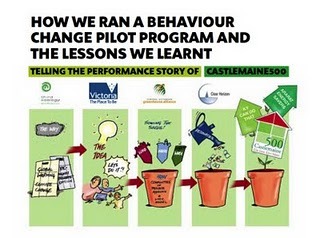
Since 2006 a unique (as far as I know) COMMUNITY DEVELOPMENT climate change project has been under way in Castlemaine, Victoria. Now the results are in.
As the team included a number of facilitators, it seemed natural to make it a COMMUNITY DEVEOPMENT project…one that would work bottom-up (tho’, inevitably, it ended up being partly top-down as well). This implied handing over maximum control with the local community, and this is the shining glory of the project, as Geoff Brown’s report shows.
It illustrates a golden rule of social change: sustained change depends on shared control.
Below are some excerpts from the report summary.
See the whole report at Geoff’s web site: www.yesandspace.com.au/?p=705
And see some interviews with participants: www.youtube.com/castlemaine500
—————————————————————————
In 2006, the Central Victorian Greenhouse Alliance (CVGA) secured the Victorian Government’s support to fund a behaviour change program that would test – by engaging a significant proportion of a township in household energy reduction – whether major savings could be achieved and measured at the regional level. The objective was to get 500 households to commit to a long-term process that required active participation and input to achieve a 15 to 30% reduction in energy consumption.
Both parties agreed that this process should be documented to assist other townships in their development of locally focused projects.
With active support from the Department of Sustainability and Environment, the CVGA called for expressions of interest from townships with populations of between 5,000 and 10,000 residents (with access to reticulated gas). After short-listing, Castlemaine was selected, and a program of activities including workshops, home assessments, community conferences and a local leaders program (to support activities beyond the project timeframe) began.
Castlemaine 500 also had a strong focus on building community capacity and leaving behind a legacy in the Castlemaine community after the initial funding had ceased. To this end, the project ran a number of leadership activities with a core group of participants and attempted to broker partnerships with key groups in the community. This side of the project has proved very successful, with some of the leaders going on to organise their own events, take part in a participatory evaluation and coordinate a network of interested people. Leaders have reported a range of new skills and knowledge as a result of their involvement in the project.
One leader was awarded the citizen of the year award for her work to assist households to reduce energy in her own community. Another leader has become the C500 coordinator, employed through the local Community House, completing the handover of the project to the local community.
In 2008, the efforts of the Castlemaine community were internationally recognised by a United Nations World Environment Day award.
Of significant interest in our findings is that the creation of social spaces proved to be one of the most influential aspects of the project. Participants reported that the opportunities to talk with each other and share their knowledge and experiences were vital to their capacity building processes. Events such as Energy Smart Workshops provided opportunities for participants to learn from and interact with each other.
Both the Energy Smart Workshops and Home Energy Assessments were highly useful as a way of supporting participants as they learned to change their behaviour and reduce energy use. Specific tools like the Home Energy Assessment Tool (HEAT), Home Energy Action Plan (HEAP), a free energy smart thermometer and a project letterbox sticker were also regarded as highly beneficial. This pilot project was always about much more than measuring reductions in energy consumption, and the feedback validates this.
Additionally (and unexpectedly), two new projects emerged in the project’s second year. The Kyabram (Ky Can Do Thatg) and Ararat (Ararat Energy Savers) projects were instigated by the Central Victorian Greenhouse Alliance (CVGA), delivered in part nership with regional partners and funded by the Department of Sustainability and Environment. The newly appointed coordinators of both the Kyabram and Ararat project workers became involved in C500 leadership activities, with their plans heavily influenced by the lessons learned during the C500’s first year.
Notably, a number of other townships (large and small) expressed an interest in developing a similar model in their local area. Valuable learnings from these projects are described on pages 26 & 45 of this report; further detailed (and useful) information is available at the CVGA’s website (www.cvga.org.au).
While the C500 project has been very successful in achieving many of our goals, it also encountered many hurdles and challenges.
The initial target of signing up 500 houses proved overly ambitious, with a f
inal tally of 351 households formally registered to C500. At the outset, the project steering committee bounded eligibility to households within the postcode 3450 [population about 6400]. After significant community feedback this restriction was expanded to include 3451 [population around 4500], however, the project struggled to attract households from these parts of the Castlemaine community. Spin off projects at Kyabram and Ararat and a significant level of interest from other townships illustrates that the numbers were large, even if not formally based in the Castlemaine area.
Whilst the energy monitoring strategy yielded only small numbers of households with reliable, pre and post electricity and gas data, these small sample sizes still allowed us to make conclusions about overall changes in energy consumption across C500 households. However, comparisons between different sub groups of households and project interventions were not possible. Results indicate an overall reduction in gas consumption in C500 households by approximately 15%, and a reduction in electricity consumption by approximately 8%. It’s important to keep in mind that small sample sizes limit our ability to be more specific.
The results presented in this report clearly point to the complex nature of behaviour change projects and the difficulty involved with attempts to attribute project activities to influencing ‘impact level’ data such as energy consumption. In our view, the project does demonstrate tangible outcomes – despite the difficulties encountered in proving concrete reductions in energy consumption (and greenhouse gas emissions). Our findings identify the need for projects of this nature to carefully consider their approach to behaviour change and to factor in the social context in which change occurs. There is also a need for future projects to be more prepared for the unexpected, to be flexible and adaptive and to conduct monitoring at various levels, using a mixture of techniques. Above all, projects of this nature must be committed to building ownership within the community. It is hoped that this report, which has strived to tell both the good and the more difficult aspects of delivering a behaviour change program, is a useful tool for other townships across Victoria as collectively we face the challenges of a changing climate.
<o:p></o:p>
]]>