Notice: Function _load_textdomain_just_in_time was called incorrectly. Translation loading for the limit-login-attempts-reloaded domain was triggered too early. This is usually an indicator for some code in the plugin or theme running too early. Translations should be loaded at the init action or later. Please see Debugging in WordPress for more information. (This message was added in version 6.7.0.) in /home1/enabling/public_html/blog/wp-includes/functions.php on line 6121

Deprecated: Hook site-logo is deprecated since version 13.4! Use custom-logo instead. Jetpack no longer supports site-logo feature. Add custom-logo support to your theme instead: https://developer.wordpress.org/themes/functionality/custom-logo/ in /home1/enabling/public_html/blog/wp-includes/functions.php on line 6121

Warning: Cannot modify header information - headers already sent by (output started at /home1/enabling/public_html/blog/wp-includes/functions.php:6121) in /home1/enabling/public_html/blog/wp-includes/feed-rss2.php on line 8
buzz – Changeology Snax https://www.enablingchange.com.au/blog Treats for changemakers, from Les Robinson. Wed, 09 Feb 2011 21:30:00 +0000 en hourly 1 https://wordpress.org/?v=6.8.2 150648124 Illuminating questions https://www.enablingchange.com.au/blog/facilitation-2/illuminating-questions/ https://www.enablingchange.com.au/blog/facilitation-2/illuminating-questions/#respond Wed, 09 Feb 2011 21:30:00 +0000 http://enablingchange.posterous.com/illuminating-questions Good questions are like spotlights in the dark, suddenly illuminating pathways through seemingly messy problems.

Sue Burton, who manages the Sustainable Schools program at NSW DECCW, took some notes from a workshop with the ever exuberant Professor Stuart Hill and turned them into conversation starters. She said I could share them.

Imagine using these questions to frame a conversation with your team or organisation about achieving social change.

What small acts could have a lot of effect?

What could make small acts contagious?

What are some ways we could do better at talking to others and working with others?

Who is already making change we could lend our support to?

When did you last seize the day with an unplanned opportunity?

What’s a good way to be kind to ourselves?

How could we reward ourselves for good work?

When do you last act from the heart?

When will you next spend time in nature?

When will you next spend time with others?

How could we develop our knowledge, understanding and skills.

If we see something wrong, how could we intervene in a positive way? 


]]>
https://www.enablingchange.com.au/blog/facilitation-2/illuminating-questions/feed/ 0 134
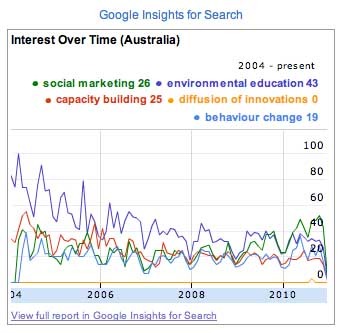
Mysterious trends and fads https://www.enablingchange.com.au/blog/marketing-and-communications/201008mysterious-trends-and-fads-html/ https://www.enablingchange.com.au/blog/marketing-and-communications/201008mysterious-trends-and-fads-html/#comments Mon, 30 Aug 2010 06:55:00 +0000 http://enablingchange.posterous.com/2010/08/mysterious-trends-and-fads.html From Google Trends, a popularity chart of social change buzz words over time (in Australia).

Noticeable:

…the decline of “environmental education” and (thankfully) “capacity building”;

…the gradual rise of “social marketing”;

…the steady popularity of “behaviour change”;

…the strange invisibility of “diffusion of innovations” (arguably the only one of these buzz words that represents a coherent body of knowledge!)

Buzz_word_insights

]]>
https://www.enablingchange.com.au/blog/marketing-and-communications/201008mysterious-trends-and-fads-html/feed/ 1 115
The power of the world's best question https://www.enablingchange.com.au/blog/facilitation-2/200908power-of-worlds-best-question-html/ https://www.enablingchange.com.au/blog/facilitation-2/200908power-of-worlds-best-question-html/#respond Tue, 25 Aug 2009 12:33:00 +0000 http://enablingchange.posterous.com/2009/08/power-of-worlds-best-question.html
Media_http3bpblogspot_ijlcw

Steph Twaddle, Community Relations Officer at Environment Bay of Plenty writes:

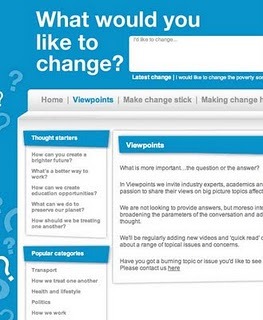
“I was in Sydney on the weekend and saw huge flags on Darling Harbour and newspaper ads proclaiming: What would you like to change?

“There was no branding for any government agency or business so I checked out www.whatwouldyouliketochange.com.au. Price Water House Coopers are gaining huge amounts of community input on a huge range of issues, from all sorts of people. It’s worth a quick look.”

“What would you like to change?” – That’s a question you hardly ever hear from government…and PWC is getting flooded with answers, about everything!

It’s hardly connected to a credible change strategy, I mean, they’re an accountancy firm for heaven’s sake…but it just goes to show people’s hunger for being asked a really great question!

I wonder what government agencies and councils would learn if they stopped worrying about what they might hear and let rip with some really strategic questions?

Facilitating a community consultation for Warringah Council in the last couple of months, we got to pose some big strategic questions to workshops of randomly recruited residents, like: “If more money was available in the council budget, how would you spend it on?” and “If there was less money, what would you cut?” and “What should council be doing that it’s not doing now?” The results were surprising, affirming, and useful, since they are exactly the same questions that councillors themselves must struggle with.

]]>
https://www.enablingchange.com.au/blog/facilitation-2/200908power-of-worlds-best-question-html/feed/ 0 188
Is change social? Well, yes. https://www.enablingchange.com.au/blog/strategy-2/200908is-change-social-well-yes-html/ https://www.enablingchange.com.au/blog/strategy-2/200908is-change-social-well-yes-html/#respond Mon, 03 Aug 2009 17:49:00 +0000 http://enablingchange.posterous.com/2009/08/is-change-social-well-yes.html Nice article on research that shows how Quitting smoking travels (like practically everything else) through social networks of people who know each other.

P.S. We keep being surprised by this kind of research, but the insight goes right back to the very start of diffusion research… a simply written, plain English, article written by Bryce Ryan and Neal Gross in a humble rural sociology journal in 1943…


To see it, go to http://chla.library.cornell.edu then search under “diffusion” with the author names “Ryan” and “Gross”. Their article is in Rural Sociology Volume 8.


]]>
https://www.enablingchange.com.au/blog/strategy-2/200908is-change-social-well-yes-html/feed/ 0 10
Against communication https://www.enablingchange.com.au/blog/facilitation-2/200907against-communication-html/ https://www.enablingchange.com.au/blog/facilitation-2/200907against-communication-html/#respond Fri, 31 Jul 2009 12:23:00 +0000 http://enablingchange.posterous.com/2009/07/against-communication.html Here’s part of a conversation I’m having with a Luke Wright, a journalist who’s writing about communicating change:

Well of course communication is vital however even the cleverest communication is a waste of effort if it does not meet a vital condition – that the communication is part of a conversation about things that matter to the audience. So, even though I’ve spent my professional life as a communicator, I don’t talk about communication any more, I talk about conversation. A good conversation is, of course, two way, about concerns, stories and solutions that matter to both sides of the conversation. The commonest reasons communication campaigns fail is that they are only about things that matter to the sender, not the receiver; and treats the receiver as a passive vessel for ‘truth’ to arrive. The vast majority of social marketing campaigns fail for this reason – they are little more that government agencies having elaborate conversations with themselves.

Even though you want to run your story as about communication, I’d like you to ask yourself whether you may be perpetuating ‘message fetish’, rather than opening up a new and interesting discussion.

In the Arabic smoking story*, for instance, what mattered was the time spent listening to the concerns of Arabic-speaking people and hearing some of the solutions they had spontaneously innovated to their own social dilemmas around smoking, then depicting those solutions in an ad campaign that acted as a virtual conversation, providing solutions to matters they already knew were at stake in their lives. The interesting work was the listening and spotting answers to problems people were experiencing. The communication was not unusual or remarkable. It was just how the solution was packaged. What makes a gift great is how it fits into the peoples’ hopes and dreams, not the packaging. In this way, the ad campaign packaged up just the right gift, and the art was in selecting the gift not choosing the packaging.

* See “The Art of Stickiness” chapter on my web site.
]]>
https://www.enablingchange.com.au/blog/facilitation-2/200907against-communication-html/feed/ 0 157