
You have to admire the sheer consistency of non-self-reflection in indigenous affairs in this country. The location of Aboriginal problems, is, of course, Aboriginal people. And to prove it there is a seemingly endless cavalcade of studies evaluating Aboriginal communities. But, although I’ve read every evaluation of the NT Intervention, I can find only one study that actually evaluates the performance of government program managers.
Tellingly, it’s a Department of Finance study that was suppressed as ‘Cabinet in Confidence’ until Channel Seven got hold of it under Freedom of Information in 2011.
Although it’s written in cold technocratese, it’s a damning summary of bureaucratic short-sightedness which, unfortunately, will be perfectly familiar to virtually anyone who has received funding from a government agency, in any context, for any purpose, in Australia.
I have a great idea: what if agency executives got training in program design? Might that avoid the river of wasted money, effort and hope? Or is it more structural? Something in the very organisation of government? I suppose it probably is structural, but in the meantime, some more critical self-reflection, or at least curiosity, would help.
Here’s an excerpt. I emphasised my favourite bits, but the whole text should be chiselled on the walls of our parliaments.
“Consistently and repeatedly over the past decade, many…voices have called on the Australian Government and its agencies to reduce the administrative burden and unnecessary complexity associated with accessing essential and desirable funding support through its broad array of Indigenous programs. The justifications behind these petitions are well known and extensively documented:
- existence of multiple ‘like’ programs which overlap and duplicate each other in places, while also leaving gaps in others, together leading to complexity and confusion;
- programs with poorly articulated objectives often underpinned by flawed assumptions and weak program logic which then raise unrealistic expectations of what can actually be achieved through the program;
- short term, staccato and ‘pilot’ funding arrangements with no commitment to ongoing funding and disconnected from the reality of the scale and timing of investment needed to drive lasting change;
- annual funding rounds for ongoing service needs which draw heavily on the limited administrative and management capacity of community organisations;
- multiple and complex funding arrangements – both within and across government agencies – with a need for greater commonality in their alignment and contract management approaches even though the contracting party throughout is the ‘Commonwealth of Australia’;
- the barriers created by these funding arrangements for long term planning and recruiting and retaining skilled and motivated staff who are essential for achieving the gains sought in challenging contexts;
- an approach by many program managers on contractual rather than relational governance, leading to management styles that micro-manage Indigenous and other organisations, and stifle innovation and agility by local providers;
- the unintended consequence of these funding arrangements in diverting precious resources from service delivery towards administrative compliance; and
- the compounding negative effects for the sustainability and organisational capacity of Indigenous organisations.”
Quoted from Department of Finance and Regulation (2010) Strategic Review of INDIGENOUS EXPENDITURE, Report to the Australian Government, p300
https://www.finance.gov.au/foi/disclosure-log/2011/foi_10-27_strategic_reviews.html
We expect decision-makers to be open to partnerships and multi-disciplinary processes because they break down silos – the No1 way organisations destroy their capacity to make change – and they are just, well, the modern way to do things. But that discounts the natural fears of decision-makers.
Helping people manage their fears, by preemptively addressing them, is one of the main tasks of a change maker, so having a handle on those fears matters.
Here’s the list of fears, which, of course, involve worries about time, risk, conflict, wasted effort, and having to defend oneself against people who think differently.
http://www.twyfords.com.au/news-and-media/our-blog/meeting-collaborative-danger-headon
Twyfords seem to be making a specialty of collaboration…check their blog: http://www.twyfords.com.au/our-blog/+collaborative%20governance
]]>
1) Let’s propose huge reductions in water allocation to scores of Murray-Darling Basin communities reeling after decades of drought.
2) Let’s proclaim ourselves for our exemplary science.
3) Then, let’s travel to these communities to “consult” on a document that’s already fully written.
4) Wonder why everyone hates us.
Those of you with a memory for these things will recall the almost identical debacle in 2006 over the plan for drinking recycled water in Toowoomba, and, for that matter, the endless impasse over native vegetation management laws.
Ms Schultz writes:
“The scientific and environmental research was exemplary, but the glaring gap in the voluminous report was of research that used the full range of tools of the humanities and social sciences, research that engaged with people, that drew on historical and international precedents, that explored the detail of local differences, the psychological response to change, the economic consequences and opportunities, resilience and fear. Research that enabled the progressive leaders dotted throughout these towns to imagine and articulate a different future, research that put the environmental issues in human terms, and helped maintain a place for the people who know and love the lands of the basin.”
Yes, it’s true that experts from the humanities and social sciences barely participate in environmental policy making in Australia, or environmental anything for that matter. The field is dominated by smart, well-meaning people with environmental science degrees. I know this because I’ve trained hundreds of environmental managers in the basics of social science, which they welcome like parched explorers sighting an oasis.
However I’m not sure that appending voluminous social science studies to yet another “draft framework” is going to solve the crisis in the Murray-Darling.
How about this: sit down with these communities. Lay a blank sheet of paper on the table and say “We have a problem. Let’s figure out the path forward together.”
Here are four generalisations that are pretty close to the truth:
1) Every authority on community engagement will tell you that sharing power to affected publics is the only way to avoid outrage in situations like this. See, for instance, Peter Sandman’s work www.psandman.com/handouts/sand42.pdf
2) Scientists are incapable of sharing power with the public. They don’t get that, in the human world, there are multiple valid versions of the truth. They are impatient and often contemptuous at lay peoples’ truths. Yet, in Ms Schultz words, “The non-specialists who live in these towns wanted everyone to know that they had something to add, and that in the era of connectivity they expected their hard-won expertise to be considered.”
3) The automatic reaction of scientists to any problem is to carry out more research.
4) In Australia, we have allowed scientists to dominate policy-making in land and water management. That’s why we so much research and so much outrage.
Scientists are brilliant servants but terrible masters. The simple answer is – don’t put them in charge. The solution to these complex, intractable problems is not about truth, it is about process: process that includes the people affected and relegates scientists to the role they are best at – expert advisors. And, I hate to say it, it’s a good idea to have a subtle and seasoned politician in charge of these processes, someone, in fact, just like Craig Knowles, recently appointed to Chair the Murray Darling Basin Commission in a canny move by the Australian Government.
http://www.theage.com.au/opinion/society-and-culture/shared-visions-20110128-…
]]>

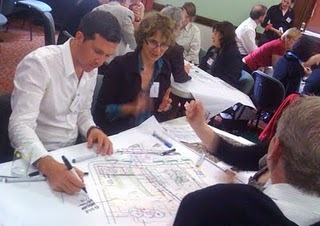
We had 40 participants from a rich mix of professions – architects, landscape designers, community renewal staff, sustainability gurus, Housing NSW managers, community gardens facilitators – a smorgasbord of jargons and perspectives (but don’t ask me where the public housing tenants were…we obviously can’t achieve perfection overnight!)

When initiatives failed
Our studies showed that when business initiatives failed, the ‘players’ were likely to be:
- pursuing their own agenda: there was no shared bigger picture between units and little understanding or empathy for others, and leaders allowed conflicting agendas to prevail
- avoiding and denying: employees avoided reality checks, there was a limited use of data in feedback and decision-making and the company had poor problem-solving practices
- stifling communication: there was an absence of listening, e-mail was used as the main means of communication, there was a prevalence of hoarded information and alternative views were often dismissed
- protecting their own turf: employees prioritised and planned in isolation, used their status to influence decisions and fostered inconsistency in processes and systems
- playing ‘I win, you lose’: employees were blamed as soon as things went wrong, and success was rewarded inside the silos rather than across the company.
When initiatives succeeded
When business initiatives succeeded, the ‘players’ were likely to be:
- sharing the big picture: companies created and shared one big picture, found common goals and synergies and focused on what was best for the organisation
- sharing the reality: employees were focused on real performance, made fact-based decisions and had the tough conversation rather than avoiding reality
- sharing the air: companies invited ideas from employees in every area of the business, and employees expressed opinions clearly and succinctly and listened to others
- sharing the load: employees prioritised and planned together, were clear about roles and expectations and looked for common ground
- sharing the wins and losses: companies paid close attention to joint results, learned and adapted together and rewarded true performance.

