You have to admire the sheer consistency of non-self-reflection in indigenous affairs in this country. The location of Aboriginal problems, is, of course, Aboriginal people. And to prove it there is a seemingly endless cavalcade of studies evaluating Aboriginal communities. But, although I’ve read every evaluation of the NT Intervention, I can find only one study that actually evaluates the performance of government program managers.
Tellingly, it’s a Department of Finance study that was suppressed as ‘Cabinet in Confidence’ until Channel Seven got hold of it under Freedom of Information in 2011.
Although it’s written in cold technocratese, it’s a damning summary of bureaucratic short-sightedness which, unfortunately, will be perfectly familiar to virtually anyone who has received funding from a government agency, in any context, for any purpose, in Australia.
I have a great idea: what if agency executives got training in program design? Might that avoid the river of wasted money, effort and hope? Or is it more structural? Something in the very organisation of government? I suppose it probably is structural, but in the meantime, some more critical self-reflection, or at least curiosity, would help.
Here’s an excerpt. I emphasised my favourite bits, but the whole text should be chiselled on the walls of our parliaments.
“Consistently and repeatedly over the past decade, many…voices have called on the Australian Government and its agencies to reduce the administrative burden and unnecessary complexity associated with accessing essential and desirable funding support through its broad array of Indigenous programs. The justifications behind these petitions are well known and extensively documented:
- existence of multiple ‘like’ programs which overlap and duplicate each other in places, while also leaving gaps in others, together leading to complexity and confusion;
- programs with poorly articulated objectives often underpinned by flawed assumptions and weak program logic which then raise unrealistic expectations of what can actually be achieved through the program;
- short term, staccato and ‘pilot’ funding arrangements with no commitment to ongoing funding and disconnected from the reality of the scale and timing of investment needed to drive lasting change;
- annual funding rounds for ongoing service needs which draw heavily on the limited administrative and management capacity of community organisations;
- multiple and complex funding arrangements – both within and across government agencies – with a need for greater commonality in their alignment and contract management approaches even though the contracting party throughout is the ‘Commonwealth of Australia’;
- the barriers created by these funding arrangements for long term planning and recruiting and retaining skilled and motivated staff who are essential for achieving the gains sought in challenging contexts;
- an approach by many program managers on contractual rather than relational governance, leading to management styles that micro-manage Indigenous and other organisations, and stifle innovation and agility by local providers;
- the unintended consequence of these funding arrangements in diverting precious resources from service delivery towards administrative compliance; and
- the compounding negative effects for the sustainability and organisational capacity of Indigenous organisations.”
Quoted from Department of Finance and Regulation (2010) Strategic Review of INDIGENOUS EXPENDITURE, Report to the Australian Government, p300
https://www.finance.gov.au/foi/disclosure-log/2011/foi_10-27_strategic_reviews.html
I’m delighted to announce the winners of the DOING SOMETHING INTERESTING? competition. (Remember? Way back in April.) Copies of Changeology are winging their way to them.
My secret intention was to flush out innovative examples I could share. I’m very happy with the result.
In no particular order the winners are:
1) Impromptu kinder engineers, Wyndham City Council, Vic
For imagination and agility in speedily improvising a delightful community engagement project on the fly.

Here is Cliff Eberly’s description:
I’m thrilled to be able to share this story with you.
Wyndham City’s Road Resurfacing Team has been doing some wonderful engagement work around the repaving and reconstruction of local roads. It started out with them taking the Wyndham Cruiser, Council’s promotional vehicle, out to do meet and greets with local residents prior to road works.
In the photos attached they connected with a kindergarten that was affected by the road resurfacing. The kids donned construction hats, high visibility vests and got up close (in a kinder safe kind of way) with the diggers while learning a bit about what Council was doing on their street.
Overall, the engineers have reported that doing face-to-face, personal engagement with local people has dramatically decreased the number of angry phone calls they receive mid-project and increased residents’ satisfaction with the job being done.
Happy to end the week on this one.
Cliff
2) Fall In Love With Nature on the Central Coast, NSW
For breaking the stereotype of a conservation engagement project.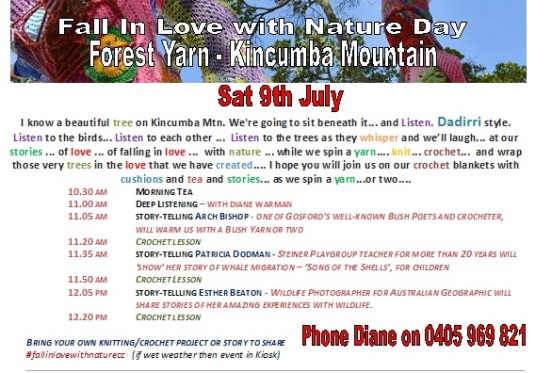
This ongoing project aims to get adults into nature by mashing nature experiences with stuff we love.
It was put together by a loose network of conservation professionals on the NSW Central Coast, organised by Rhiannon Anderson and managed by Sue Burton, and funded by AAEE/CEN. They mashed conservation with tea, stories, art and knitting, listening to the trees, and listening to each other, all wrapped up in the idea of “falling in love”, a theme they’ll just keep wrapping around more events. The core of the project is lean and simple, just an intriguing title, a card with a hashtag to give out at events, and chalkboards with the hash tag where people can write why they love nature on at community events. Look out for #fallinlovewithnaturecc
 3) Bunny Boiler Challenge, Bass Coast Landcare Network and Phillip Island Landcare, Vic
For a irresistible event.
“Rabbits are a national disgrace – they also taste great!”
This popular community event mashed a rabbit control talk with a rabbit cooking contest, plus ‘pin the tail on the rabbit’ for kids, and more. And the guests got to eat the yummy bunny dishes! Brilliant. A perfect exampling of mixing a serious subject with an irresistible social event.
110 folks turned up in March “with a mad scramble at the end for tables”. According to Joel Geoghegan, one of the organisers, it’s “90% fun and eating and 10% reality” with music, poetry and a talk on….rabbit control techniques.
4) Whimsical Wayfinding by the sustainable transport team, City of Port Phillip (Vic)
 For a perfect implementation of the Brains Trust approach.
The project, led by Jessica Cerejo, aimed to help people discover Emerald Hill by foot (as opposed to driving).
 The process: two community ‘brains trust’ workshops. The first briefed, informed and inspired the brains trust, then facilitated them to create a theory of change to create the desired future. The second session developed a fast prototype of Whimsical Wayfinding: informal signs to point people find the hidden gems of Emerald Hill.

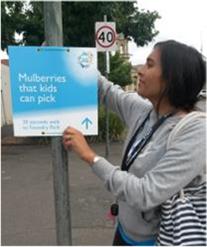
The signs were then fast prototyped at the Emerald Hill festival. People viewed the signs, added more and voted on them.
After installation, a survey showed more than 40% of people didn’t know about Pocket Park or the Community Garden/Foundry Park until they saw the signs.
PLUS an honourable mention to the City of Port Phillip’s sustainable transport team’s Ride2School Day 2016.
We don’t need to reward them. Their schools won 5 out of 6 school awards in the national program, with the city itself won the highest ranking Ride2School Day Council award with a $10,000 prize. http://www.enviroehub.com.au/ride2school
Well done all!
– Les
An anguished observer of the comprehensive failure of western aid in Africa, Sirolli innovated a seemingly radical approach to community change:
“You never initiate anything, you never motivate anybody. Instead you become a servant of local people’s passion. People who have a dream of how to be a better person. So you shut up. You never arrive in a community with any ideas …we sit with local people in a café, or at the pub and we become friends and we find out what local people want to do. The most important thing is passion. You can give somebody an idea. If that person doesn’t want to do it, what are you going to do? The passion that the person has for their own growth is the most important thing.”
Sirolli says the most useful role for a change maker is to be a servant to entrepreneurs by connecting them with the resources to act. And since no one can simultaneously be an ideas-person, a marketer, or a good administrator, the most important resource is the people who can fill the missing roles.
I love how he describes that “planning is the death of entrepreneurship” and why community meetings are always failures (because the local entrepreneurs don’t turn up).
There is so much in this video that I’m using it to introduce my Changeology training workshops this year. It captures exactly the leap we need to make from paternalism to enablement and the way success or failure depends, above all else, on the assumptions we bring along with us.
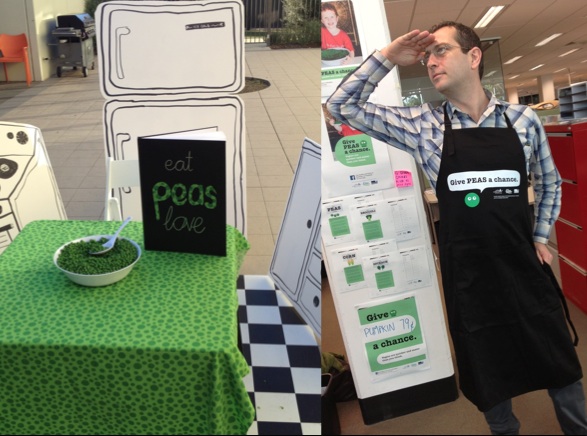
The humble green pea gets a fun profile boost in this clever healthy eating campaign from Wyndham City Council. I love the footpath stickers that guide people to a pop-up kitchen in the local shopping centre, where they can add their favourite pea recipe to a book. This works because it’s novel and fun. I suspect the mandatory healthy eating information is the least effective element…it’s the little green faces and personal recipes that do the trick of grasping attention and priming people to make different choices as they proceed to wander down the supermarket aisles.
Created by the Wyndham City Council’s Healthy Communities team.



Outdoor living rooms to slow traffic
Some Australian councils are doing a great job busting out of the conventional municipal straightjacket. This program from Darebin City’s Safe Travel team aims to enable neighbourhoods to take control of their streetscapes. It helps neighbours get together do creative things with their front yards, footpaths and nature strips, including permanent features like planter boxes, sculptures, street gardens, and venues for after-school games.
The idea is that a street that looks like it’s loved and used will slow down drivers. The web site says it succinctly: “Love your street? You can get to know your neighbours and slow down the neighbourhood at the same time with Drive With Your Heart. By creating an outdoor living room in your street, you will show motorists that your street is a shared space and they will take notice and slow down.” (packing a value proposition and a theory of change into one neat paragraph).
The streets participating so far illustrate the outpouring of energy and imagination when people are given permission to take control of their streets (photos below from the Coburg Better Block Project off the Darebin City website). The program is called Drive With Your Heart. There’s a downloadable neighbourhood guide on the web site.


Community Engagement Innovations
I’m a regular visitor to this Pinterest page by Andrew Coulson, community engagement specialist at the City of Salisbury, South Australia.
Every time I look there’s a breathtaking new idea for engaging communities in plan-making.

popupcity.net
Pop Up City is a site is packed with cool place-making ideas.
To change behaviour we need to change people’s environment. Ideas like innovative street seating, pop-up town squares, Better Block projects, modular parks, playful street installations, and adventure playgrounds profoundly humanise public spaces, creating new conversations and human interactions.
For example I particularly loved the Barter Bench idea from Amsterdam, where a simple red peg transforms a park seat into a free economy barter site.

And Nike’s on demand laser beam street football pitch.

Sex education with vegetables
My adult students were showing this around during a Changeology workshop.
It made me think: what COULDN’T you animate with vegetables? http://www.youtube.com/watch?v=q64hTNEj6KQ
World Peace and other 4th-Grade Achievements
“One of the things I learned is that other people matter. In this game one person can’t win, everyone has to win.”
This amazing classroom project shows how 9 year olds have all the cognitive power necessary to tackle fantastically complex social problems if the process trusts and enables them.
If primary school kids can operate at this level, I wonder why we persistently design interventions that treat adults like they can’t?
So, how to stimulate conversations? I can think of four ways:
1) Broadcast remarkable stories though the media (Chip and Dan Heath’s book Made to Stick covers this ground nicely).
2) Bring people together for facilitated discussions (field days, workshops at the like).
3) Recruit and train Popular Opinion Leaders. For example.
4) Conversation-starting initiatives and events.
There are a host of ways we can use events or public installations to start conversations. Here’s a list I developed for a recent project. It’s a PDF you can download to use in presentations.
http://www.enablingchange.com.au/conversation_starters.pdf

It was developed by Forum for the Future as a large-scale model for a sustainable society. But it works beautifully on the smaller scale of groups and communities as well.
It excited me then, and it’s stuck with me, because it’s so obviously superior to the standard Triple Bottom Line model, with its three arms of ecology, society and economy.
You can read the standard version of Five Capitals on the Forum for the Future, but I interpret it like this:
A community is healthy and sustainable when five kinds of capital are present in people’s lives:
1) Natural capital = the quality and productivity of the natural environment.
2) Infrastructure = quality of housing, accessible transport, medical and welfare services, food distribution systems, communication infrastructure.
3) Financial capital = access to liquidity, fair wages.
4) Social capital = the web of voluntary organisations like trade unions, clubs and societies, play groups, Landcare groups, and so on.
5) Individual capital = the life skills, social skills and technical skills that give people the self-efficacy to lead autonomous lives.
In my book I wrote “There are rarely silver bullets in this kind of work. Instead, change is more like a pattern.” Five Capitals illuminates what kind of pattern that might be.
One thing it does is explain why programs based only one kind of capital fail to achieve much progress, even when they are exceptionally well designed and well received. For example, the focus on indigenous development in Australia has been overwhelmingly on money + housing + services. That’s only two kinds of capital. Which is why a program that develops life skills (individual capital) like the Family Wellness Program at Yarrabah is so important, and it also explains why that program alone can’t produce a hoped-for transformation of community well-being.
Five Capitals throws a challenge out to all of us. We tend to focus exclusively on building one kind of capital. Often we’re only delivering a health service, or a financial incentive program, or restoring a river. The challenge is – can we build two or more capitals into one project? Could we, for example, build emotional life skills while also restoring a riparian corridor? Could we provide housing and also a small grants program for local vegetable production?
I was inspired a few years ago to hear a story from the NSW south coast, about a youth leadership project called Growing Our Future Leaders, funded by the Southern Rivers CMA.
David Newell, a catchment officer at SRCMA, pulled together the funding for a first-time partnership between the Pathways Foundation, The Crossing Land Education Trust, and the Bournda Environmental Education Centre. It was quite an innovation for the CMA, which, like every other NRM organisation, had been more comfortable doing on-ground work like fencing creeks and planting tree corridors.
In all, the project took about 40 young people on camps that mixed personal development, environmental learning, and physical work on Landcare sites: a potentially transforming experience at a pivotal moment in their lives.
David’s thinking was: “If you can provide right kind of experience, not too much head, plenty of hands, and a bit of heart, then young people grow into it and infect each other with enthusiasm.” Which is what happened.
This was not just innovative, it was beautiful because it combined three capitals: individual capital, environmental capital, and the social capital represented by the three organisations. Imagine if it provided a pathway to employment or start-up grants…that would be a fourth capital. And then, if it left behind some permanent infrastructure, that would be all five!

A Growing Our Future Leaders camp on the NSW south coast. ]]>