 With so many men turning to bikes for exercise, and many having not a clue about good behaviour on shared paths, it’s getting scary to be a pedestrian, especially with children around.
So, I’ve been thinking about how to communicate good shared path protocols for cyclists.
Building on thinking for a cycling behaviour strategy for the City of Sydney, I’ve just made some mock-ups (below).
First, it should be unmissable, big and bold, so no one can be in doubt that it’s important. So a full width path stencil should do the trick.
Second, it should clearly illustrate the behaviour, so cyclists know precisely what’s expected of them.
Thirdly, it should not tell people they are wrong (which will lead to resistance). It should just neutrally describe the desired behaviour. The aim should be to form in cyclists’ minds an idea of the behaviours other people expect as normal. That makes it about social norms rather than compliance.
Which behaviour? Other campaigns have focused on having a one-metre overtaking distance. However that’s liable to send the wrong message – that’s it OK to overtake at high speed (and still scare the bejesus out of people) so long as you’re a little distance away.
Better to focus on belling. The reason is that it focuses on communication, reminding training cyclists that pedestrians and other cyclists really exist, and expect to be communicated with. I think that, once you’re communicating, it helps you consider the other person’s point of view.
So “A gentle ting”. Three words that describe the desired behaviour with precision.
Here are the mock-ups.
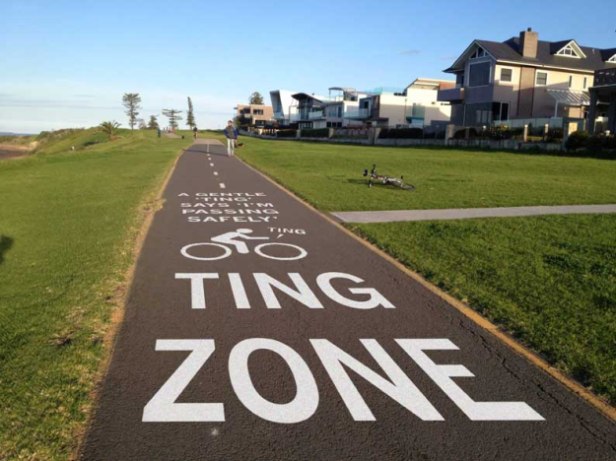
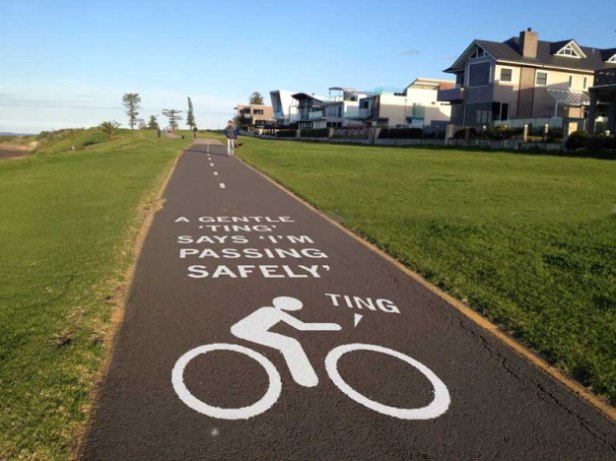 ]]>
]]>“So far there are many images of the child…but many of them tend to underline the needs of the child, what the child does not have, what the child is not.
Instead we should see the child as “protagonist and constructor of his own life and of the sense of life, in relationship with the others and with the world, a child is strong and rich, the strength and richness of curiosity, the strength and richness of the wise, the strength of those who want to have the tools for living, the strength and the richness of this wonder and astonishment, the strength and richness of curiosity, the wonderful curiosity of our children. Competent, I said, competent to learning, to loving and to be loved since the moment of birth; competent in the relationship and interaction with a great enthusiasm and curiosity for the otherness from him and her; competent in constructing himself while he and she constructs the world; competent in constructing explanation, theories, about the world; competent in reflecting; competent in thinking; bearer of values and rights; constructor of values and rights.”
Our children are the bearers of “values such as solidarity, optimism, availability, courage, playfulness, joy..”
She calls on us to “to change our point of view; to change our organisation of time and space; to change the way in which our schools, our houses, sometimes our cities are designed; to change our time with the time that the children offer us; maybe to change a part of our economy, to welcome the rights of children.”
From the Carla Rinaldi Inaugural Lecture, Adelaide Entertainment Centre, 27 March
2012 http://www.thinkers.sa.gov.au/Thinkers/CarlaRinaldi/p510.aspx
 ]]>
]]>There’s a nice page on his work at http://www.pps.org/reference/wwhyte/

It includes these marvellous quotes:
“What attracts people most, it would appear, is other people.”
“One felicity leads to another. Good places tend to be all of a piece – and the reason can almost always be traced to a human being.”
“It is difficult to design a space that will not attract people. What is remarkable is how often this has been accomplished.”
“We are not hapless beings caught in the grip of forces we can do little about, and wholesale damnations of our society only lend a further mystique to organization. Organization has been made by man; it can be changed by man.”
“The street is the river of life of the city, the place where we come together, the pathway to the center.”
“If there’s a lesson in streetwatching it is that people do like basics — and as environments go, a street that is open to the sky and filled with people and life is a splendid place to be.”
“The human backside is a dimension architects seem to have forgotten.”
“Up to seven people per foot of walkway a minute is a nice bustle”
“There is a rash of studies underway designed to uncover the bad consequences of overcrowding. This is all very well as far as it goes, but it only goes in one direction. What about undercrowding? The researchers would be a lot more objective if they paid as much attention to the possible effects on people of relative isolation and lack of propinquity. Maybe some of those rats they study get lonely too.”
“So-called ‘undesirables’ are not the problem. It is the measures taken to combat them that is the problem.”
“I end then in praise of small spaces. The multiplier effect is tremendous. It is not just the number of people using them, but the larger number who pass by and enjoy them vicariously, or even the larger number who feel better about the city center for knowledge of them. For a city, such places are priceless, whatever the cost. They are built of a set of basics and they are right in front of our noses. If we will look.”
]]>
http://www.placemakingchicago.com/about/qualities.asp
Chicago’s Metropolitan Planning Council, in an effort called “Project for Public Spaces”, reviewed thousands of public spaces around the world and concluded that successful places share four qualities:
– they are easily accessible;
– they have a mix of uses and activities attracting different ages and interests;
– they are comfortable and have a good image; and,
– they are sociable places, where people meet each other and take people when they come to visit.”

“Imagine the center circle on the diagram is a specific place that you know: a street corner, playground, or plaza outside a building. You can evaluate that place according to four criteria in the orange ring. In the green ring are a number of intuitive or qualitative aspects by which to judge a place; the blue area shows the quantitative aspects that can be measured by statistics or research.”
]]>Just took a long coffee break to read Cities: Who Decides?, an illuminating study by Jane-Frances Kelly from the independent Australian think-tank The Grattan Institute.
She asked: “What kind of decision-making arrangements are associated with sustained success in cities?”
Then she looked at eight cities with comparable characteristics to Australian cities – Vancouver (2.1m), Toronto (5.1), Seattle (3.3m), Portland (2.1m), Chicago (9.4m), Austin (1.5m), Dublin (1.8m) and Copenhagen (1.8m).
The report is readable, including eight succinct pen-portraits of what works in each of the cities.
Her top-line findings –
“First, high and sustained levels of public engagement in decision-making were found in many of the cities, particularly where improvement required tough choices.
“Second, cities that achieved meaningful, long-term success typically demonstrated a consistent strategic direction across political cycles. Similarly, many successful cities benefited from cross-sector collaboration between government, the business community, and civic organisations. In many cases, a level of regional co-operation was in place, with efforts integrated both within and across levels of government.
“Finally, there was usually a trigger [by which she means a crisis] for improvement, which catalysed the political will required for real, sustained improvement.
“Of equal significance was what we failed to find. In particular, the research suggested that success did not depend on any particular type of government structure. Nor was there an ideal ‘model of development’.”
The two implications for Australian cities are:
“1) Residents must be involved in decisions. Those cities that made tough choices and saw them through had early, genuine, sophisticated, and deep public engagement. This level of engagement is an order of magnitude different from what happens in Australia today.
“2) Changing structures does not in itself result in success. No one particular type of governance structure was associated with broad-based improvement. Changing structures has the danger of being a distraction.”
It’s interesting that the current success of most of these cities arose out of deep crises of economic decline and questions about the future of the city: would it have a derelict core dominated by freeways or would people stand up for the values of city life? In most cases, decisive civic leadership combined with deep community engagement shifted the historic direction of the city, putting in place human-centred city visions that have been consistent to this day.
It’s hard to imagine that Copenhagen in the 1990s, following the withdrawal of the Danish Navy, was in economic crisis with a population who had “become like beaten animals with no self confidence…” Now cities around the world are scrambling for the magic formula of “Copenhagenization”. Mostly secret seemed to be the way cities involved their people in decision-making.
In Portland, for instance, a unique alliance between a visionary Democratic Mayor and a Republican Governor in the 1970s led a community revolt against plans for inner-city freeways, galvanizing a high level of community involvement in planning and commencing Portland on it’s path to becoming America’s most livable city.
“Portland is well known for its high quality public engagement including “all kinds of citizens’ involvement: public hearings, workshops, open houses and citizen events”. The public is “very involved in policy making, which means that they are not going to let it go very far off course”. One interviewee emphasised that Portland had benefited from “taking planning back a step and asking people what they want” rather than “telling people what the planners have decided”.
Interestingly, in most cases, a dense layer of intermediary community and business groups was pivotal in driving government to be more responsive and inclusive. In Seattle, for instance, the “culture of advocacy groups, and the way they interact with, support, and motivate elected officials has been ‘more important than anything’.”
It’s telling that no common development model was responsible in these success stories. The transformations were variously human-capital-led, culture-led, government-led and private-sector led. Success wasn’t about development fads, it was mostly about the patient, hard work of involving people in decision-making. The two cities that did this the least, Austin and Dublin, appear to have ridden an economic wave and now face some tough postponed choices.
It’s fascinating to contemplate that most of these cities effectively diluted state power by giving people choices in important decisions. The result was tough, sound decision-making. Australian governments, meanwhile, have relentlessly concentrated executive power since the 1980s [see for instance today’s Sydney Morning Herald article, Planning Powers Too Much for Minister] and the result is vacillation, risk aversion and an inability to make tough decisions. Is there a pattern?
Here is a sample, discussing Vancouver, a city whose trigger for public involvement was the need to manage galloping sprawl and the environmental impacts of growth.
Public engagement has been critical to developing a well-supported vision and plan for the City and the region, and Vancouver’s extensive public and stakeholder engagement in urban development has been recognised around the world. Rigorous public consultation started decades ago, when planner Harry Lash asked people “what they wanted” for the region and undertook to “get back to people with answers”. More recently, the City of Vancouver’s de
velopment of CityPlan in the mid-90s directly involved over 20,000 members of the public, with an extra 80,000 individuals feeling they had contributed in some way by the end of the process. These figures accounted for around 4 and 20% of the City population, respectively.
Engagement did not promote a favoured approach, or necessarily seek consensus. Instead choices were presented, along with their pros and cons – “there’s no right or wrong answer, there’s just different consequences”. “Without this involvement I don’t think you would ever have got the same kind of agreement to build more housing choice in lower density neighbourhoods”. The resulting CityPlan process has been recognised around the world for its involvement of citizens in building a shared vision for the future.
This does not mean that consolidation has not been controversial. It has been especially challenging in the established, lower density suburbs. The City of Vancouver’s CityPlan achieved some support for increasing density and housing choice in the City’s suburbs. However, in 2007, when the Mayor “thought he knew better” how to achieve more density in single-family neighbourhoods, he lost the next election. The EcoDensity program, rolled out from 2008, has been more favourably received. It applies principles of “sensitive density”: “gentle” and “hidden” (for example off laneways). Social Bonus Zoning allows higher density development while requiring public amenities such as parks, schools, and social housing. “We’ve been able to show that the level of population growth is not the problem, it’s how you manage the growth…you need to have high quality amenity and high quality public spaces…”. People need to be able to “see a benefit to the new growth coming in”. “At the end of the day it’s about will, and choice, and attitude, because those things can overcome regulatory deficiencies”.
The City of Vancouver’s experience with cars underscores the importance of making the hard decisions. The ban on freeways in the City was critical: “the most important thing that never happened to Vancouver…a staggeringly important turning point”. “You have to pick your [transport mode] priorities. Vancouver did that many years ago”.
The depth of Vancouver’s public participation process is instructive – especially the use of an ‘ideas’ phase to stimulate people’s sense of possibility:
In 1992, the Vancouver City Council decided to develop a municipal plan. An inter-departmental team developed a four-stage consultation process:
1. Ideas (Nov 1992 – April 1993): Council invited people to form
‘city circles’ of 10-15 individuals. These circles received city information kits and access to a City resource centre. Over 300 city circles were facilitated by citizen volunteers, and their ideas recorded. Ideas were supplemented with submissions from the public, and the contributions of 3,000 people were published in an Ideas Book.
2. Discussion (April-June 1993): Illustrated ideas and models of proposed developments were displayed at a three-day Ideas Fair. Ten thousand people attended the Fair and identified ideas for further consideration.
3. Choices (February-August 1994): The issues and trade-offs raised by ideas were presented in a 40-page Choices Workbook. The workbook was distributed to 6,000 people on the CityPlan mailing list and made available in six languages, and information was also publicised through workshops and the media. Readers of the workbook completed a questionnaire indicating their preferred direction for different elements of the city.
From that came four possible futures for Vancouver, which shared common features but diverged on some elements (such as neighbourhood character and community services). The futures were described in an 8-page brochure that was mailed to all households and printed in non-English newspapers. A display of the futures toured the city, with 15,000 people visiting and completing a questionnaire indicating their preferred future.
4. Consider draft plan with Council (Feb-June 1995): Results
from the previous stages were collated into a draft plan that was publicly displayed. An open house at City Hall invited discussion with councilors.
The resulting CityPlan attempted to maintain popular features of the city, but made changes in other respects, including in relation to housing type, job location, development of industrial sites, and service delivery. The Plan Directions were used to develop new Transportation, Financing Growth, Housing, Industrial, Community and Neighbourhood Plans.
Quotes from Kelly, J., 2010, Cities: Who Decides?, Grattan Institute, Melbourne.
http://www.grattan.edu.au/pub_page/report_cities_who_decides.html
]]>
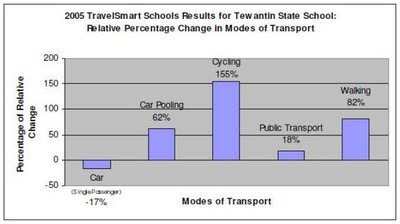
Walk to School programs have a checkered history. A large recent program in inner Sydney schools, for instance, focusing on educational interventions, produced ‘mixed results’ for major a 2 year effort.
Yet here is an example from Queensland that met with outstanding success.
Just check these results, for a 12 month effort…..(see graph).
I just had a look at the evaluation of this program and one thing stands out: getting the SETTING right.
Before the project began, the Travelsmart team conducted a site audit at the Tewantin school, along with officers from the Qld Transport Road Safety Office and Noosa Council. The audit resulted in an agenda of road infrastructure improvements around the school. Specifically: speed signs, road markings, threshold treatments, and intersection improvements, all focused on safety. This physical investment (amounting to $78k) “to improve the environment for walking and cycling around Tewantin School meant that there were little physical barriers to address”.
The Travelsmart program then rolled out, with a volunteer parent-teacher working group and $27k spent on activities including an access guide, a poster, a cycle skills course, teaching units, a TravelSmART competition, a staff Walk to Work day, a Walk and Ride Wednesday, an interschool class challenge and a celebration assembly.
This points to a valuable principle of behaviour change projects: a major factor that enables behaviour is THE SETTING…a principle that goes way back to the Ottawa Charter (‘Creating Supporting Environments’) – one that’s now very well recognised in health promotion projects.
Most of the Trewantin TravelSmart activities focused on ‘salience’ (bringing cycling and walking to front-of-mind) and ‘buzz’ (getting people talking). However I suspect at least two would have had a big impact on self-efficacy: the changes to the physical road setting around the school , and the cycle skills course. These would have changed the environment-of-decision-making for parents, lowering their fears of letting their little ones walk or cycle on their own. After all, it’s largely mothers who make the decision about how to commute to school, and safety is a big consideration. A 2005 study in the American Journal of Health Studies noted that a “theme that emerged from all three focus groups was one of (real of perceived) personal safety issues and concerns, including recent or memorable kidnappings, crimes in the neighbourhood, and heavily trafficked streets.” It concluded that distance, safety and traffic concerns were the biggest influences on travel to school choice.
Interestingly, there was little enthusiasm at Tewantin State School for formal walking, cycling or car-pooling programs because of fears that parents would be unwilling to volunteer for those duties. Informal arrangements were preferred – a useful lesson.
An nice touch was writing “TravelSmart Coordinator” into the job description of the newly appointed Deputy Principal.
The evaluation doesn’t seem to have been published, but you can probably get a copy from Graham Lunney, TravelSmart Manager, Queensland Transport.
You could ask him for a copy of the TravelSmart School Training Manual that was developed from the program.
TravelSmart Noosa’s web page gives a summary of the project.
